










Sansera records Rs 1,091.5 crore Q2 revenue as margin rises
Key highlights
- Sansera's Q2 FY 2027 revenue rose 32% year on year to a record Rs 1,091.5 crore.
- Q2 FY 2027 EBITDA increased 48% to Rs 211.2 crore and EBITDA margin rose about 200 basis points to 19.4%.
- Sansera's ADS backlog rose to Rs 5,870 crore at September 30, 2026, from Rs 4,440 crore in June.
- Sansera raised its FY 2027 capital-expenditure projection to Rs 800 crore, with about Rs 400 crore indicated for ADS.
powered by IRIS
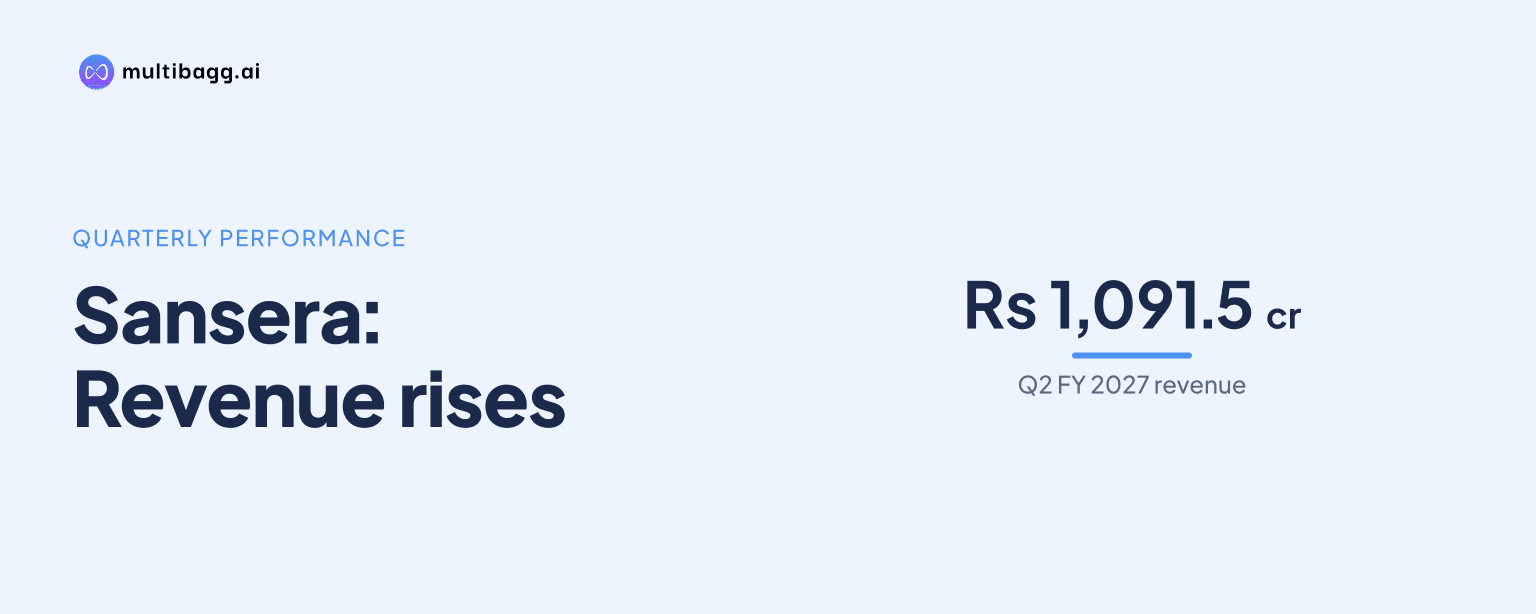
Sansera Engineering Limited recorded its highest quarterly revenue of Rs 1,091.5 crore in the second quarter (Q2) of financial year (FY) 2027, up 32% year on year, while EBITDA margin rose about 200 basis points to 19.4% despite a Rs 16.7 crore Karnataka wage provision and higher freight costs.
Know Sansera Engineering inside out
Results, valuation, peers and who's buying, in one view.
How did Sansera perform in Q2 FY 2027?
Sansera grew profit faster than revenue in Q2 FY 2027, with earnings before interest, tax, depreciation and amortisation (EBITDA) rising 48% year on year to Rs 211.2 crore and profit after tax (PAT) increasing 52% to Rs 108.6 crore. Revenue increased 32% to Rs 1,091.5 crore, while PAT margin was 10%.
The margin also rose sequentially. EBITDA margin increased by 15 basis points from the preceding quarter to 19.4%, while gross margin rose 180 basis points year on year to 43%. Management attributed the expansion to a richer product mix and operating leverage, despite increased employee, freight and logistics costs.
For the first half (H1) of FY 2027, revenue grew 33% to Rs 2,112.7 crore and EBITDA increased 48% to Rs 407.3 crore. H1 EBITDA margin rose 200 basis points to 19.3%, while reported PAT grew 46% to Rs 196 crore; management said normalized PAT was Rs 208.7 crore after excluding the Rs 12.7 crore post-tax effect of a Q1 litigation settlement.
What offset Sansera's wage and freight cost pressures?
Sansera said its product mix and operating leverage offset higher costs and lifted Q2 FY 2027 EBITDA margin to 19.4%. Management said the renewed West Asia conflict raised costs for cutting tools, freight and logistics, while the Karnataka minimum-wage revision added to the quarter's cost base.
Employee costs rose 25% year on year to Rs 146.9 crore, including a Rs 16.7 crore provision for the Karnataka wage revision. This increase was below the 32% revenue growth rate. Management said it was monitoring the Labour Codes for any further cost effect.
Other expenses rose 41% to Rs 111.4 crore, faster than revenue, reflecting higher scale and freight costs. The chief financial officer said the line also included logistics and tariff costs booked in the previous quarter, as well as freight inflation. Depreciation rose 20% to Rs 60.2 crore, and finance cost increased to Rs 14.6 crore from Rs 8.1 crore because of the expanded asset base and higher borrowing for capital expenditure and working capital.
Which businesses contributed to Sansera's revenue growth?
Sansera's growth was spread across automotive and non-automotive operations, led by Rs 669.7 crore of Auto ICE sales and Rs 164.3 crore of aerospace, defence and semiconductor (ADS) revenue in Q2 FY 2027. Auto ICE sales rose 18% year on year, and management said passenger vehicles, two-wheel motorcycles and scooters each reported their highest quarterly sales.
Auto ICE represented about 65% of sales, a share management said was broadly in line with its target at the time of the initial public offering. Management said this mix shift reflected faster growth in newer businesses rather than a slowdown in its core automotive operations. Its technology-agnostic automotive and electric-vehicle businesses also delivered their best sales quarter, although management did not disclose their combined revenue.
Non-automotive sales exceeded Rs 200 crore for the first time in a quarter and accounted for 20.9% of total sales. ADS generated Rs 309.7 crore in H1 FY 2027. Management said new stock-keeping units expected to come on stream in H2 FY 2027 should support ADS growth.
Management also cited industry conditions for its automotive outlook. Domestic passenger-vehicle wholesale exceeded 5 lakh units in October for the first time, according to management, while order backlogs and lean dealer inventories supported visibility for Q3 FY 2027. Commercial production at the Sansera-Nichidai joint venture is expected towards the end of H2 FY 2027.
Got a follow-up? Ask IRIS
What does Sansera's order book say about demand?
Sansera ended September 30, 2026 with an ADS unexecuted lifetime order backlog of Rs 5,870 crore, executable over the next five years, and a non-ADS order book of Rs 2,241 crore measured at peak annual sales. ADS backlog increased from Rs 4,440 crore in June, including a large multi-year semiconductor order, while the non-ADS order book rose from Rs 1,850 crore.
Management said ADS added a couple of aerospace customers in the quarter. Its semiconductor business continued to have one customer, although management said it was making progress towards adding a second. Management clarified that the five-year backlog represents confirmed orders scheduled across future years and is not a limit on revenue that could be booked in that period.
The non-ADS order book was roughly equally split between domestic and export markets and was more weighted towards passenger vehicles, according to management. It said domestic orders included programmes for an export customer whose engine would be built in India, a new tractor customer and nominations from existing passenger-vehicle customers for new engine programmes.
How is Sansera funding its expansion plans?
Sansera's net debt rose to Rs 261.2 crore at the end of September 2026 from Rs 60.4 crore in March as investment in capacity and working capital exceeded H1 operating cash flow. H1 operating cash flow was Rs 207.3 crore, compared with about Rs 326 crore of automotive and ADS capital expenditure and Rs 30 crore invested in the Nichidai joint venture.
Working capital rose to Rs 854.4 crore from Rs 735.9 crore in March, mainly because ADS requires inventory support and volumes increased. Management said working capital equalled about 19.6% of annualized Q2 revenue, while net debt was about 0.3 times annualized H1 EBITDA.
Management raised its FY 2027 capital-expenditure projection to Rs 800 crore, phased with customer validations. It said about 50%, or close to Rs 400 crore, would be directed to ADS, and the second bay at its existing plant had been constructed for machines needed to execute the current order book.
Conclusion
Sansera combined 32% Q2 FY 2027 revenue growth with 48% EBITDA growth, expanding EBITDA margin to 19.4% while absorbing a Rs 16.7 crore Karnataka wage provision and higher freight-related costs. Auto ICE remained the largest business at Rs 669.7 crore of quarterly sales, while non-automotive sales crossed Rs 200 crore and ADS backlog reached Rs 5,870 crore.
The next disclosed milestones are new ADS stock-keeping units in H2 FY 2027, the dedicated defence facility expected to begin operations towards the end of Q3 FY 2027, and commercial production at the Nichidai joint venture towards the end of H2 FY 2027. Management also plans Rs 800 crore of FY 2027 capital expenditure and continues to monitor possible Labour Code effects on costs.