










Sansera top-five customer share falls to 44.5% in FY26 sales
Key highlights
- Sansera’s top-five customer share of sales declined from 59.2% in FY21 to 44.5% in FY26.
- The FY26 top-five customer share was 1.7 percentage points below FY25’s 46.2%.
- Sansera says 60% of customer relationships have lasted more than 10 years.
- Other non-auto sales increased from Rs 137 crore in FY21 to Rs 222.1 crore in FY26.
powered by IRIS
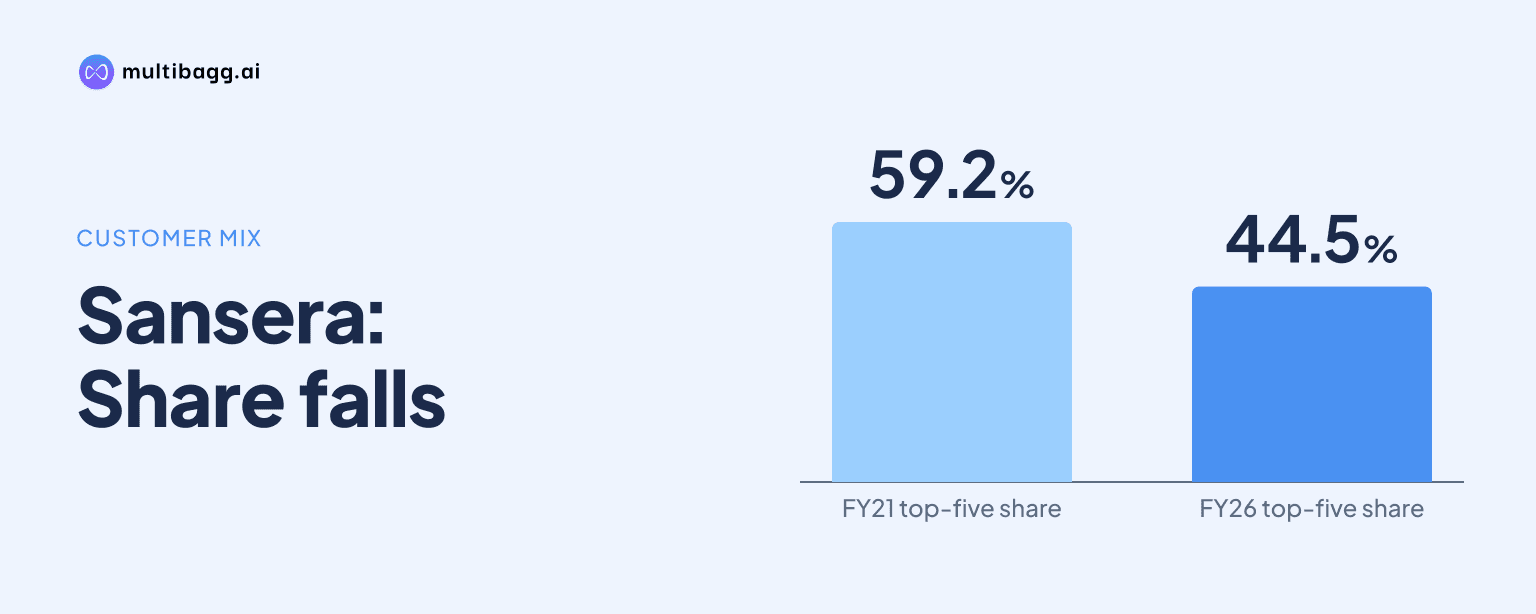
Sansera Engineering Ltd reduced the top-five customer share of sales to 44.5% in FY26 from 59.2% in FY21, a 14.7-percentage-point decline over five years. The reported ratio fell in every financial year in that period, while the presentation cites multiple customer additions and qualification-intensive component relationships.
Know Sansera Engineering inside out
Results, valuation, peers and who's buying, in one view.
How much has Sansera reduced its top-five customer concentration?
Sansera reduced the sales share represented by its five largest customers by 14.7 percentage points between FY21 and FY26. The ratio moved from 59.2% in FY21 to 53.9% in FY22, then declined to 50.8% in FY23, 47.3% in FY24, 46.2% in FY25 and 44.5% in FY26. This was a continuous annual reduction over the six reported financial years rather than a one-year movement.
The largest year-on-year reduction in the series was 5.3 percentage points, from FY21 to FY22. The pace then moderated, with declines of 3.1 percentage points in FY23, 3.5 percentage points in FY24, 1.1 percentage points in FY25 and 1.7 percentage points in FY26. Sansera attributes the overall change to multiple customer additions that diversified its customer base and lowered dependence on the largest customers.
What does Sansera disclose about customer relationship tenure?
Sansera reports that 60% of its customer relationships have lasted at least 10 years, comprising 40% lasting more than 20 years and 20% lasting more than 10 years. The remaining 40% of relationships are less than 10 years old, which the presentation describes as reflecting the continuous addition of new customers.
The tenure data sits alongside the FY21-to-FY26 fall in the top-five share from 59.2% to 44.5%. It shows that Sansera’s reported customer base combines established accounts with newer relationships, although the presentation does not provide customer-level revenue, the total number of customers, or the revenue contribution from accounts added during the period.
Sansera says long-standing relationships and qualification-intensive, critical components drive repeat business across platforms. This identifies the stated operating mechanism behind repeat orders, as components must meet customer qualification requirements. The presentation does not quantify qualification periods, renewal rates, programme durations or the proportion of FY26 sales generated by repeat business.
Which OEM relationships does Sansera report?
Sansera reports relationships with 23 key domestic two-wheeler original equipment manufacturers, or OEMs, and 13 key domestic electric-vehicle OEMs. Its disclosed relationship base also includes 16 key international light-vehicle OEMs, 12 key international medium- and heavy-commercial-vehicle OEMs, and collaborations with two leading global electric-vehicle OEMs.
These categories total 66 reported OEM relationships and collaborations, although Sansera presents them by category rather than as a list of unique named customers. The 23 domestic two-wheeler OEM relationships are the largest reported group, followed by 16 international light-vehicle OEM relationships. Sansera does not state how many of these relationships were included within the top-five customer concentration calculation for FY26.
The mix of 13 domestic electric-vehicle OEMs and two global electric-vehicle OEM collaborations is part of Sansera’s stated expansion into newer automotive programmes. Its strategic priorities list hybrid programmes with a leading global Japanese OEM and an energy-storage order from a leading North American electric-vehicle player, but the presentation does not disclose the related order value or expected revenue timing.
Got a follow-up? Ask IRIS
How does Sansera diversify beyond its top-five customers?
Sansera’s diversification programme extends into non-auto, semiconductor equipment, aerospace and defence-related activities as well as automotive technologies. Other non-auto sales rose to Rs 222.1 crore in FY26 from Rs 137 crore in FY21, representing 2.0 times growth and a 14.5% compound annual growth rate, although this segment’s share of total sales declined to 6.8% from 7.8%.
In H1FY27, other non-auto sales were Rs 124.7 crore and represented 6.3% of total sales. The presentation separates this business into off-road, agriculture and other applications, and says fungible production lines share capacity between automotive and non-auto work. It also says the non-auto business has been reported separately from the ADS category since FY25.
Sansera’s product-entry timeline lists non-auto agriculture and industrial products from 2014, engineering and capital-goods products from 2017, semiconductor parts from 2021, aerospace engine casings from 2022, aerospace aerostructure parts from 2023 and defence parts from 2024. The sequence documents entry into additional product categories, but it does not assign sales or margins to each category.
What are Sansera’s disclosed diversification plans?
Sansera’s stated way forward is to progress to 40% of revenue from emerging segments. The plan includes expanding customer engagement across the global semiconductor market, raising content per vehicle on hybrid and electric-vehicle platforms, and ramping a new aerospace facility for backlog. These are disclosed plans rather than reported outcomes, and the presentation gives no deadline for the 40% revenue objective.
Sansera also plans about Rs 500 crore of annual capital expenditure across internal-combustion-engine automotive, ADS and forging activities. Its priorities include commercial production at the Nichidai joint venture in H2 FY27, subject to customer validation and sample approvals, and an evaluation of a United States manufacturing footprint subject to tariff clarity.
The Nichidai joint venture is intended to manufacture precision-forged and machined aluminium and steel parts for differential assemblies, compressors, driveline and other advanced automotive components not currently made by Sansera. Sansera is to hold 60% of the Bengaluru-based venture and plans to invest Rs 50 crore in one or more tranches over about two years.
Conclusion
Sansera’s FY26 top-five customer share of 44.5%, compared with 59.2% in FY21, shows a broadening of sales concentration over five years. The company pairs that trend with 60% of customer relationships exceeding 10 years and reported OEM connections across two-wheelers, electric vehicles, light vehicles and commercial vehicles, while non-auto sales increased from Rs 137 crore in FY21 to Rs 222.1 crore in FY26.
The next disclosed milestones are commercial production at the Nichidai joint venture in H2 FY27, subject to customer validation and sample approvals, and annual capital expenditure of about Rs 500 crore across automotive, ADS and forging. Investors can watch whether those plans, together with the 40% emerging-segment revenue ambition, coincide with further changes in the top-five customer share after FY26.