










Sansera targets H2 FY27 production from Nichidai joint venture
Key highlights
- Sansera expects Nichidai Sansera to begin commercial production in H2 FY27 after customer validation and sample approvals.
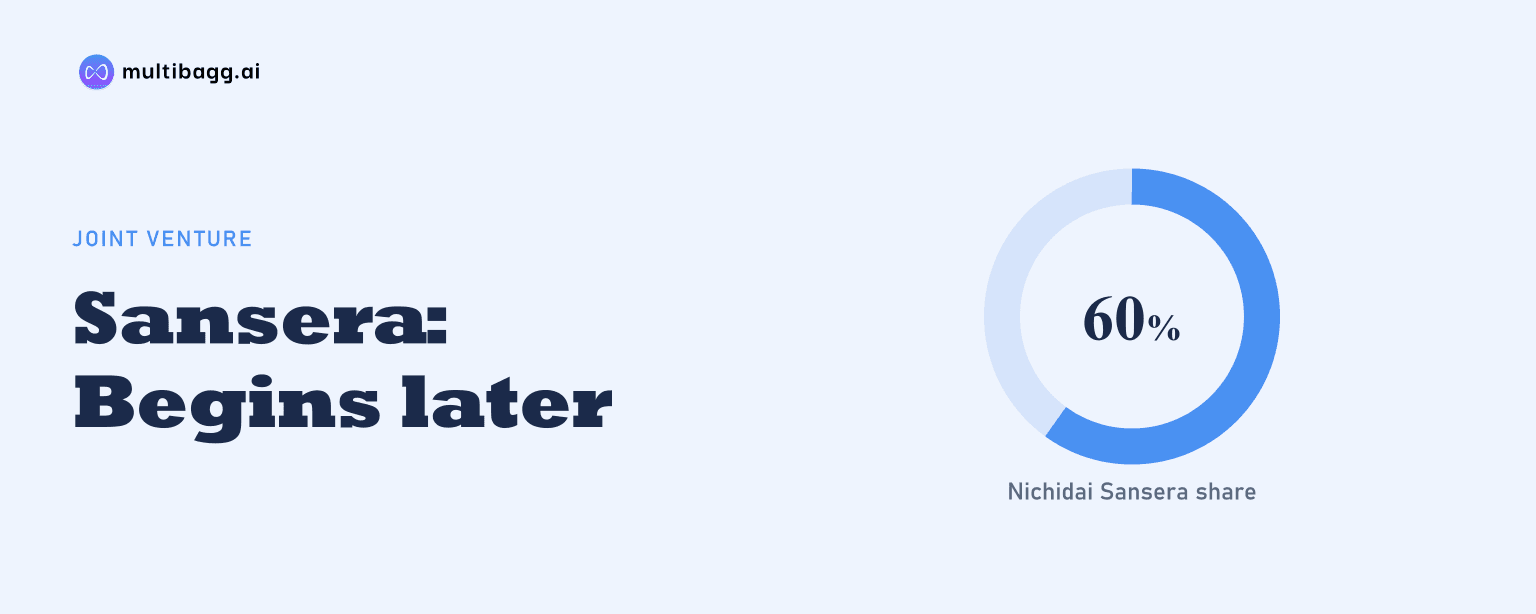
- Sansera owns 60% of Nichidai Sansera and will nominate 4 of its 7 directors.
- Sansera plans to invest Rs 50 crore in the venture in one or more tranches over about 2 years.
- Sansera’s FY26 revenue was Rs 349.79 crore, compared with Rs 301.68 crore in FY25.
powered by IRIS
Sansera Engineering Ltd expects its 60% Nichidai Sansera Private Limited joint venture with Nichidai Corporation to begin commercial production in H2 FY27, after customer validation and sample approvals. The venture is planned to make precision-forged and machined aluminium and steel automotive components that Sansera does not currently manufacture.
Know Sansera Engineering inside out
Results, valuation, peers and who's buying, in one view.
What will Nichidai Sansera manufacture?
Nichidai Sansera will manufacture precision-forged and machined aluminium and steel parts for differential assemblies, compressors, driveline applications and other advanced automotive components. The Bengaluru-incorporated private limited company is intended to serve India and overseas markets, with its disclosed product scope focused on parts that Sansera does not currently make.
The venture’s portfolio is designed for both internal-combustion-engine, or ICE, and electric-vehicle, or EV, ecosystems. Sansera describes the platform as technology agnostic, meaning its disclosed differential, compressor and driveline products are not restricted to one powertrain type or a single automotive component category.
Commercial production is expected in H2 FY27 rather than immediately following the venture’s incorporation. Customer validation and sample approvals are stated conditions for that timeline, making qualification of the forged and machined parts the disclosed mechanism between product development and commercial supply.
Who owns Nichidai Sansera and how is it governed?
Sansera owns 60% of Nichidai Sansera, while Nichidai Corporation owns the remaining 40%. Sansera will nominate four directors to the seven-member board and Nichidai will nominate three, giving Sansera majority ownership and four of seven board nominations.
Sansera plans to invest Rs 50 crore in one or more tranches over about two years. The presentation identifies this as a planned investment, not an amount already fully deployed, and does not provide a tranche-by-tranche funding schedule or an allocation between tooling, machinery, working capital and product programmes.
The JV board has allotted 8,000 equity shares of Rs 10 each to Nichidai. Separately, Nichidai contributes its stated 50 years of experience in dies, precision components and filters, with Japan and Thailand cited for its operations, while Sansera contributes its established presence in India’s automotive sector.
Why has Sansera partnered with Nichidai?
Sansera says the venture is intended to diversify its precision-component portfolio and reduce exposure to ICE-engine parts. The proposed expansion includes new customer segments and international markets, with Japan, Korea and East Asia specifically identified alongside the planned Indian automotive business.
The partnership combines Nichidai’s dies, precision-components and filters experience with Sansera’s Indian automotive manufacturing presence. Sansera describes the resulting business as a domestic and global platform spanning ICE and EV ecosystems, rather than a venture dedicated solely to EV components.
Management lists additional revenue streams, better financial performance, a stronger automotive-value-chain position and skilled jobs in Karnataka as intended outcomes. These remain objectives rather than reported results because the venture’s commercial-production target is H2 FY27 and depends on validation and sample approvals.
Got a follow-up? Ask IRIS
How does the venture compare with Sansera’s FY26 performance?
Sansera reported higher revenue, earnings before interest, tax, depreciation and amortisation, or EBITDA, and profit after tax, or PAT, in FY26 than FY25. Revenue increased by Rs 48.11 crore, EBITDA rose by Rs 11.71 crore and PAT increased by Rs 10.92 crore, while the Nichidai Sansera venture had not yet reached its expected H2 FY27 production stage.
FY26 EBITDA margin was 18.1%, compared with 17.1% in FY25, and PAT margin was 9.3%, compared with 7.2%. These are Sansera-wide reported figures and do not establish revenue, margins or profitability for Nichidai Sansera, whose stated commercial start remains conditional on approvals.
Sansera’s top-five-customer sales share fell to 44.5% in FY26 from 46.2% in FY25 and 59.2% in FY21. The company attributes the longer-term decline to multiple customer additions, while the venture separately seeks access to customer segments and overseas markets for its differential, compressor and driveline components.
What needs to happen before H2 FY27 production?
Customer validation and sample approvals must be completed before the commercial-production expectation for H2 FY27 can be met. Sansera does not disclose customer names, individual part programmes, order values, plant capacity or expected production volumes for the aluminium and steel components.
The planned Rs 50 crore investment over about two years is another disclosed execution item. The presentation does not specify how much funding will be committed to precision forging, machining, dies, working capital or the separate differential, compressor and driveline product categories.
Sansera identifies India, Japan, Korea and East Asia as the venture’s intended markets but provides no geographic revenue target. The disclosed near-term sequence is therefore samples, customer qualification and validation, followed by commercial production in H2 FY27 if those approvals are secured.
Conclusion
Sansera’s 60:40 venture with Nichidai creates a defined route into precision-forged and machined aluminium and steel automotive components that it does not currently manufacture. The business combines Sansera’s four of seven board nominations and planned Rs 50 crore investment with Nichidai’s stated 50 years of dies, precision-components and filters experience.
The next disclosed matters to watch are customer validation and sample approvals, the timing of investment tranches over about two years and progress toward H2 FY27 production. Sansera has not disclosed customer names, orders, capacity, product-level volumes or revenue targets for Nichidai Sansera, leaving those factors unresolved before launch.