










Sansera September profit rises as capex and inventory increase
Key highlights
- Sansera’s September-quarter consolidated profit rose to Rs 108.65 crore from Rs 71.39 crore a year earlier.
- September-quarter revenue from operations increased to Rs 1,091.45 crore from Rs 825.20 crore.
- Six-month payments for property, plant and equipment rose to Rs 355.06 crore from Rs 256.63 crore.
- Current borrowings increased to Rs 563.02 crore at 30 September 2026 from Rs 361.95 crore at 31 March 2026.
powered by IRIS
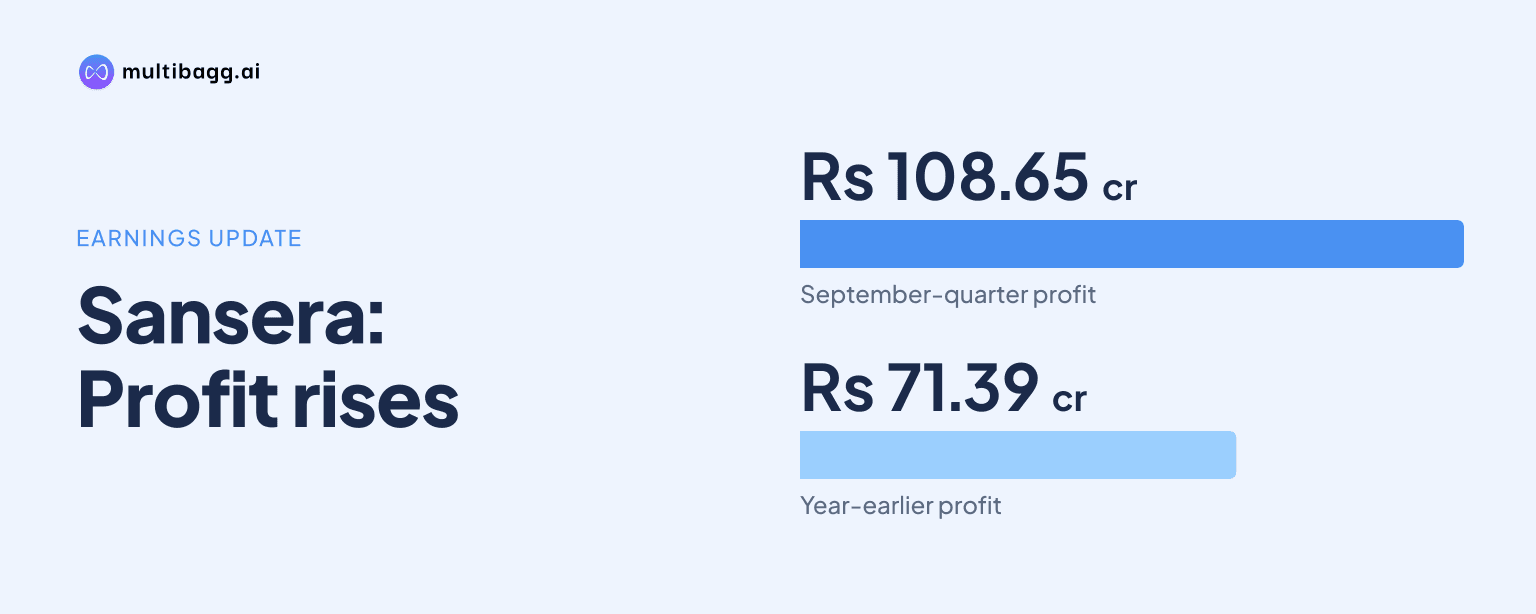
Sansera Engineering Limited reported consolidated profit of Rs 108.65 crore for the quarter ended 30 September 2026, compared with Rs 71.39 crore a year earlier, as revenue from operations reached Rs 1,091.45 crore. For the six months, Sansera paid Rs 355.06 crore for property, plant and equipment and absorbed Rs 226.24 crore in inventory.
Know Sansera Engineering inside out
Results, valuation, peers and who's buying, in one view.
How did Sansera perform in the September 2026 quarter?
Sansera’s consolidated profit rose 52.2% year on year to Rs 108.65 crore in the quarter ended 30 September 2026, from Rs 71.39 crore in the corresponding 2025 quarter. The result was also above Rs 47.36 crore in the preceding June 2026 quarter, which included exceptional items recorded during that period.
Revenue from operations was Rs 1,091.45 crore, compared with Rs 825.20 crore a year earlier and Rs 1,021.26 crore in the June 2026 quarter. Sansera classifies its activities as one operating segment, manufacturing of precision-engineered components, and therefore did not disclose separate revenue for automotive, non-automotive or geographic operations.
Profit before exceptional items and tax increased to Rs 148.06 crore from Rs 96.22 crore in the September 2025 quarter. Tax expense was Rs 37.68 crore, compared with Rs 23.44 crore a year earlier, while finance costs were Rs 14.64 crore against Rs 13.34 crore in the corresponding quarter.
Basic earnings per share were Rs 17.31 for the September 2026 quarter, compared with Rs 11.50 in the year-earlier quarter and Rs 13.89 in the June 2026 quarter. Sansera said basic and diluted earnings per share for interim periods are not annualised.
Why is Sansera’s June-quarter profit not directly comparable?
Sansera’s June 2026 quarter included a Rs 16.93 crore exceptional charge, making the sequential profit comparison different from a comparison of ordinary operations alone. The charge represented the balance not previously provided for under a US$2 million settlement agreement with a customer concerning a civil suit in the United States District Court for the District of South Carolina, Charleston Division.
Sansera paid the US$2 million settlement on 28 July 2026 without admitting liability, according to the filing. It had provided Rs 2 crore in earlier years, leaving Rs 16.93 crore to be expensed in the June quarter and the six months ended 30 September 2026.
The June quarter also included a Rs 12.61 crore provision for additional US import-duty tariffs on products supplied to certain US customers. Sansera said these costs had remained recoverable at 31 March 2026, but it provided for them after assessing recovery risk and continues efforts to recover the amounts paid.
For the six months ended 30 September 2026, profit before tax after exceptional items, including the share of associate results, was Rs 264.73 crore, against Rs 179.92 crore a year earlier. Operating cash flow before working-capital movements rose to Rs 416.79 crore from Rs 293.59 crore over the same periods.
How much cash did Sansera spend on capex and working capital?
Sansera used Rs 370.36 crore in investing activities in the six months ended 30 September 2026, compared with Rs 198.34 crore in the corresponding 2025 period. Payments for property, plant and equipment increased to Rs 355.06 crore from Rs 256.63 crore, while payments for intangible assets were Rs 1.80 crore.
Inventory absorbed Rs 226.24 crore of operating cash, compared with Rs 112.97 crore in the prior-year six months. Trade receivables used Rs 34.44 crore, while an increase in trade payables supplied Rs 181.80 crore, compared with Rs 53.03 crore in the corresponding 2025 period.
Sansera generated Rs 222.31 crore from operating activities after tax, up from Rs 204.91 crore a year earlier, but this was lower than the Rs 370.36 crore investing outflow. Net financing cash flow was Rs 151.96 crore, compared with a net outflow of Rs 0.08 crore in the prior-year period, as net proceeds from current borrowings rose to Rs 248.39 crore.
Got a follow-up? Ask IRIS
What changed in Sansera’s balance sheet by September 2026?
Sansera’s inventories rose to Rs 897.45 crore at 30 September 2026 from Rs 671.21 crore at 31 March 2026. Trade receivables increased to Rs 649.52 crore from Rs 627.03 crore, and other current assets rose to Rs 131.65 crore from Rs 94.21 crore.
Current borrowings increased to Rs 563.02 crore at 30 September 2026 from Rs 361.95 crore at 31 March 2026. Non-current borrowings declined to Rs 73.30 crore from Rs 95.63 crore, while current and non-current lease liabilities combined rose to Rs 156.53 crore from Rs 133.58 crore.
Property, plant and equipment stood at Rs 2,219.47 crore at 30 September, up from Rs 2,071.96 crore at the March year-end. Capital work in progress increased to Rs 276.58 crore from Rs 219.55 crore, alongside the higher Rs 355.06 crore cash payment for property, plant and equipment during the half year.
Total assets increased to Rs 5,067.52 crore from Rs 4,494.68 crore over the six-month balance-sheet comparison. Total equity rose to Rs 3,292.90 crore from Rs 3,107.49 crore, while current liabilities increased to Rs 1,420.98 crore from Rs 1,032.40 crore.
What did Sansera disclose about review and future commitments?
Sansera’s consolidated unaudited results for the quarter and six months ended 30 September 2026 received an unmodified limited-review conclusion from Deloitte Haskins & Sells. The auditor stated that one subsidiary’s interim financial information included assets of Rs 128.04 crore and a six-month cash outflow of Rs 0.16 crore, and was not reviewed by that subsidiary’s auditor but was considered not material to the group.
Sansera had invested Rs 30.01 crore in Nichidai Sansera Private Limited by 30 September 2026 for a 60% holding. Its board had approved an investment of Rs 50 crore on 29 January 2026, leaving Rs 19.99 crore of the approved amount not yet invested at the reporting date.
The filing also said Sansera paid a final dividend of Rs 4 per equity share for financial year 2025-26 on 1 October 2026, following shareholder approval on 24 September 2026. Separately, the company said it would monitor the Labour Codes for further effects on employee-benefit liabilities after recording Rs 15.76 crore of exceptional items in the year ended 31 March 2026.
Conclusion
Sansera’s September-quarter revenue and profit increased from both the year-earlier and preceding quarters, while the six-month cash-flow statement shows a substantially higher allocation to property, plant and equipment and inventory. Operating cash generation rose to Rs 222.31 crore, but investment outflows reached Rs 370.36 crore and current borrowings increased to Rs 563.02 crore by 30 September 2026.
The next disclosed developments to watch are completion of the remaining Rs 19.99 crore of Sansera’s approved investment in Nichidai Sansera Private Limited, progress on recovering US tariff costs, and any further employee-benefit measurement impact from the Labour Codes. Sansera has not provided a timetable for the tariff recovery or for the remaining approved Nichidai Sansera Private Limited investment.