










SAR Televenture tower network reaches 1,800 sites in 2026
Key highlights
- SAR's tower-site count rose from 650 in 2025 to 1,800 in 2026.
- SAR says it completed more than 1,800 4G and 5G telecom-infrastructure towers.
- SAR has signed MSAs with three major telecom operators for tower sharing.
- SAR reported 330,000 broadband home passes and 157,000 additional home passes completed in H1 FY27.
powered by IRIS
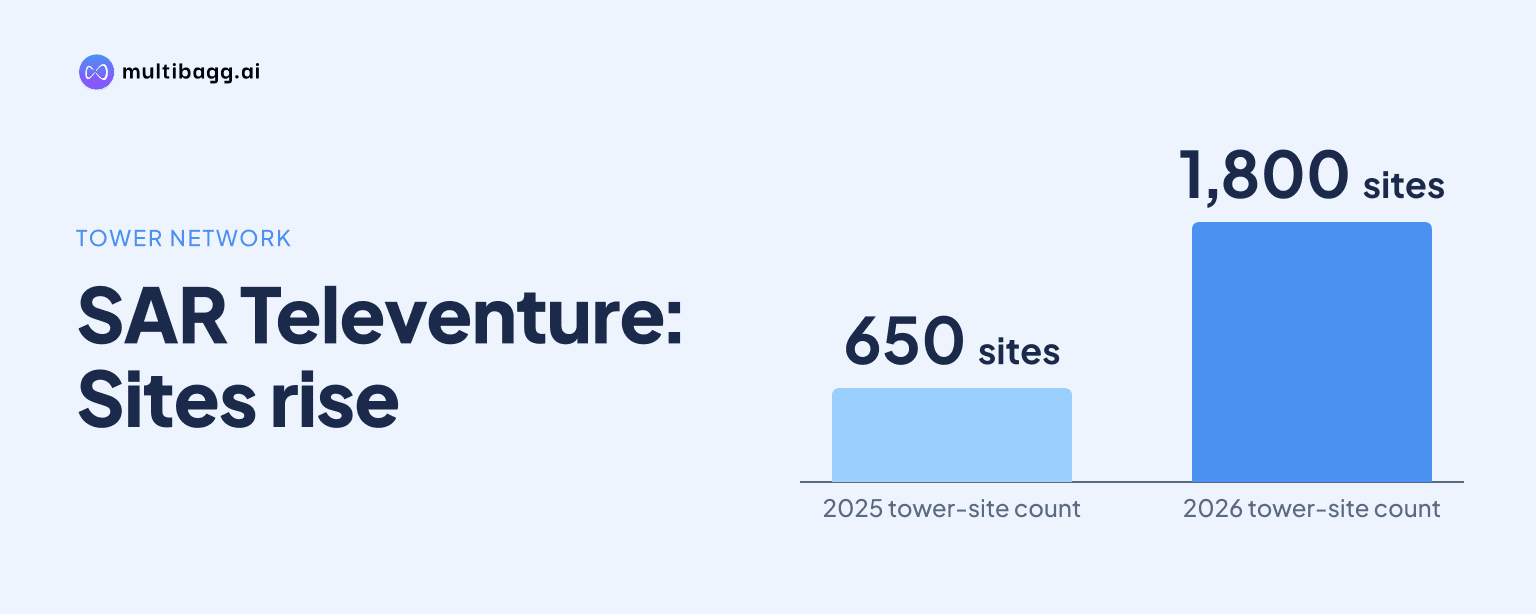
SAR Televenture reported 1,800 tower sites in 2026, up 1,150 from 650 in 2025, and says master service agreements with three major telecom operators make the estate ready for sharing. Management says the model can increase revenue with low capital expenditure, although the presentation provides no tenancy or tower-sharing revenue figure.
Know Sar Televenture inside out
Results, valuation, peers and who's buying, in one view.
What drove SAR's tower network expansion in 2026?
SAR's reported site base rose to 1,800 in 2026 from 650 in 2025, the largest annual increase shown in its network-expansion chart. The chart labels the periods as 2019 through 2026 but does not specify whether the 2026 figure is a financial-year-end, calendar-year-end or current-period measure. Its strategic-acquisition update separately states that SAR completed more than 1,800 4G and 5G telecom-infrastructure towers.
The presentation links the enlarged tower estate to its strategic-acquisition overview rather than providing a site-by-site construction schedule. It also says SAR received an additional 60 4G and 5G tower sites from Vodafone. The presentation does not state the date of that transfer or clarify how the 60 sites are reflected in the 1,800-site figure.
How fast did SAR's tower site base grow since 2019?
SAR expanded from one tower site in 2019 to 1,800 sites in 2026, an increase of 1,799 sites over the period presented. Growth was slower before 2026: the network rose by 40 sites from 373 in 2023 to 413 in 2024, then by 237 sites to 650 in 2025, before the reported 1,150-site increase in 2026.
SAR's earlier site count rose from 38 in 2020 to 125 in 2021, 233 in 2022 and 373 in 2023. The presentation describes the tower-development process as site identification, permits and approvals, engineering and design, site preparation, foundation and construction, tower erection, equipment installation, connectivity setup, testing and commissioning, and integration and optimisation.
How could tower sharing affect SAR's revenue model?
SAR says it has signed master service agreements, or MSAs, with three major telecom operators, making its tower infrastructure ready for a sharing model. Management says sharing can lead to increased revenue with low capital expenditure, or CAPEX, because the tower infrastructure is already in place. The presentation does not name the three operators or disclose commercial rates, contract duration or expected revenue.
The 1,800-site figure measures the physical tower estate, while the stated sharing opportunity concerns use of that estate by telecom operators. SAR does not disclose active tenants per tower, a tenancy ratio or the number of sites being shared. The presentation therefore identifies the mechanism for possible additional revenue but does not quantify the financial outcome from the three MSAs.
Got a follow-up? Ask IRIS
What other network assets does SAR operate?
SAR's tower network sits alongside an optic-fibre and internet service provider, or ISP, business that reached 330,000 broadband home passes. It also reported 157,000 additional home passes completed in H1 FY27. These fixed-broadband measures are separate from the 1,800-site telecom-tower estate and should not be treated as tower additions.
SAR provides duct and fibre-cable laying, network construction, dark-fibre leasing and maintenance services for telecom operators, broadband providers and ISPs. Its 100% subsidiary, SAR Televentures F.Z.E in the United Arab Emirates, undertakes fibre-cable installation and network-equipment supply. SAR also has fibre-to-the-home, or FTTH, agreements with ISPs in Lucknow, Ghaziabad, Faridabad, Gurugram, Noida, Rohtak and Sonipat.
What could expand SAR's tower opportunity next?
SAR identifies Bharat Sanchar Nigam Limited's plan to set up about 112,000 towers for 4G and 5G services as an opportunity to expand its tower infrastructure. This is a market opportunity cited in the presentation, not a contract award, committed order or construction target for SAR. The presentation gives no expected number of those towers that SAR could build, acquire or operate.
SAR also reports completing the acquisition of Tikona Communications Limited to expand its ISP business. Tikona Communications Limited has signed a share purchase agreement for the proposed acquisition of Tikona Infinet Private Limited, while SAR has proposed consolidating Fusionnet Web Services Limited under Tikona Communications Limited. Management says its focus includes ISP integration, infrastructure utilisation and operational efficiencies, without disclosing financial effects or a timetable.
Conclusion
SAR's site base rose from 650 in 2025 to 1,800 in 2026, while its strategic update describes completion of more than 1,800 4G and 5G towers. The increase supplies the physical estate for the three MSAs that management says can support tower sharing with low incremental CAPEX, but disclosed information does not show tenants, pricing, utilisation or revenue from that model.
The next disclosures to watch are tower-sharing activity under the three MSAs and any changes in SAR's total site count or tenancy metrics. Management's ISP integration plan, the proposed Tikona Infinet Private Limited acquisition and the proposed Fusionnet Web Services Limited consolidation are also unresolved matters, while the approximately 112,000-tower Bharat Sanchar Nigam Limited plan has no disclosed SAR participation target or schedule.