










Saregama plans 100 Q3 AI podcast hours and polices remakes
Key highlights
- Saregama plans around 100 hours of GenAI-assisted podcast content in Q3 FY27.
- Saregama owns more than 180,000 songs and adds 4,500 to 5,000 releases each year.
- Saregama reported Q2 FY27 revenue from operations of Rs 314.3 crore, up 37% year on year.
- Saregama guided to Rs 300 crore to Rs 350 crore of new-content spending in FY27.
powered by IRIS
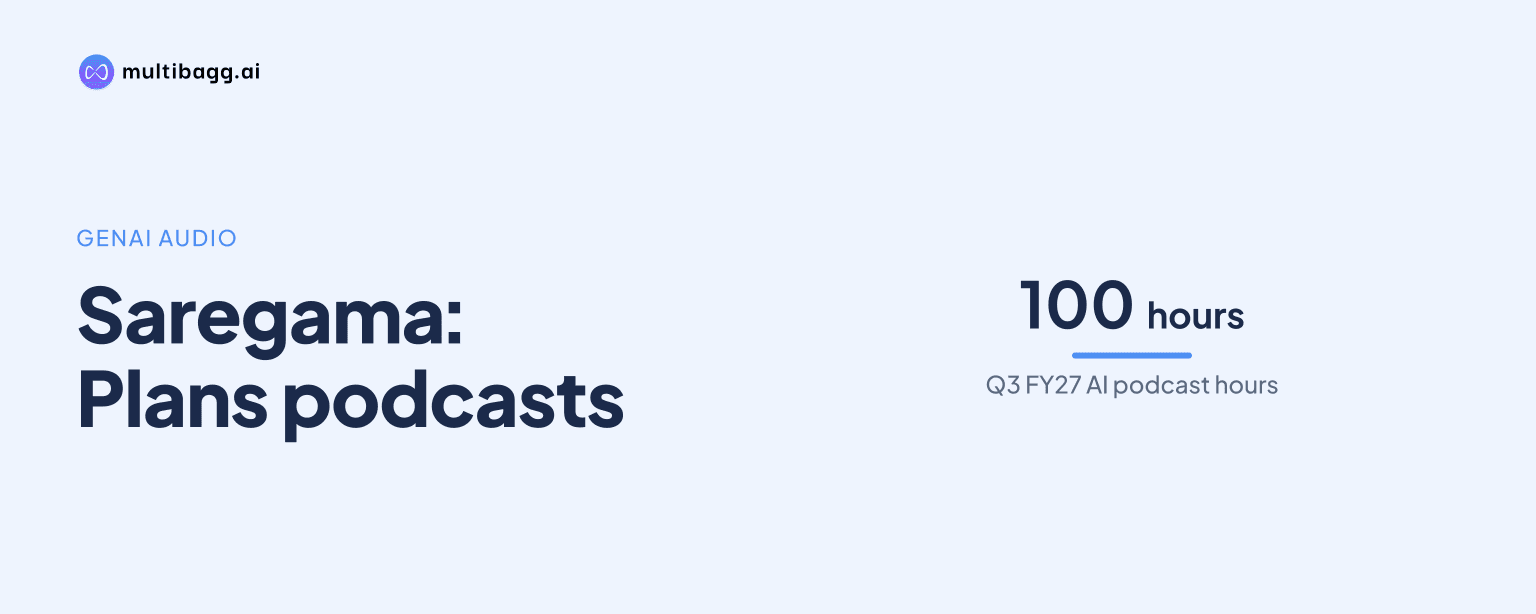
In Q3 FY27, Saregama India Limited plans to release about 100 hours of generative-AI-assisted podcast content while using technology to identify and buy out or remove unlicensed AI versions of its songs. Saregama said its two AI-focused teams are aimed at faster content production, lower costs and protection of its 180,000-plus-song catalog.
Know Saregama India inside out
Results, valuation, peers and who's buying, in one view.
What AI teams has Saregama created?
Saregama has created two AI-dedicated teams: one for content and one for company-wide processes. The content team uses generative artificial intelligence, or GenAI, tools to create adjacent audio programming such as podcasts using Saregama songs and new-age music videos around older songs. Management said this team will release around 100 hours of podcast content in Q3 FY27.
The second team is reviewing every Saregama process for possible use of AI tools, with cost optimization as its stated objective. Management said this work has already resulted in marginal manpower-cost savings, although it expects the full impact only over the next few quarters. The programme is intended to reduce production time and costs rather than replace Saregama's new music releases.
The content team can draw on a catalog of more than 180,000 songs, which Saregama said grows by 4,500 to 5,000 releases each year. That catalog provides material for AI-enabled podcast and video formats, while the company continues to buy new intellectual property, or IP. Management guided to Rs 300 crore to Rs 350 crore of new-content spending in FY27.
How is Saregama policing unlicensed AI remakes?
Saregama is using technology to track AI cover versions and remakes across streaming platforms, then either buying them out or pulling them down. Management identified unlicensed AI covers and remakes of existing songs as the more immediate issue for a catalog owner than entirely AI-created songs competing with new releases. The approach applies to uses of Saregama's catalog that lack authorization.
Saregama is also opening discussions with AI creators to own and distribute AI versions of its biggest songs. Management said its preferred model is licensed, credited and paid use, rather than removal in every case. New digital licensing agreements are being structured with protection against rights dilution and potential fraud, according to management's November 4, 2026 Q2 FY27 comments.
Management said available data and consumer research indicate that AI-created music is gaining primarily through volume rather than consumer listening. It said the limited global examples so far have largely been AI versions of existing hits. Saregama cited Spotify's planned licensed remix and cover features, which require rights-holder consent, credit and compensation, as consistent with its proposed model.
Got a follow-up? Ask IRIS
How does AI fit Saregama's music investment strategy?
Saregama is deploying AI alongside a larger new-content investment programme, not in place of it. Management expects Rs 300 crore to Rs 350 crore of FY27 spending on new content and said budgets would rise at a nominal 10% annually thereafter. Using the Rs 325 crore midpoint for FY27, management projected around Rs 1,200 crore of new-content spending across FY28 to FY30.
Saregama's music strategy combines film albums, non-film releases and catalog monetization. Q2 FY27's biggest film hit was the Telugu album Paradise, whose song “yeshanagula” reached number one on YouTube's global daily music-video charts during the quarter. Management said the second half would focus more on movie albums including Love & War, Seyon and Naagzilla, while AI teams develop adjacent content around owned songs.
In FY26, music released after 2000 accounted for 60% of Saregama's music revenue, according to management. This means newer IP accounted for most music revenue even as the company uses older songs for podcast and video formats. Management retained a five-year payback target for newly acquired music, followed by an expected 55 to 75 years of returns from that music.
What was Saregama's financial context for the AI plan?
Saregama reported Q2 FY27 revenue from operations of Rs 314.3 crore, up 37% year on year, while adjusted earnings before interest, tax, depreciation and amortization, or EBITDA, rose 39% to Rs 118 crore. Operational profit before tax increased 43% to Rs 85.8 crore. Management nevertheless asked investors to assess results on a rolling 12-month basis rather than a single quarter.
The music vertical, comprising licensing, artist management and retail, generated Rs 251.3 crore in Q2 FY27 revenue and Rs 154 crore in EBITDA. Management said the first half of FY26 was a low comparison base for music, which helped the reported growth rate. It retained short-to-medium-term guidance of 20% to 23% compound annual growth in music revenue and a 60% to 65% music EBITDA margin.
AI is one of several mechanisms Saregama is using to broaden monetization beyond streaming. At the end of Q2 FY27, its artist-management operation represented 340 artists with a combined Instagram and YouTube following of more than 450 million. Saregama also completed more than 20 brand deals, produced 54 Carvaan Live shows for about 10,000 attendees and staged Ilaiyaraaja's 11-city US tour for 20,000 attendees.
Conclusion
Saregama's disclosed AI strategy combines content creation with rights enforcement. The planned 100 hours of Q3 FY27 podcasts are its clearest near-term AI output, while technology-led tracking of AI covers and remakes is intended to protect catalog value through removal, buyouts or licensed distribution. These initiatives operate alongside Rs 300 crore to Rs 350 crore of FY27 new-content spending.
The next disclosures to watch are the Q3 podcast releases and management's update on whether process automation produces savings beyond the marginal manpower-cost reduction already reported. Management also plans to spend around Rs 1,200 crore on new content across FY28 to FY30, based on its FY27 midpoint, while Bhansali Productions is preparing Love & War for release in Q4 FY27.