










Saregama maps Rs 1,200 crore music spending through FY30
Key highlights
- Saregama plans Rs 300 crore to Rs 350 crore of new music-content spending in FY27.
- Saregama expects around Rs 1,200 crore of new-content spending across FY28 to FY30 using 10% annual budget growth.
- Saregama’s music vertical reported Rs 251.3 crore of quarterly revenue, up 35% year on year.
- Music released after 2000 generated 60% of Saregama’s FY26 music revenue.
powered by IRIS
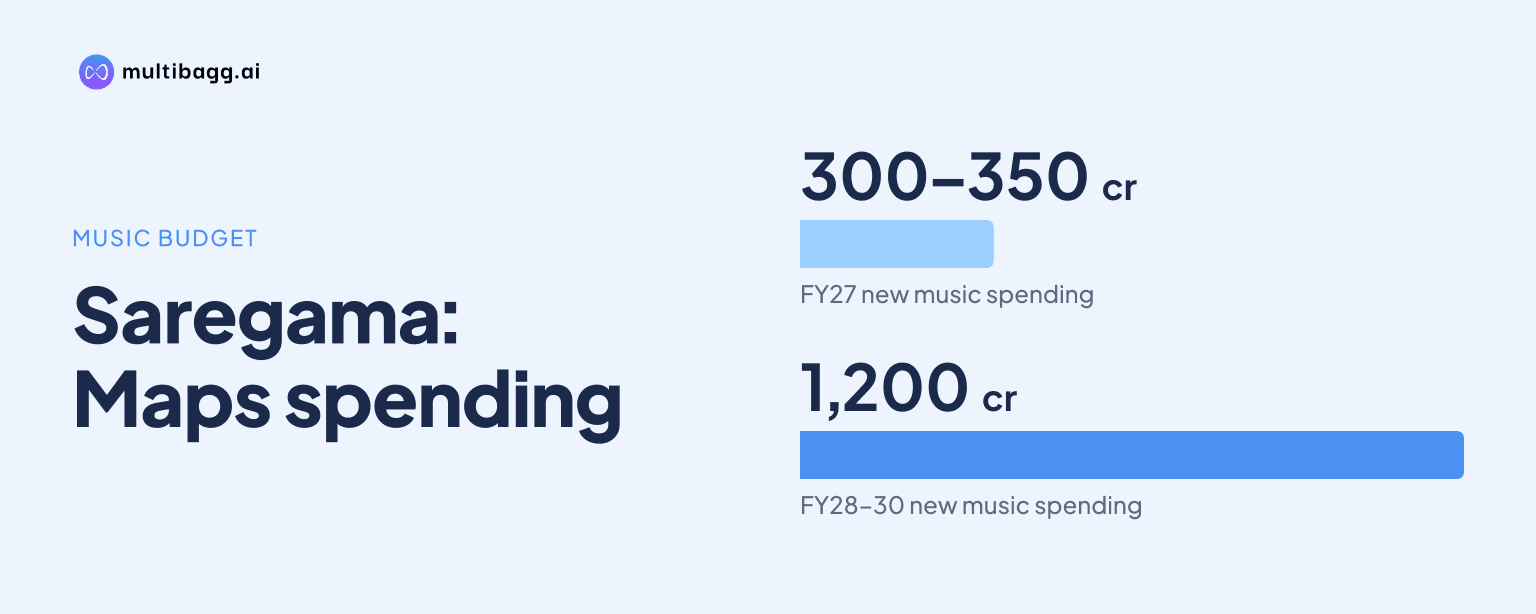
Saregama India Limited plans to spend Rs 300 crore to Rs 350 crore on new music content in FY27 and, based on a Rs 325 crore midpoint and 10% annual budget growth, expects around Rs 1,200 crore of new-content spending across FY28 to FY30. Management linked the programme to its 20% to 23% music-revenue compound annual growth rate, or CAGR, guidance.
Know Saregama India inside out
Results, valuation, peers and who's buying, in one view.
How much will Saregama spend on new music content?
Saregama will spend between Rs 300 crore and Rs 350 crore on new content in FY27. Managing Director Vikram Mehra disclosed the range on the November 4, 2026 earnings call for the quarter ended September 30, 2026, without providing a split between film albums, non-film music, languages or individual projects.
Saregama based its FY28-FY30 estimate on the Rs 325 crore midpoint of the FY27 range and a nominal 10% annual increase in content budgets. On that assumption, management expects around Rs 1,200 crore of new-content spending over the three financial years from FY28 through FY30. The figure is a planned investment outline rather than reported expenditure.
The company described the 10% annual increase as its approach going forward after the larger FY27 allocation. FY27 is therefore the starting point for the disclosed Rs 1,200 crore calculation, while the call did not state a budget beyond FY30 or specify whether spending would vary with film-release schedules or acquisition opportunities.
Which music releases will Saregama fund in FY27?
Saregama said the second half of FY27 will focus more on movie albums after the first half put greater emphasis on non-film music. The named film projects were Sanjay Leela Bhansali’s Love & War, Sivakarthikeyan’s Seyon, Dharma’s Kartik Aaryan-starrer Naagzilla, and a Tiger Shroff film produced by Sanjay Leela Bhansali.
The company identified the Telugu album Paradise as its biggest film hit of the quarter, with its song yeshanagula reaching number one globally on YouTube’s daily music-video charts during the period. In contrast, first-half non-film releases included I-Pop Star albums in Hindi and Tamil, Haryanvi and Bihari songs, and an album by Punjabi artist Nijjar, which management said generated several songs trending on YouTube and Instagram.
The disclosed programme therefore combines film soundtrack opportunities and non-film releases rather than relying solely on either category. Management did not quantify the FY27 spending attached to Love & War, Seyon, Naagzilla, the Tiger Shroff project or Paradise.
Why is Saregama increasing content investment now?
Saregama is increasing investment because management said music bought two, three and four years ago is beginning to generate positive margins. The company maintained guidance for 20% to 23% revenue CAGR and a 60% to 65% earnings before interest, tax, depreciation and amortisation, or EBITDA, margin for the music vertical over the short to medium term.
In the quarter, the music vertical, including licensing, artist management and retail, reported revenue of Rs 251.3 crore, up 35% year on year. Its EBITDA was Rs 154 crore, up 37%, and its stated net margin was Rs 116.5 crore, up 46%. Management cautioned that the first half of FY26 was a low base for the vertical, contributing to the FY27 growth rates.
Saregama’s stated model assumes a five-year payback period for all new music bought, followed by 55 to 75 years of returns from that music. This is management guidance rather than a reported outcome for FY27 investments. The company said its catalogue contains more than 180,000 songs and is growing by 4,500 to 5,000 releases annually.
Got a follow-up? Ask IRIS
How has newer music changed Saregama’s revenue mix?
Saregama said 60% of all music revenue in FY26 came from music released after 2000. The disclosure means newer releases accounted for most music revenue despite the company also owning a large heritage catalogue, supporting management’s description of Saregama as a company with a substantial contribution from newer intellectual property, or IP.
The FY27 plan follows quarterly company revenue from operations of Rs 314.3 crore, up 37% year on year, adjusted EBITDA of Rs 118 crore, up 39%, and operational profit before tax, or PBT, of Rs 85.8 crore, up 43%. The music vertical’s Rs 251.3 crore revenue was substantially larger than the video vertical’s Rs 18.3 crore revenue in the same quarter.
Video revenue declined 16% year on year to Rs 18.3 crore after Saregama made a conscious decision to wind down its film business and invest in Bhansali Productions instead. Management said video revenue could decline further during the transition, while Bhansali Productions was preparing Love & War for a fourth-quarter release and working on its FY28 slate.
What could support returns from Saregama’s new catalogue?
Saregama expects paid subscription adoption to support music monetisation, although management did not provide a subscription-revenue target. It cited an EY and Indian Music Industry study stating that 64% of free-music users would shift to a reasonably priced paid service if the free service stopped, while management said India’s current growth comes entirely from new subscribers.
Management said pricing could become a second growth engine in two to three years, which is an expectation rather than a platform commitment. It also said digital platforms including Spotify, YouTube and JioSaavn are pursuing paid subscription revenue, while Saregama’s new digital licensing agreements include protections against rights dilution and potential artificial-intelligence, or AI, fraud.
The company also uses releases to develop artists for live events, weddings and brand endorsements, from which it earns a share. At quarter-end, Saregama represented 340 artists with a combined follower base of more than 450 million across Instagram and YouTube. It completed more than 20 brand deals during the quarter, including with Apple, Airbnb, Google, Cadbury and Tanishq, without disclosing revenue from those agreements.
Conclusion
The planned FY27 allocation and FY28-FY30 outlay show that Saregama is directing capital towards expanding newer music IP while management says earlier acquisitions are beginning to contribute positive margins. The revenue mix supports that rationale: music released after 2000 supplied 60% of FY26 music revenue, and the music vertical generated Rs 251.3 crore in quarterly revenue compared with Rs 18.3 crore for video.
The next disclosures to watch are the second-half FY27 performance of Love & War, Seyon, Naagzilla and the Tiger Shroff film, alongside progress against management’s 20% to 23% music-revenue CAGR and 60% to 65% EBITDA-margin guidance. Other scheduled markers include around 100 hours of AI-assisted podcast content in Q3 and Bhansali Productions’ Love & War release in Q4.