










Saregama Music EBIT Margin Expands as Paid Listening Grows
Key highlights
- Saregama's music EBIT margin rose 700 basis points year on year to 55.4% from 48.4% in H1.
- Management said content investments from financial years 2024 to 2026 now generate revenue above their charge-offs.
- Saregama said paid subscriptions are growing much faster than advertising-led listening and produce a higher yield per song.
- Saregama's 20% to 23% growth outlook for music, artist management and retail is a three-to-five-year CAGR target.
powered by IRIS
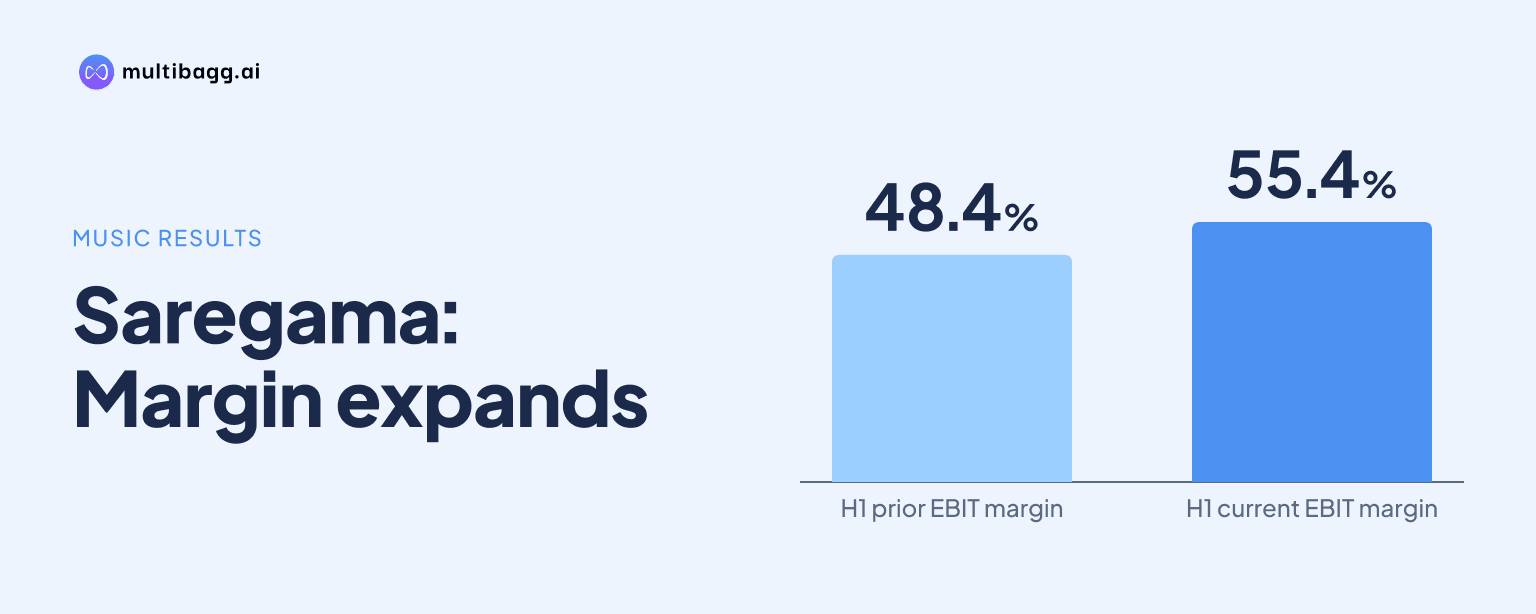
Saregama India Limited reported a 700-basis-point year-on-year rise in music earnings before interest and tax, or EBIT, margin to 55.4% in H1, driven by earlier content investments producing revenue above their charge-offs and by paid subscriptions growing much faster than advertising-led listening.
Know Saregama India inside out
Results, valuation, peers and who's buying, in one view.
Why did Saregama's music EBIT margin expand?
Saregama's music EBIT margin expanded because revenue from content acquired in earlier financial years is now exceeding the related content-cost charge-offs by a wider margin. Management said the margin increased to 55.4% in H1 from 48.4% a year earlier, a gain of 700 basis points, or 7 percentage points.
Management traced the change to the investment cycle for new music rather than to a single-quarter reduction in costs. It said that when Saregama began investing heavily in newer content in financial year 2024, the initial revenue increase was broadly equal to the charge-off being taken on that content. The early revenue contribution therefore did not create the same margin benefit now being seen.
The subsequent outcome has differed because content investments made in financial years 2024, 2025 and 2026 have matured. Management said the revenue increase attributable to those investments is now far higher than the charge being taken on content cost. Saregama described this as the progression it had outlined three years earlier.
The call did not provide music-segment revenue, the value of content charge-offs, or the contribution of individual catalogues to the 55.4% margin. The reported margin therefore establishes the combined financial outcome, but does not allow a calculation of how much came from each release batch, language catalogue or soundtrack.
How are paid subscriptions affecting Saregama's music yield?
Paid subscriptions are growing much faster than advertising-based consumption and generate a higher yield for the same song, according to management. Saregama said a song heard by a paid customer earns much more than the same song heard by a free customer, making the shift in listening mix relevant to music profitability.
Management did not disclose paid-subscriber growth, advertising revenue growth, a paid-listening share of music revenue, or a per-stream yield. It nevertheless identified paid consumption as a second mechanism, alongside the maturation of older content investments, behind the direction of the 700-basis-point margin expansion.
Saregama pointed to actions by global music platforms and labels in India as signs of a subscription-focused market. Management cited Spotify's description of India as a major growth opportunity and said streaming economics typically rely on subscriptions rather than advertising. These were management observations about the market, not numerical forecasts for Saregama's subscription revenue.
Management also referred to Universal Music's reported paid-first content windowing arrangement in India, under which some music reaches paid users before free users. Saregama presented this as evidence that platforms and labels are seeking to grow subscriptions, but did not say its own catalogue uses the same arrangement.
Got a follow-up? Ask IRIS
How are earlier content investments changing Saregama's profit model?
Earlier content investments are changing Saregama's profit model because their revenue is continuing to build while the associated content-cost charge is no longer absorbing most of that growth. Management said the revenue bump from new content was initially about equal to the cost charge-off when its heavier investment cycle began in financial year 2024.
The later-stage effect is different for content bought in financial years 2024 through 2026. Management said those investments have reached a point where the revenue increase is far higher than the charge-off taken against them. This explains why a catalogue investment can have a limited initial margin effect and a larger later contribution.
Saregama said its intellectual-property catalogue is growing by 4,500 to 5,000 releases a year. That scale provides context for management's portfolio-level explanation, although the call did not identify a specific title, film soundtrack or regional catalogue as the main source of the rise from 48.4% to 55.4%.
The disclosed model also separates the timing of investment from the timing of financial return. A new release can add both revenue and content cost in its initial period, while an older release can continue generating revenue as its annual charge-off is recognised. Saregama did not provide a target period for a release to reach this later stage.
Does Saregama's H1 performance change its growth outlook?
No, Saregama did not revise its longer-term growth outlook after an analyst said the music, artist management and retail vertical grew about 37% in H1. Management said its 20% to 23% growth expectation is a compounded annual growth rate, or CAGR, over three to five years rather than a forecast for each financial year.
Management said annual results can move above or below the 20% to 23% range while the three-to-five-year CAGR remains within that expectation. The analyst's H1 figure covers music, artist management and retail together, whereas the 55.4% EBIT margin discussed in the call relates specifically to the music segment.
This distinction limits direct comparisons between growth and profitability. The margin explanation focused on content charge-offs, revenue from earlier investments and the higher yield of paid listeners. The three-to-five-year outlook covers a broader vertical grouping and does not set a music EBIT-margin target or a paid-subscriber target.
Saregama therefore gave investors a longer-term revenue-growth framework but left several near-term measures undisclosed. The company did not provide guidance for music revenue, advertising revenue, paid users, the proportion of listening on paid plans, or the future level of content charge-offs.
What should readers watch in Saregama's next updates?
Readers should watch whether paid listening continues to outpace advertising-led consumption and whether older content continues to generate revenue above its charge-offs. Those two mechanisms were management's direct explanation for the rise in music EBIT margin to 55.4% from 48.4% in H1.
The other disclosed benchmark is the 20% to 23% CAGR expectation for music, artist management and retail over three to five years. Since management did not give a music-margin forecast or a paid-subscription target, subsequent disclosures on segment revenue, monetisation mix and content costs would provide additional evidence on the durability of the H1 margin movement.
Conclusion
Saregama's H1 music-margin expansion combined two developments: content investments made in financial years 2024 to 2026 are now delivering revenue above their charge-offs, while paid listening is growing faster than lower-yield advertising-led use. The 55.4% music EBIT margin, compared with 48.4% a year earlier, is the reported result of those factors, although their individual contributions were not quantified.
Next, management's stated plan points to tracking progress toward the 20% to 23% three-to-five-year CAGR for music, artist management and retail. Management also highlighted faster paid-subscription growth and paid-first content windowing trends, but it did not disclose a paid-user target, a music-margin target or a timetable for further monetisation details.