










Satin Creditcare says it can protect 14.5% NIM in rate rises
Key highlights
- Satin reported quarterly NIM of 15.9%, compared with 14.3% in the preceding quarter.
- Management said about 14.5% is Satin's stable annual and cross-cycle NIM target.
- Satin had more than Rs 4,000 crore of sanctions and Rs 2,200 crore of liquidity in hand.
- About 50% of Satin borrowings are floating rate and reset on six-monthly or annual schedules.
powered by IRIS
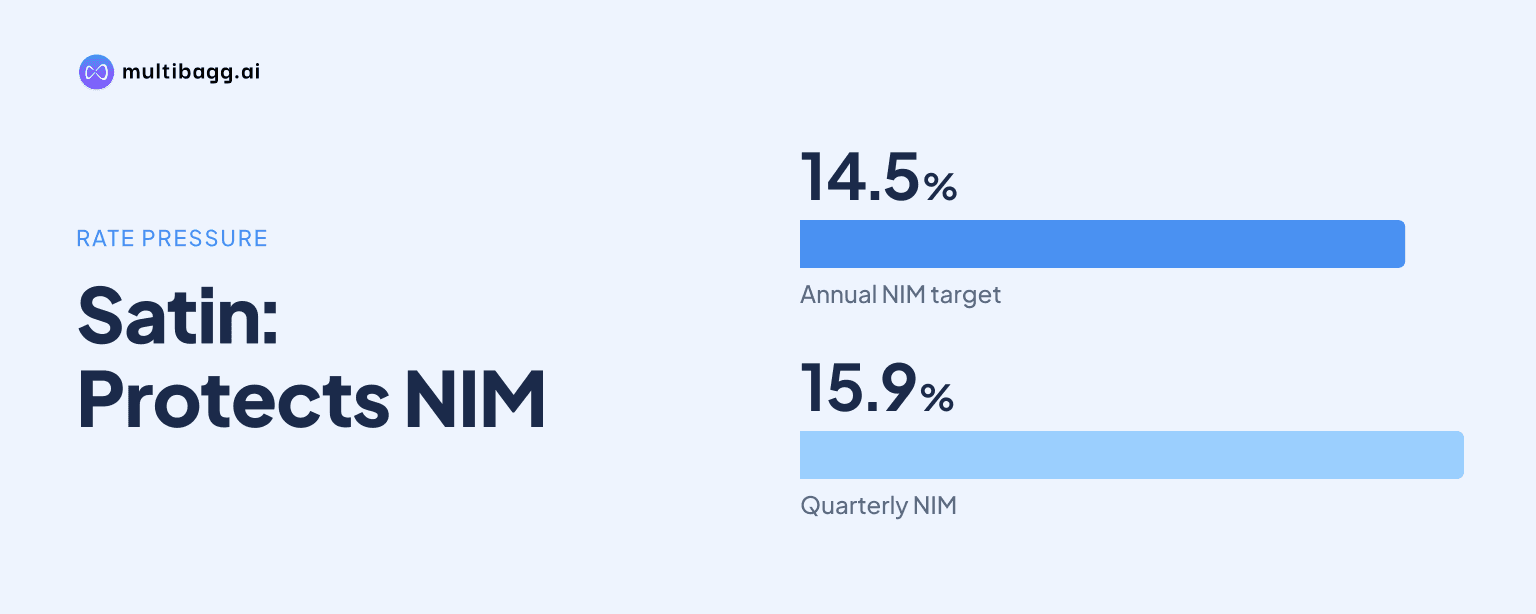
Satin Creditcare said its stable net interest margin should remain about 14.5% through a rate-hike cycle, despite 50% of borrowings being floating rate. Management based that view on more than Rs 4,000 crore of funding sanctions, Rs 2,200 crore of liquidity, staggered debt repricing and the ability to change lending rates over time.
Know Satin Creditcare Network inside out
Results, valuation, peers and who's buying, in one view.
How does Satin plan to maintain a 14.5% NIM?
Satin said it plans to maintain a net interest margin, or NIM, of about 14.5% over time rather than sustain the reported quarterly peak. Management said quarterly NIM reached 15.9%, up from 14.3% in the preceding quarter, but described 14.5% to 15% as the sustainable range and about 14.5% as the stable annual level.
Management attributed the rise from 14.3% to 15.9% to better portfolio quality, a lower cost of funds, improved liquidity management and a somewhat higher direct-assignment, or DA, contribution. It said DA can lift reported yield in a quarter and that its DA activity is broadly in a 21% to 23% range during the year. Lower operating expenditure can also produce quarterly movement around the 14.5% level.
Satin said changes in borrowing costs and other factors can be factored into its lending rates over time, which management presented as a key mechanism to protect a 14.5% NIM. In response to an analyst's question, management said there is no cap on the interest rates charged to borrowers. It did not specify the timing, size or customer impact of any future lending-rate revisions.
What funding is available to Satin if rates rise?
Satin said it had more than Rs 4,000 crore of sanctions in hand and Rs 2,200 crore of liquidity when asked about its refinancing strategy for the next four to six quarters. Management said these resources, together with lender discussions and its operating performance, meant it did not anticipate a challenge in raising funding required for growth.
Management reported a marginal cost of borrowing of 10.28%. It said the reported cost of funds was affected by subordinated debt raised during the period, while the incremental borrowing cost had declined sequentially. H. P. Singh said the latest quarter's incremental borrowing rate was 65 basis points lower, where one basis point equals one-hundredth of a percentage point.
The funding position was central to management's answer on a possible increase in policy rates. Satin said it did not expect its cost of funds to rise substantially even if rates rose, given the sanctioned funding already available. Management also said that if borrowing costs rose sharply across the wider system, it had the ability to pass on the increase to customers while seeking to preserve a NIM of about 14.5%.
When will Satin's floating-rate borrowings be repriced?
Satin said about 50% of its borrowings are floating rate, but the entire floating-rate book does not reprice immediately after a benchmark-rate change. Management said some facilities are repriced every six months and others annually, based on lender agreements and sanction terms. Rate movements therefore pass through to funding costs periodically rather than on the next day or necessarily in the next quarter.
Management said most floating-rate facilities are linked to the repo rate, while some are tied to internal bank benchmarks. It also said both upward and downward rate changes follow the applicable reset date. The transcript does not disclose the contractual spread on these facilities, the share attached to each benchmark, their maturity profile or the calendar of upcoming resets.
H. P. Singh said Satin negotiates with lenders when facilities are repriced, citing the 65-basis-point decline in the latest quarter's incremental borrowing rate. Another management speaker used a more qualified formulation: funding-cost changes and other factors would be reflected in lending rates over time. These statements describe management's margin-protection plan, not a fixed outcome for every interest-rate move.
Got a follow-up? Ask IRIS
What else affected Satin's quarterly margin and returns?
Satin said the improvement in portfolio quality contributed to higher yields in the quarter. Portfolio at risk for one day, or PAR 1, declined to 2.92% from 5.79% year on year. Management said it was seeking further improvement in the second half, supported by collection activity and underwriting, while noting that seasonal conditions can affect the period-to-period trajectory.
Management identified lower credit cost as the most significant driver of improved returns in the first half. It said operating expenditure had declined 60 basis points year on year, while credit cost had fallen by more than 200 basis points from the previous financial year. Satin retained credit-cost guidance of 3% to 3.5% and said its credit cost over the past 6.5 years, including difficult periods, was 3.3%.
Satin also continued to build a management overlay that affects reported profit and credit cost. The overlay stood at Rs 50 crore after the company added Rs 14 crore during the quarter to the Rs 36 crore already created. Management said the full Rs 50 crore was an overlay after restating expected credit loss calculations, and said profit would have been higher and credit cost lower without it.
How does DA activity affect Satin's reported NIM?
Satin said a higher DA mix was one reason reported NIM rose to 15.9% from 14.3% in the preceding quarter. Management explained that a higher value of DA transactions can lift net income and reported yield in a particular quarter. It therefore asked investors to assess NIM through a stable annual level of about 14.5%, rather than treat a quarterly high as the expected run rate.
Management said DA activity generally remains in a 21% to 23% band through the year. It also said there was no one-off income reflected in profit, describing DA as one instrument used to raise liquidity. Satin noted that it continues servicing pools assigned in earlier quarters and incurs costs for them, which management said balances the effect over the longer term.
The comparison between the 15.9% quarter and the 14.5% stable-state view shows why management separates transient factors from its cross-cycle objective. A somewhat higher DA contribution, lower funding costs and operating-cost changes can move individual quarters. Management's stated objective is to use pricing, funding and liquidity measures to hold NIM near 14.5% through those variations.
Conclusion
Satin's case for a 14.5% NIM rests on available funding, staggered reset schedules for its floating-rate debt, lender negotiations and management's stated ability to revise lending rates. The increase from 14.3% to 15.9% in the reported quarter also reflected factors management considers variable, including portfolio quality, liquidity management and DA activity, rather than a new baseline.
The next issue to watch is the timing of resets across the roughly 50% floating-rate borrowing book and whether higher benchmark rates alter the marginal borrowing cost of 10.28%. Management has disclosed more than Rs 4,000 crore of sanctions and Rs 2,200 crore of liquidity, while its stated target remains a stable NIM of about 14.5% over time.