










Satin Creditcare Network Limited targets Rs 100 crore overlay
Key highlights
- Satin Creditcare held Rs 263 crore of provisions against Rs 197 crore of GNPA at Q2 FY27.
- The management overlay reached Rs 50 crore after a Rs 14 crore Q2 FY27 addition.
- Management's internal overlay target is about Rs 100 crore.
- H1 FY27 slippages fell 68% year on year to Rs 103 crore from Rs 317 crore.
powered by IRIS
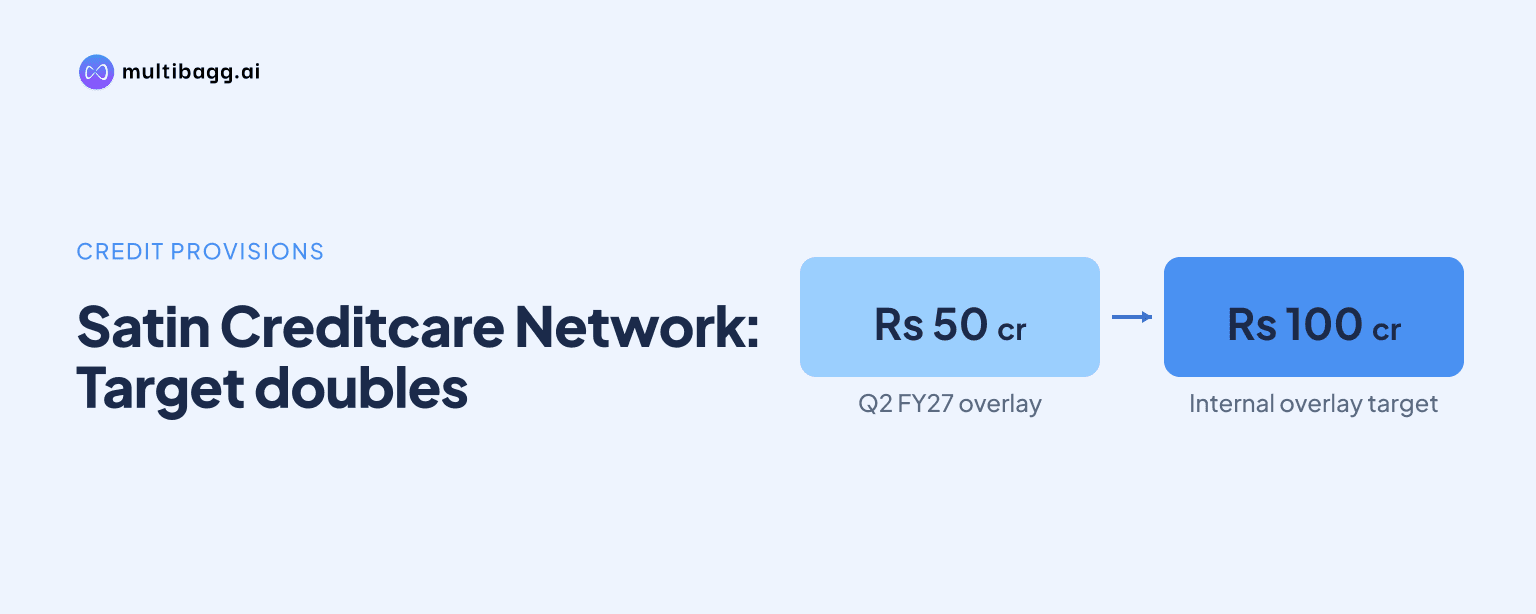
Satin Creditcare is targeting a Rs 100 crore discretionary management overlay after reaching Rs 50 crore in Q2 FY27, although Rs 263 crore of on-book provisions already exceeded Rs 197 crore of gross non-performing assets, producing 133% coverage. Management says the reserve is intended to protect against future microfinance cycles.
Know Satin Creditcare Network inside out
Results, valuation, peers and who's buying, in one view.
Why is Satin Creditcare adding an overlay despite 133% coverage?
Satin Creditcare is adding the overlay because management wants a separate buffer for an adverse microfinance cycle rather than relying only on model-driven provisions. At Q2 FY27, its on-book provision was Rs 263 crore, compared with gross non-performing assets, or GNPA, of Rs 197 crore and a Rs 152 crore requirement under the norms management cited. The provision coverage ratio, or PCR, was 133%, up from 115% in June.
Management said the overlay is a prudent, discretionary amount built during favourable credit conditions. It described the Rs 50 crore cumulative balance as roughly midway towards an internal target of about Rs 100 crore. Chairman and Managing Director H.P. Singh said management may stop adding to the reserve if it determines that further provisioning is unnecessary, but its initial plan remains a Rs 100 crore buffer against future events.
The distinction matters because Satin Creditcare said the overlay is not required by its expected credit loss, or ECL, model. Chief Strategy Officer Aditi Singh explained that ECL is restated across the portfolio each quarter. If the model requirement fell from Rs 100 crore to Rs 80 crore, the difference would not mean a Rs 20 crore release; similarly, management considers the entire Rs 50 crore balance to be overlay rather than a model requirement.
How much did the Rs 50 crore overlay reduce Q2 FY27 returns?
The Rs 50 crore overlay lowered Satin Creditcare's reported Q2 FY27 standalone return on assets, or ROA, to 4.9% from a management-adjusted 6.0%, and return on equity, or ROE, to 20.6% from 25.0%. Management said the company had absorbed more than 100 basis points of ROA into the balance sheet rather than reporting the higher earnings that would have resulted without the buffer.
For credit cost, the reported Q2 FY27 figure was 2.47%, down from 4.83% a year earlier. Management said Q2 credit cost would have been 0.99% excluding the overlay. For H1 FY27, reported credit cost was 2.77%, while the figure excluding the overlay was 2.0%, both below management's 3.0% to 3.5% standalone credit-cost guidance for FY27.
The company added Rs 14 crore during Q2 FY27, taking the overlay from Rs 36 crore to Rs 50 crore. Management confirmed in the question-and-answer session that Rs 50 crore, rather than Rs 86 crore, was the cumulative amount for the first half. This treatment means the adjusted calculations account for the entire Rs 50 crore because management says it could release the earlier Rs 36 crore as well.
Got a follow-up? Ask IRIS
What does asset quality show alongside the larger reserve?
Asset quality improved materially in H1 FY27, giving Satin Creditcare scope to build the reserve while still reporting higher earnings. H1 slippages fell 68% year on year to Rs 103 crore from Rs 317 crore in H1 FY26. Standalone GNPA declined to 1.9% at the end of September from 2.2% in June and 3.5% a year earlier.
The coverage measures also improved across delinquency stages. Stage 3 coverage reached 91% from 85% in June, while Stage 2 coverage increased to 62% from 21%. Portfolio at risk after one day, or PAR 1, stood at 2.9%, and ex-pocket collection efficiency was 99.8%. Satin Creditcare also recovered Rs 16 crore against write-offs during H1 FY27.
Management linked the reduced credit cost chiefly to lower slippages, while noting that net interest margins, funding costs and operating expenses also contributed. The operating-expense ratio declined to 6.6% in Q2 FY27 from 7.2% a year earlier, while cost to income fell to 41.6% from 49.8%. These changes accompanied standalone Q2 profit after tax of Rs 172 crore, up 231% year on year.
Management also said the Assam flood event did not require use of the overlay. It granted moratoriums to 42,394 borrowers, of whom nearly 90% resumed repayments during the moratorium period. Karnataka and Maharashtra each represented 1% of the on-book portfolio, and management said it had not seen repayment stress there despite drought concerns.
Can Satin Creditcare reach Rs 100 crore without changing FY27 goals?
Satin Creditcare said it can continue building the overlay while retaining its FY27 guidance, although this is management's stated plan rather than a revised target. The company reported H1 FY27 standalone ROA of 4.3%, above its 3.5% to 4.0% guidance range despite the Rs 50 crore reserve. Management said this performance supported its decision to disclose reported and adjusted return measures every quarter.
The planned overlay equals half of the internal Rs 100 crore target, so a further Rs 50 crore would be needed if the company completes the plan without releasing or using any reserve. Management did not give a timetable for reaching that level. It said its aim was to create a cycle-proof return profile by retaining earnings in benign credit periods, while preserving flexibility to halt additions if the buffer became sufficient.
Balance-sheet data provides the context for that plan. Consolidated capital adequacy was 27.89% on September 30, 2026, compared with 26.74% in June, and net worth rose to Rs 3,437 crore from Rs 3,243 crore. Total on-book borrowings were Rs 10,033 crore and leverage was 2.9 times, down from 3.2 times. The company also reported liquidity of Rs 2,235 crore and undrawn sanctions of about Rs 4,600 crore.
Management maintained FY27 consolidated assets under management, or AUM, growth guidance of 20% to 25%. Consolidated AUM was Rs 16,589 crore, up 31% year on year but up 9% in the first half on a sequential basis that management said annualised to roughly 19%. It expects seasonally stronger second-half disbursements to bring full-year growth into the guided range.
Conclusion
Satin Creditcare's Rs 100 crore overlay plan shows that reported asset-quality metrics are only part of its provisioning position. With Rs 263 crore of provisions against Rs 197 crore of GNPA, a 133% PCR and H1 slippages down to Rs 103 crore, management is choosing to retain some current earnings for a reserve it says is outside its ECL-model need. The result is lower reported Q2 returns than management's adjusted measures.
The next point to watch is whether Satin Creditcare adds the remaining Rs 50 crore needed to meet its internal target, pauses further provisioning, or deploys the reserve during a credit event. Management will also be assessed against its maintained FY27 credit-cost range of 3.0% to 3.5% and its expectation of 20% to 25% consolidated AUM growth, supported by a stronger second half.