










SBI advances grow 17.84% as agriculture, SME lead
Key highlights
- SBI’s gross advances rose 17.84% year on year to Rs 52.08344 lakh crore in September 2026.
- Agriculture advances grew 22.64% and SME advances grew 21.97% in September 2026.
- Foreign-office advances increased 22.86% to Rs 8.31332 lakh crore, with GNPA at 0.11%.
- SBI’s whole-bank GNPA ratio fell 34 basis points year on year to 1.39% in Q2FY27.
powered by IRIS
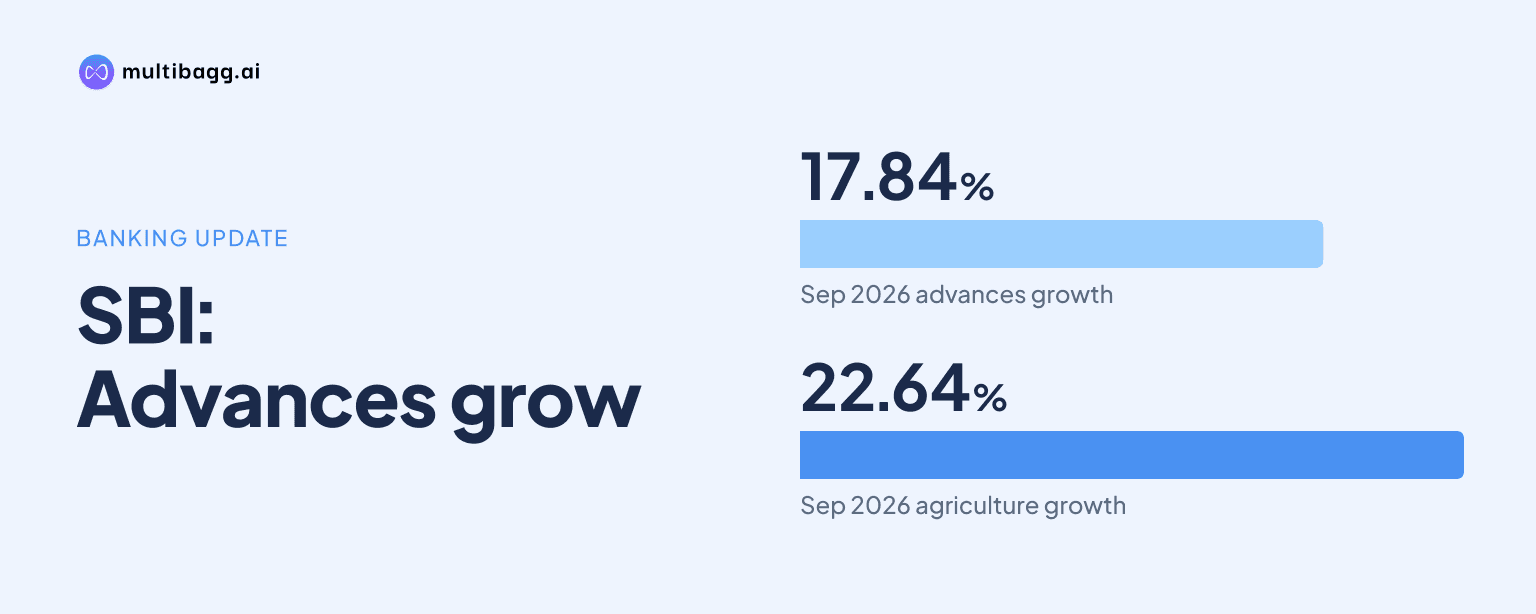
SBI’s gross advances rose 17.84% year on year to Rs 52.08344 lakh crore in September 2026, as foreign-office advances increased 22.86%, agriculture lending rose 22.64% and SME lending grew 21.97%, all faster than the 14.54% expansion in retail personal advances.
Know State Bank of India inside out
Results, valuation, peers and who's buying, in one view.
What drove SBI’s 17.84% advance growth in September 2026?
SBI’s advance growth was led by foreign offices, agriculture and SME, whose growth rates exceeded both the 16.94% rise in domestic advances and the 17.84% increase for the whole bank. Total advances increased from Rs 44.19674 lakh crore in September 2025 to Rs 52.08344 lakh crore in September 2026, while domestic advances rose from Rs 37.43039 lakh crore to Rs 43.77012 lakh crore.
Retail personal lending remained SBI’s largest domestic category at 41.70% of domestic advances in September 2026, followed by corporate advances at 32.88%, SME at 15.11% and agriculture at 10.31%. The retail, agriculture and SME, or RAM, portfolio accounted for 67.12% of domestic advances, showing that the faster agriculture and SME growth came from smaller bases than retail personal lending.
SBI’s lending rose faster than deposits, which grew 12.27% to Rs 62.77919 lakh crore in September 2026 from Rs 55.91700 lakh crore a year earlier. The domestic credit-deposit ratio was 73.02% in September 2026, above 69.82% in September 2025 but below 74.23% in June 2026.
How did SBI’s retail personal loan book change?
SBI’s retail personal portfolio rose 14.54% year on year to Rs 18.25083 lakh crore in September 2026, below whole-bank advance growth but equal to 41.70% of domestic advances. The presentation reported an approximately 14% three-year compound annual growth rate for this portfolio as of September 2026.
Home loans remained the largest retail personal product at Rs 9.85537 lakh crore, representing 54.00% of the portfolio, after 11.94% year-on-year growth. Personal loans were Rs 3.78769 lakh crore and grew 7.48%, while auto loans stood at Rs 1.36294 lakh crore after 5.88% growth; their gross non-performing asset, or GNPA, ratios were 1.15% and 0.52%, respectively.
Personal gold loans were the fastest-growing retail personal product, increasing 89.31% to Rs 1.37349 lakh crore in September 2026. They accounted for 7.53% of retail personal advances and had a 0.05% GNPA ratio, compared with 0.57% for home loans and 0.57% for other personal-segment loans.
Which domestic sectors grew faster than SBI’s loan book?
SBI’s services portfolio grew 25.61% year on year to Rs 6.60758 lakh crore as of September 30, 2026, above the 16.94% domestic-advance growth rate. Agriculture increased 22.64% to Rs 4.51438 lakh crore, while other retail loans rose 20.38% to Rs 7.03252 lakh crore, also outpacing the domestic book.
Within infrastructure, power loans grew 20.12%, but total infrastructure advances increased only 6.01% to Rs 4.12931 lakh crore. Roads and ports fell 20.22% and telecommunications declined 8.34%, meaning that growth in power and other infrastructure categories did not translate into comparable growth for the aggregate infrastructure portfolio.
Engineering lending rose 47.66%, commercial real-estate loans grew 27.75%, and aviation and airports increased 27.29% as of September 2026. SBI’s corporate rating mix also changed: the AAA share increased to 44% from 41% in September 2025, while the BB and below share declined to 7% from 8%; the presentation puts about 40% of the corporate portfolio with public-sector undertakings or government departments.
Got a follow-up? Ask IRIS
How did SBI’s international lending contribute to growth?
SBI’s foreign-office advances grew 22.86% year on year to Rs 8.31332 lakh crore in September 2026, compared with 16.94% domestic advance growth. The international book rose in each reported period, from Rs 6.76635 lakh crore in September 2025 to Rs 6.93332 lakh crore in December 2025, Rs 7.42941 lakh crore in March 2026 and Rs 7.70574 lakh crore in June 2026.
Management attributed customer-credit growth mainly to external commercial borrowings and local credit, with contributions from US operations, London, GIFT City, Middle East and East Asia branches. The presentation reported 13.84% year-on-year growth in dollar terms, compared with 22.86% in rupee terms, and listed FCNR(B) loans of USD 8.83 billion.
Local lending represented 39.7% of the international loan portfolio in September 2026, India-linked loans 37.2% and trade finance 23.1%. The United States accounted for 24% of the portfolio, followed by GIFT City at 16%, the United Kingdom at 15% and the United Arab Emirates at 10%; international GNPA declined to 0.11% from 0.19% a year earlier.
What does SBI’s asset-quality data show alongside loan growth?
SBI reported a whole-bank GNPA ratio of 1.39% and a net NPA ratio of 0.36% in Q2FY27, compared with 1.73% and 0.42% in Q2FY26. Credit cost fell 17 basis points to 0.22%, while the provision coverage ratio, or PCR, was 74.43%, down from 75.79% a year earlier.
The presentation describes the 1.39% GNPA and 0.36% net NPA ratios as the lowest in more than two decades, alongside 17.84% whole-bank advance growth. It does not provide credit-cost figures by faster-growing segment, although it reports 0.11% GNPA for international banking and retail product-level GNPA ratios ranging from 0.05% for personal gold loans to 1.15% for personal loans.
Conclusion
SBI’s September 2026 credit expansion was broader than retail personal lending, with agriculture, SME and foreign-office advances each growing faster than the 17.84% whole-bank rate. Retail personal loans nevertheless remained the largest domestic category, while the reported whole-bank GNPA ratio declined by 34 basis points year on year to 1.39% in Q2FY27.
The next reported periods will show whether agriculture growth of 22.64%, SME growth of 21.97% and foreign-office growth of 22.86% continue while deposits grow at 12.27%. The presentation does not disclose future delinquency targets for those faster-growing books, but it reports Q2FY27 credit cost of 0.22% and international GNPA of 0.11% in September 2026.