










SBI YONO registrations nearly double as digital loans scale
Key highlights
- SBI reported 59.63 lakh YONO registrations in Q2FY27, up 95% from 30.53 lakh in Q2FY26.
- SBI recorded 9.72 crore YONO fund transfers in Q2FY27, up 68% from 5.77 crore a year earlier.
- SBI digital loans totalled Rs 7,225 crore in H1FY27, including Rs 2,824 crore of PAPL disbursements.
- SBI advances through analytical leads reached Rs 96,214 crore in H1FY27, up 29.40% year on year.
powered by IRIS
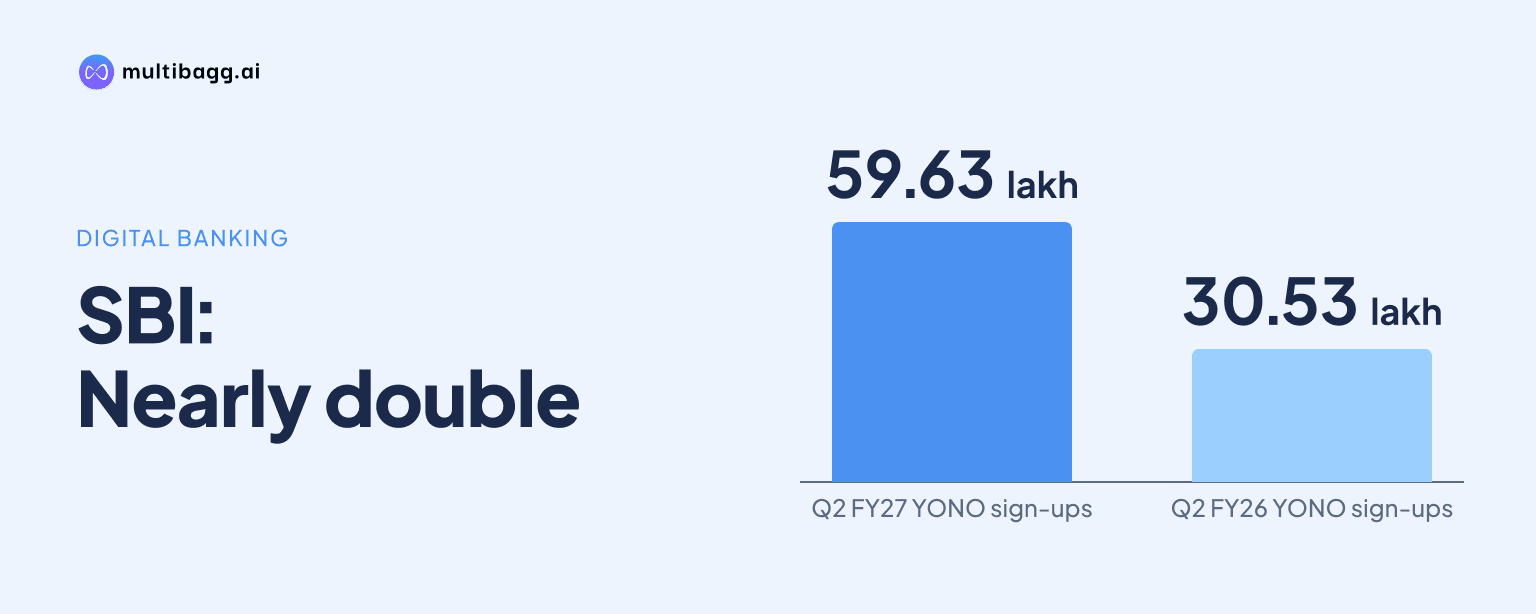
State Bank of India reported 59.63 lakh YONO registrations in Q2FY27, 95% above 30.53 lakh in Q2FY26, while digital loans totalled Rs 7,225 crore in H1FY27. SBI’s presentation indicates that YONO, payments channels and analytical leads are being used for transactions, account opening, product distribution and lending.
Know State Bank of India inside out
Results, valuation, peers and who's buying, in one view.
How quickly did SBI YONO registrations grow?
SBI’s YONO registrations rose 95% year on year to 59.63 lakh in Q2FY27 from 30.53 lakh in Q2FY26. The bank reported a daily average of about 66,000 registrations during the quarter. This quarterly measure differs from the registered-user base, which increased to 11.1 crore at September 2026 from 9.3 crore at September 2025.
YONO fund transfers also increased, reaching 9.72 crore in Q2FY27, up 68% from 5.77 crore in Q2FY26. SBI reported about 11 lakh fund transfers per day in Q2FY27. It also recorded 1.84 crore WhatsApp Banking registrations during the quarter, showing that its reported digital access includes both YONO and messaging-based banking.
How is SBI using YONO beyond registrations?
SBI reported YONO-related digital activity across account opening, cash services and financial-product distribution in Q2FY27. The figures included 29.2 lakh savings-bank accounts opened, 83.0 lakh YONO Cash transactions, 0.4 lakh National Pension System, or NPS, accounts opened and 0.89 lakh Public Provident Fund, or PPF, accounts opened.
The bank also reported 20.5 lakh personal accident insurance policies, 37,000 e-Shield Insta life-insurance policies and 3.3 lakh approved credit cards in Q2FY27. Gross mutual-fund sales were Rs 8,100 crore, while digital loans disbursed numbered 0.81 lakh. SBI did not provide a comparable Q2FY26 figure for digital-loan count or its quarterly value.
SBI listed four end-to-end digital lending products with Q2FY27 disbursements: Rs 1,510 crore for PAPL, Rs 907 crore for Real Time Personal Loan, Rs 362 crore for Insta Home Top Up Loan and Rs 117 crore for Loan against Mutual Funds. These displayed products totalled Rs 2,896 crore. The presentation does not expand PAPL.
How significant are digital payments in SBI’s transaction mix?
SBI reported that digital channels accounted for 95% of transactions in September 2026, compared with 94% in September 2025. Its digital-channel definition includes internet and mobile banking, point of sale, e-commerce, Unified Payments Interface, or UPI, YONO and Green Channel. The share for automated teller machines and cash-deposit machines declined to 3% from 4%, while business-correspondent and branch channels each remained at 1%.
On a separate measure, alternate channels represented 98.9% of transactions at September 2026. SBI reported 1,828 crore UPI remittance transactions during Q2FY27 and 26.30 crore cumulative unique SBI UPI users by account number at September 2026. Its reported UPI remittance market share was 25.28%, compared with 28.40% in mobile-banking transaction count and 22.23% in mobile-banking transaction value.
Debit cards and payment-acceptance infrastructure continued to form part of the network. SBI had 25.84 crore debit cards as of September 30, 2026, with about 9.1 crore debit-card spend transactions worth about Rs 26,000 crore in Q2FY27. It also reported about 1.1 crore automated teller machine transactions per day, 61.44 lakh BHIM SBI Pay QR codes and 17.8 lakh SBI payment terminals.
Got a follow-up? Ask IRIS
How large are SBI’s analytical-lead advances and digital loans?
SBI reported Rs 96,214 crore of advances through analytical leads in H1FY27, up 29.40% from Rs 74,355 crore in H1FY26. Annual advances through analytical leads rose to Rs 1,80,518 crore in FY26 from Rs 1,24,268 crore in FY25. FY25 was below Rs 1,37,357 crore in FY24, meaning FY26 exceeded both the FY25 and FY24 levels.
Retail loans accounted for Rs 48,091 crore of H1FY27 advances through analytical leads, followed by ABU at Rs 28,220 crore, SMEBU at Rs 15,286 crore and REHBU at Rs 4,617 crore. The presentation does not define ABU, SMEBU or REHBU. SBI separately reported Rs 108 crore of CVE commission fee income from analytical leads, distinguishing the fee amount from lending advances.
Digital loans totalled Rs 7,225 crore in H1FY27. PAPL accounted for Rs 2,824 crore, PABL for Rs 2,061 crore, RTPL for Rs 1,592 crore, Insta Home Top Up for Rs 509 crore and PASBL for Rs 239 crore. The first three categories together represented Rs 6,477 crore, while SBI did not provide their full forms in the presentation.
What analytics and artificial-intelligence initiatives has SBI disclosed?
SBI said Project SARAL has rolled out artificial intelligence and machine learning, or AI/ML, collection models. The models are intended to predict early delinquency and generate standardised account-level risk flags, which SBI said can help prioritise collection actions across products and business units.
SBI also disclosed analytics-model-driven digital lending to gig workers using data-driven and cash-flow-based credit assessment. Management said the approach is intended to improve access to institutional finance with effective risk management. The presentation provides no disbursement figure, borrower count, launch date or performance data for the gig-worker programme.
Conclusion
SBI’s figures show digital activity extending beyond app adoption. Quarterly YONO registrations nearly doubled, fund transfers grew 68%, and the bank reported digital account opening, insurance, mutual-fund sales and digital lending. At the same time, 95% of transactions were digital in September 2026 and analytical leads generated Rs 96,214 crore of advances in H1FY27.
What to watch next is whether SBI provides outcome data for Project SARAL and its analytics-led gig-worker lending programme. The bank has disclosed the collection-risk-flag mechanism and cash-flow-based assessment approach, but not their portfolio scale, collection outcomes or contribution to future analytical-lead advances and fee income.