










Scoda Tubes Limited says European buyers manage duty costs
Key highlights
- Scoda Tubes said European duty slabs vary from 5% to 25%, with the highest paid so far at 25%.
- Management used a 6,000-ton quarterly import example against a 4,000-ton quota to explain pooled duty costs.
- Almost 40% of Scoda Tubes' approximately Rs 185 crore order book is from exports.
- Scoda Tubes said RINA Marine certification could support Italy-related order execution in December or January.
powered by IRIS
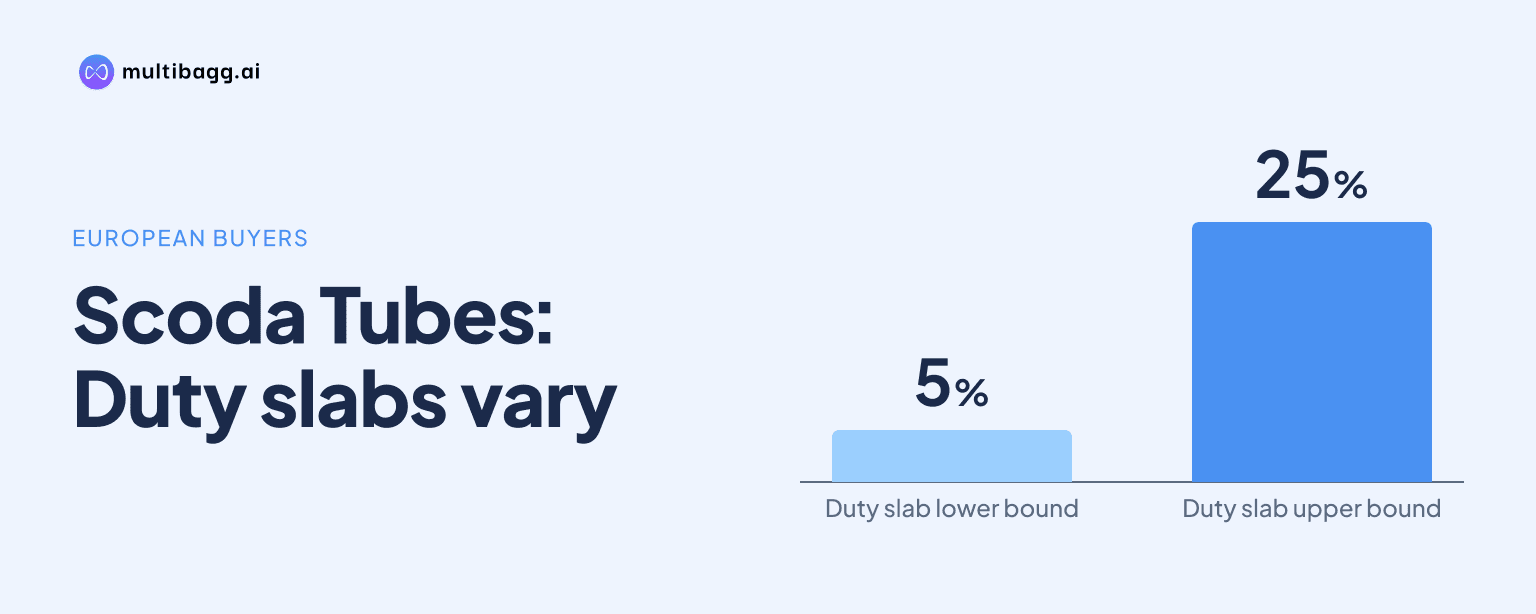
Scoda Tubes Limited said European customers are managing import-duty costs through quarterly purchasing and bonded warehouses, with quarterly duty slabs ranging from 5% to 25% and the highest paid so far at 25%. Management said this has slowed European business but does not prohibit imports once a quota is reached.
Know Scoda Tubes inside out
Results, valuation, peers and who's buying, in one view.
How are Scoda Tubes customers handling European duty costs?
European customers are handling the changed regime by setting quarterly purchase cycles and investing in bonded warehouses, according to Scoda Tubes. Management said European business has been affected and slow, while customers are also trying to resolve the situation with their respective governments. The quarterly pattern lets customers plan purchases around the duty slab applicable in each quarter.
Bonded warehouses are the second mechanism identified by Scoda Tubes. Customers can store material there and clear it at what management described as a lower average antidumping rate, rather than treating the illustrative 4,000-ton quota as a single hard stop. The warehouses alter the timing of clearance but also create rent and handling costs for customers.
Does the European quota stop Scoda Tubes imports after 4,000 tons?
No, Scoda Tubes said the quota system does not ban imports once 4,000 tons have been reached. Management rejected the interpretation that material above the quota automatically attracts a flat 50% duty. Instead, it said the relevant duty is shared across all importers and the total volume imported during the quarter.
Using a 6,000-ton quarterly import example, management said a charge could average near 15% across all imported tonnage and customers. It described the duty as a quarterly slab that can range from 5% to 25%, with the actual rate varying with the volume imported. This means customers can still import, although the cost and purchasing calendar have changed.
The 50% quota reduction mentioned by an analyst on the call was not quantified or independently restated by management. What management did confirm was that the framework has affected business and required customer adaptations. Its explanation focused on pooled duty costs across the quarter, rather than imports ending after a specified threshold.
Who pays Scoda Tubes' European duty and warehouse costs?
Scoda Tubes said European customers bear the higher duty and bonded-warehouse expenses. Management said customers need to sell at a higher price to cover the duty, warehouse rents and related costs. It characterized those additional charges as the customers' responsibility, while acknowledging that European business has been slower.
Management expects the process to become more routine within a few more quarters as customers learn to operate under the new system. It also said imports cannot simply stop because local European manufacturing capacity is not sufficient to fulfil demand. That assessment was management's view of market supply, not a disclosed forecast of Scoda Tubes sales volumes.
The duty impact comes while Scoda Tubes is managing a different product-margin profile. Management put gross margin for welded tubes at about 25%, compared with the 32% to 33% seamless-product gross-margin range cited by an analyst. The European regulation affects export customers' landed costs, while product mix and competition remain separate factors in Scoda Tubes' own economics.
Got a follow-up? Ask IRIS
What European opportunity does Scoda Tubes see in Italy?
Scoda Tubes sees a potential new European channel through RINA Marine certification secured in the quarter discussed on the call. Management said the certification provides direct-vendor access to European marine engineering and shipbuilding customers, specifically in regions of Italy. It described this as a higher-margin revenue channel and said it expects some orders to be executed in December or January.
That marine opportunity sits alongside a European business subject to quarterly duty costs of up to 25%. Management said that, despite the European challenges, Scoda Tubes remained on track for its 25% annual growth guidance. Earlier in the call, Scoda Tubes said its financial year 2027 (FY27) revenue-growth guidance of 20% to 25% includes expected contribution from the welded-tube facility due to commence commercial operations in the fourth quarter of FY27 (Q4 FY27).
The Italy plan is access-led rather than a stated revenue target. Scoda Tubes did not disclose the value, tonnage or customer count of potential RINA-linked orders. The disclosed near-term milestone is execution in December or January, which would show whether the certification translates into marine-sector sales.
How does Scoda Tubes' European business compare with domestic demand?
An analyst said Scoda Tubes' European business grew 42% in the quarter, while another analyst cited an almost 12% decline in domestic revenue in the second quarter. Management responded that it remained on track for 25% annual growth despite European challenges, but attributed the domestic decline mainly to lower activity in India's oil-and-gas sector.
Management identified power and some chemical demand as more supportive in India. Scoda Tubes said it was awaiting new BHEL and NTPC tender opportunities after completing the approval and audit process. It also said its order book was around Rs 180 crore to Rs 185 crore, representing roughly four to five months of execution.
Exports account for almost 40% of the Rs 185 crore order book, according to management, and include stockholders in the United States and Europe, automotive customers and spooling manufacturers. Scoda Tubes said it would maintain seamless-capacity utilisation at 70% in FY27, below its stated finished-goods optimum of 80% to 85%. The comparison shows that exports are an avenue for growth, but do not remove domestic-sector and utilisation constraints.
Conclusion
Scoda Tubes' account indicates that the European quota regime is changing how customers buy and clear material, rather than ending imports outright. Quarterly buying, pooled duty calculations ranging from 5% to 25%, and bonded warehouses allow customers to manage the cost, although management said the result has been slower European business and higher customer expenses.
The next points to watch are the expected December or January execution of Italy-related marine orders following RINA Marine certification, and whether customers establish a routine under the quarterly duty system within the next few quarters. Separately, Scoda Tubes plans commercial commissioning of its welded-tube facility in Q4 FY27, which management included in its 20% to 25% FY27 growth guidance.