










Scoda Tubes’ EBITDA margin falls 479 basis points in Q2 FY27
Key highlights
- Scoda Tubes reported Q2 FY27 EBITDA of Rs 15.8 crore and a 10.6% margin, down 479 basis points year on year.
- Power and fuel expense rose to 4.9% of Q2 FY27 revenue from 3.0%, while freight expense increased to 2.9% from 1.4%.
- Management cited 60,000 to 70,000 metric tonnes per annum of new seamless capacity as a constraint on price pass-through.
- Scoda Tubes’ seamless order book was about Rs 185 crore, with execution expected over four to five months.
powered by IRIS
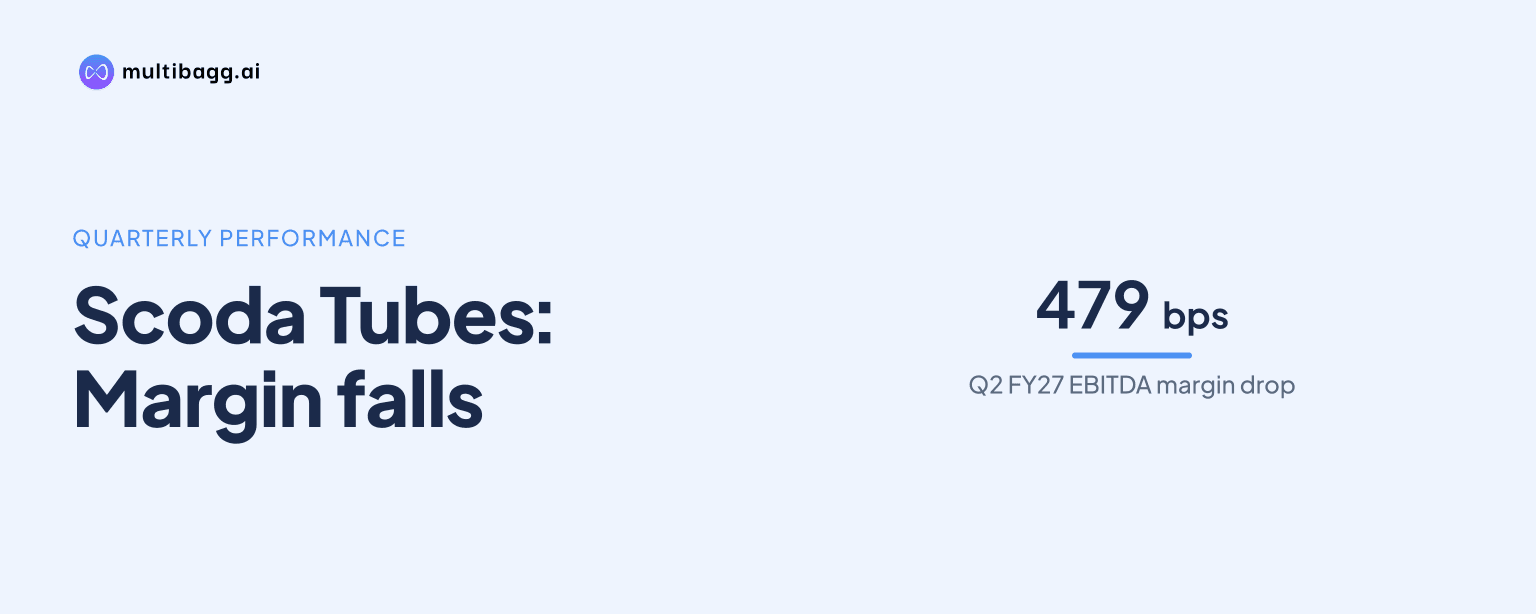
Scoda Tubes Limited reported a 10.6% earnings before interest, tax, depreciation and amortisation (EBITDA) margin in Q2 FY27, down 479 basis points from 15.38% a year earlier, as higher power, fuel and freight costs coincided with competitive pressure in seamless pipes. EBITDA declined to Rs 15.8 crore even as revenue rose 2.5% to Rs 148.9 crore.
Know Scoda Tubes inside out
Results, valuation, peers and who's buying, in one view.
Why did Scoda Tubes’ EBITDA margin fall in Q2 FY27?
Scoda Tubes’ margin fell because power, fuel and freight absorbed a larger share of Q2 FY27 revenue while competition prevented equivalent price increases. Management said power and fuel expense rose to 4.9% of revenue from 3.0% in Q2 FY26, while freight expense increased to 2.9% from 1.4%. It said selling realisations were largely stable despite those higher operating costs.
Quarterly EBITDA fell by Rs 6.5 crore to Rs 15.8 crore, although revenue from operations increased by Rs 3.6 crore to Rs 148.9 crore. The change shows that the 2.5% revenue increase did not offset the higher energy and logistics burden. Management did not provide a specific margin outlook, citing geopolitical uncertainty and limited visibility.
For H1 FY27, Scoda Tubes recorded EBITDA of Rs 31.8 crore on revenue of Rs 273.3 crore, producing an EBITDA margin of 11.6%. H1 revenue was 12.6% above Rs 242.7 crore in H1 FY26, while profit after tax was Rs 10 crore, equal to a 3.7% profit-after-tax margin.
How has seamless capacity expansion affected Scoda Tubes’ pricing?
Management said an additional 60,000 to 70,000 metric tonnes per annum of seamless-pipe capacity in the industry has raised competitive intensity and constrained Scoda Tubes’ ability to pass higher inputs on to customers. The new capacity relates to seamless production rather than welded pipes, according to management, and has put pressure on realisations.
Scoda Tubes said its Q2 FY27 growth was in volumes rather than selling value because it could not increase prices sufficiently. Management’s immediate objective is to sustain the 10.6% EBITDA margin reported in the quarter through cost optimisation, operational efficiencies, better utilisation and operating leverage as volume recovers; it declined to give a numerical margin target.
The company expects seamless utilisation of about 70% in FY27 and intends to raise it to 80% to 85% in the following year, which management described as the optimum finished-goods range. Its seamless order book was about Rs 185 crore, all in seamless products, with execution expected over four to five months and approximately 40% linked to exports.
Got a follow-up? Ask IRIS
Why have inventory and working capital increased at Scoda Tubes?
Inventory rose because Scoda Tubes maintained relatively high production in anticipation of demand, but intense competition slowed conversion of output into sales. Management expects inventory to normalise in H2 FY27 through better sales conversion, production aligned more closely with demand, and fewer inventory holding days.
The working-capital cycle differs materially by product. Management put welded pipes at about 130 to 140 days, compared with about 180 to 185 days for seamless products. It also described 180 to 190 days as the general industry cycle for seamless manufacturing, reflecting its longer production process.
Gross borrowings were Rs 229.2 crore as of September 30, 2026, after Scoda Tubes incurred about Rs 40 crore of H1 FY27 capital expenditure, mainly for machinery shipments and solar assets. Management expects peak debt of Rs 250 crore and said there were no immediate debt-reduction plans, although free cash flow after welded production begins could be used for repayment.
Can welded capacity and solar power ease Scoda Tubes’ cost pressure?
Management expects welded capacity and captive solar generation to improve cost efficiency, but it has not quantified either initiative’s effect on EBITDA margin. The 4.99-megawatt direct-current solar facility for seamless operations was energised and synchronised with the grid in August 2026. Management said it lowers power consumption costs in hot piercing and solutioning, but does not reduce gas costs.
Scoda Tubes expects revenue production from its expanded welded facility to begin in January in Q4 FY27, following a two-to-three-month construction delay associated with gas disruptions in March and April 2026. The facility will make welded pipes of up to 16 inches in diameter, intended for users including spool manufacturers and heating, ventilation and air-conditioning manufacturers serving data centres.
A further 8,000-metric-tonne-per-annum brownfield welded expansion is expected in H1 FY28 and would lift aggregate welded capacity to 21,150 metric tonnes per annum. Management initially described the project’s capital outlay as about Rs 40 crore and later gave a total budgeted capital expenditure figure of Rs 45 crore, with the remaining investment expected during FY28. Dedicated solar capacity for welded operations is also planned for use when production starts.
Conclusion
Scoda Tubes’ Q2 FY27 margin decline resulted from both costs and pricing conditions. Power and fuel expense rose to 4.9% of revenue, freight reached 2.9%, and an estimated 60,000 to 70,000 metric tonnes per annum of new seamless capacity restricted price pass-through. Revenue increased 2.5% to Rs 148.9 crore, but EBITDA fell to Rs 15.8 crore and the margin declined to 10.6%.
The next markers are the January Q4 FY27 start of welded revenue production, management’s plan to reduce inventory holding days in H2 FY27, and commissioning of the additional 8,000-tonne welded project in H1 FY28. Management has retained its FY27 revenue-growth guidance of 20% to 25%, supported by the new welded facility, improved operating conditions and higher sales volumes, while offering no margin guidance.