










Sedemac Mechatronics Limited reports ₹1,058 crore FY26 revenue
Key highlights
- SEDEMAC reported FY26 revenue of ₹1,058 crore, up 61% year on year.
- FY26 EBITDA was ₹200 crore and the EBITDA margin was 21%.
- FY26 profit after tax was ₹100 crore, while ISG unit sales reached 8.4 million.
- H1 FY27 revenue was ₹710 crore, up 41%, while Q2 FY27 EBITDA margin was 19.0%.
powered by IRIS
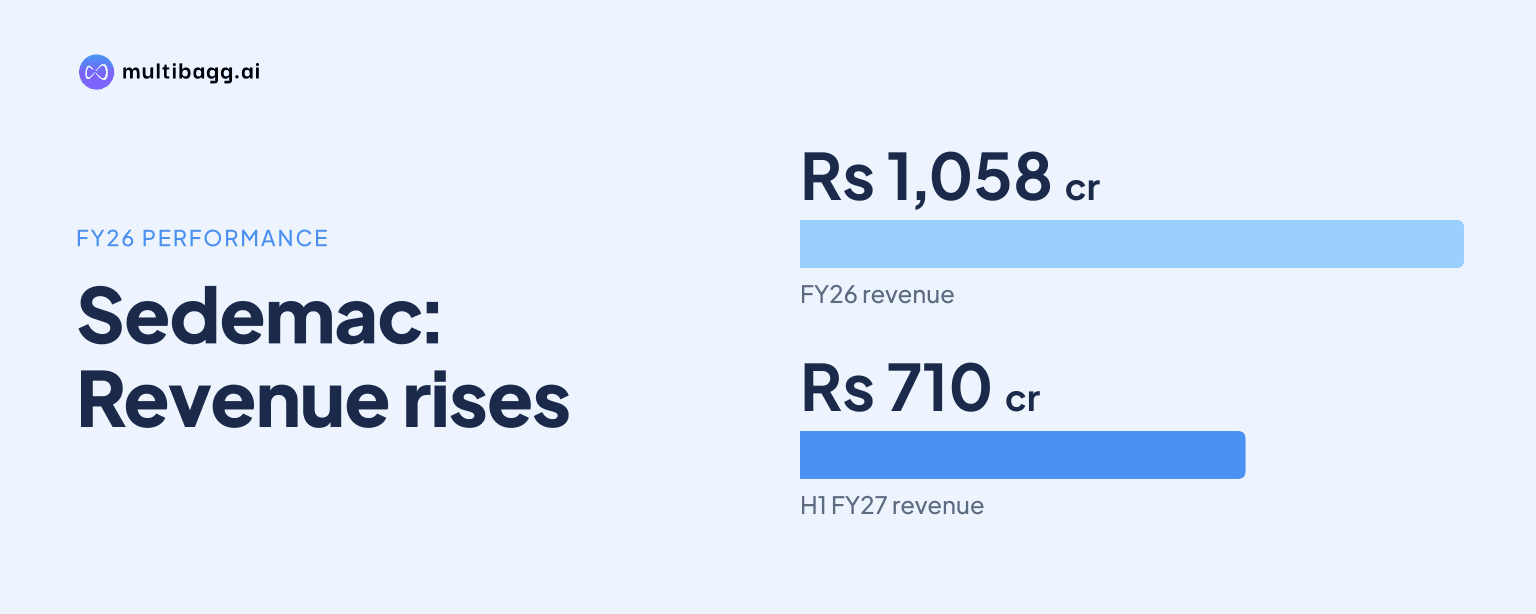
Sedemac Mechatronics Limited reported FY26 revenue of ₹1,058 crore, a 61% year-on-year increase, alongside a 21% EBITDA margin and profit after tax of ₹100 crore. The company attributed its FY26 performance to higher electronic control unit volumes and growth across mobility and industrial segments.
Know Sedemac Mechatronics inside out
Results, valuation, peers and who's buying, in one view.
What did Sedemac report for FY26?
SEDEMAC reported record FY26 revenue of ₹1,058 crore, up 61% from the preceding year, according to the summary of its Q4 FY26 earnings call held on 18 May 2026. EBITDA was ₹200 crore and the EBITDA margin was 21%, while profit after tax stood at ₹100 crore.
The figures point to strong operating growth during the year, supported by electronic control unit, or ECU, volumes. SEDEMAC also reported sales of 8.4 million integrated starter generator, or ISG, units in FY26. The company’s Q4 FY26 call summary described growth as broad-based across its mobility and industrial businesses.
The FY26 results were filed on 18 May 2026, with the investor presentation released the same day. SEDEMAC subsequently filed the earnings-call recording on 20 May and the call transcript on 22 May. These filings provide the company’s reported financial and operating context for the year ended 31 March 2026.
How did SEDEMAC perform in the first half of FY27?
SEDEMAC reported revenue of ₹401 crore in Q2 FY27 and ₹710 crore in H1 FY27, representing growth of 40% and 41%, respectively, based on the company’s investor presentation highlights released on 3 November 2026. Q2 profit after tax was ₹39 crore, while H1 profit after tax was ₹72 crore.
The reported H1 performance followed Q1 FY27 revenue of ₹310 crore. The company said demand for ECUs used by mobility and industrial original equipment manufacturers supported the first-quarter result. Its Q2 and H1 commentary referred to ECU launches and production ramp-ups as contributors to revenue growth.
However, profitability margins moderated from the FY26 level. The Q2 FY27 presentation highlights showed an EBITDA margin of 19.0%, compared with 21.7% in the stated comparison. SEDEMAC linked the pressure to raw-material and printed circuit board inflation.
Why were ECU volumes important to SEDEMAC's growth?
ECU volumes were important because SEDEMAC identified them as a key driver of FY26 revenue growth and cited continued ECU demand from mobility and industrial OEMs in Q1 FY27. The company’s business performance was therefore tied to new product launches, customer programmes and the scaling up of existing applications.
The FY26 earnings-call summary also cited broad-based growth in mobility and industrial segments. This indicates that the reported revenue increase was not described solely as the result of one programme or end market. The source material does not provide a segment-wise revenue split, so the relative contribution of mobility and industrial operations cannot be quantified from the available disclosures.
ISG sales provide an additional operating measure for the FY26 result. The company sold 8.4 million units during the year, showing the scale of an important product category alongside the reported revenue and profit figures. SEDEMAC did not disclose a unit-level price or revenue contribution for ISG products in the supplied material.
Got a follow-up? Ask IRIS
What is affecting SEDEMAC's margins and capacity plans?
SEDEMAC said raw-material and PCB inflation put pressure on EBITDA margins in H1 FY27, even as revenue expanded by more than 40%. The reported Q2 FY27 EBITDA margin of 19.0% was below the 21% margin reported for FY26 and the 21.7% comparison margin cited in the Q2 presentation highlights.
The Q4 FY26 call summary also noted possible mild margin pressure from commodity costs and supply-chain issues. It referred to the potential impact of El Nino, without quantifying any financial effect. These factors are relevant for investors because component and material costs can affect profitability even when ECU volumes and revenue rise.
SEDEMAC is expanding manufacturing capacity and diversifying its product portfolio, according to the FY26 call summary. Its H1 FY27 commentary said new plants and emerging commercial-vehicle and power-tool programmes were expected to support future capacity and growth. The company indicated that H2 EBITDA was expected to remain at H1 levels, rather than providing a higher margin target.
What disclosures have SEDEMAC made after the September results?
SEDEMAC made investor-facing disclosures after the quarter and half year ended 30 September 2026, including an earnings call held on 3 November 2026. On 5 November 2026, the company announced under Regulation 30 of the LODR framework that the video recording of that earnings call was available.
The announcement also referred to the presentation associated with unaudited quarterly and half-year results. Such disclosures allow investors to review management commentary alongside the reported financial metrics. The supplied information does not state a future results date, revenue target or margin target beyond management’s indication that H2 EBITDA could hold at H1 levels.
Conclusion
SEDEMAC’s FY26 disclosures show a sharp rise in revenue to ₹1,058 crore, supported by ECU volumes, mobility and industrial demand, and 8.4 million ISG unit sales. The start of FY27 maintained strong revenue growth, with H1 revenue reaching ₹710 crore, but margins eased as raw-material and PCB costs increased.
Investors will watch whether the company maintains its stated H2 EBITDA level, how new manufacturing capacity is ramped up, and whether commercial-vehicle and power-tool programmes add to revenue. Cost trends in commodities, PCBs and the supply chain remain relevant to the margin outlook disclosed by SEDEMAC.