










SEDEMAC ISG+EFI controller tops 1 million deployments in under two years
Key highlights
- SEDEMAC’s ISG+EFI controller exceeded 1 million deployments in under two years.
- SEDEMAC shipped close to 500,000 ISG+EFI units in the latest eight months.
- About 9.5 million to 10 million vehicles adopted ISG in the last 12 months, primarily through SEDEMAC and Honda.
- SEDEMAC said ISG can be incorporated in regular vehicle refreshes every two or three years.
powered by IRIS
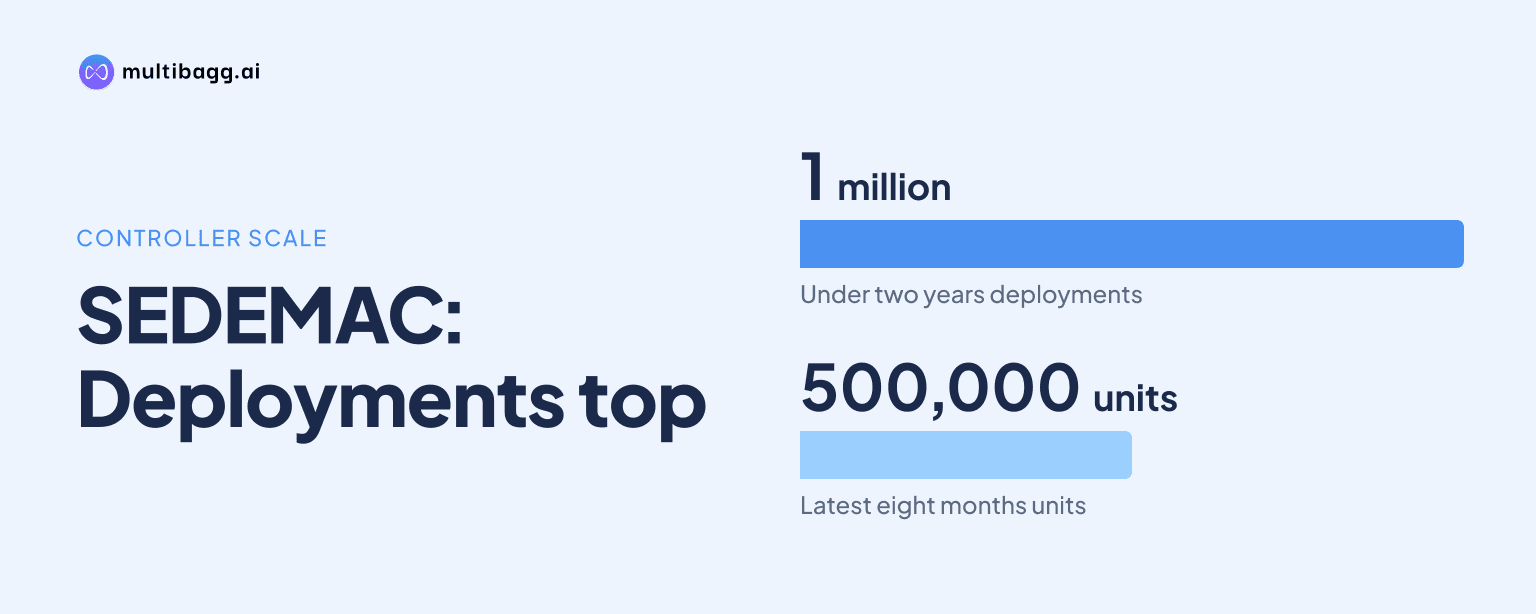
SEDEMAC’s combined ISG+EFI controller exceeded 1 million deployments in under two years, with close to 500,000 units shipped in the latest eight months. The disclosed recent volume accounts for close to half of the minimum cumulative deployment base and, according to management, has helped address concerns over whether its electronic fuel-injection system is proven.
Know Sedemac Mechatronics inside out
Results, valuation, peers and who's buying, in one view.
How quickly has SEDEMAC’s ISG+EFI controller been adopted?
SEDEMAC’s combined ISG+EFI controller has crossed 1 million deployments in under two years, and close to 500,000 units were shipped in the preceding eight months. ISG means integrated starter generator, while EFI means electronic fuel injection. The eight-month total represents close to half of the minimum disclosed cumulative base, indicating that a substantial part of product deployment has occurred recently.
SEDEMAC did not disclose current-month shipments, next-month volumes or a formal run-rate forecast. Shashikanth Suryanarayanan said the close-to-500,000-unit figure should provide an indication of the recent six- to eight-month run rate, while asking investors to make their own estimates from the available data. The company also referred to its red herring prospectus for information on its control-intensive electronic control units, or ECUs, and ISG’s contribution to them.
The disclosed figures show wider production use but do not establish a precise monthly growth rate because SEDEMAC withheld monthly data. The 1 million-plus figure is a deployment measure, not a disclosure of revenue, customer concentration, pricing or market share. Its significance in the call was instead tied to management’s argument that the EFI element has an operating history across more than 1 million installations.
Why have OEMs been cautious about SEDEMAC’s ISG+EFI controller?
Original equipment manufacturers, or OEMs, have been cautious because EFI ECUs are required under Indian emissions norms and have traditionally been supplied by large global tier-one companies. Amit Dixit said that adopting SEDEMAC’s combined controller means an OEM is changing not only its ISG ECU supply but also the supplier of the EFI ECU, which he described as the heart of the system.
Dixit said the question of whether the EFI system is proven has “pretty much” gone away after more than 1 million deployments. He identified existing relationships with EFI suppliers and an OEM’s consideration of dependence on one company as the remaining issues. The milestone therefore addresses one product-validation concern, but it does not mean that every OEM will replace an established EFI supplier.
SEDEMAC said an OEM can still choose a standalone ISG ECU rather than the combined ISG+EFI controller. Management acknowledged an analyst’s premise that the combined product can make better financial sense, but did not disclose system prices, customer savings or the proportion of ISG volumes sold as ISG+EFI. The available evidence supports product adoption, not a quantified comparison with global tier-one EFI suppliers.
Is motorcycle ISG adoption at an inflection point?
SEDEMAC said motorcycle ISG adoption is not at a single inflection point, because about 9.5 million to 10 million vehicles adopted ISG in the last 12 months, primarily through SEDEMAC and Honda. Suryanarayanan described that level as already high and said adoption is proceeding through multiple discussions with multiple parties rather than one development that would change the market dramatically.
ISG was first adopted significantly in scooters, including Honda’s Activa and TVS’s Jupiter, according to Suryanarayanan. SEDEMAC said the Raider, introduced in 2021, was the first wet-magneto motorcycle in the world to receive ISG. It subsequently cited the Ronin, Pulsar and Super Splendor as motorcycles using its ISG, demonstrating adoption beyond the earlier scooter applications.
SEDEMAC said its sensorless control technology means the motor placed inside the crankcase does not practically need to change, reducing related packaging changes. Dixit said ISG remains a major vehicle-level technology change but can be introduced through regular model refreshes every two or three years. That differs from waiting for an engine-generation change, which an analyst described as typically occurring over five to seven years.
Got a follow-up? Ask IRIS
Can SEDEMAC’s ISG technology support hybrid two-wheelers?
SEDEMAC said ISG can potentially be used in hybrid two-wheelers if the battery, motor power rating and controller are appropriately changed. Dixit described ISG as the first step toward hybridisation and said the company has several programmes at different stages based on that possibility. SEDEMAC did not disclose programme names, OEM customers, launch dates or volumes.
Suryanarayanan said ISG has a direct impact as a lever to address corporate average fuel economy, or CAFE, norms. When an analyst asked about the cost of achieving a hypothetical 20% mileage increase, SEDEMAC said it had calculations but would not share them. The call therefore supports potential hybrid-related use, but not a quantified fuel-economy result, price increase or revenue opportunity.
SEDEMAC also said its magneto-kit activity is not limited to a European two-wheeler and three-wheeler OEM win. Suryanarayanan said it had won magneto business with Indian OEMs earlier and would supply magneto kits to multiple parties. He added that planned magneto-kit supply had already been disclosed in the red herring prospectus.
What execution issues remain for SEDEMAC?
SEDEMAC said it is not dependent on a single chip supplier, citing the COVID-related semiconductor supply crunch. Dixit said the company has strategies to preserve multiple options wherever possible, including in non-obvious cases. On India-based chip production expected from fiscal year 2027 or 2028, he said SEDEMAC had no existing relationship but was monitoring developments.
Management declined to quantify raw-material savings from higher production volumes. Dixit said merely doubling volumes would not dramatically change supplier equations, although visibility of materially larger sourcing could create additional levers. He cited potential progress in the power-tool market as an example that could enable bigger sourcing, without providing a timetable or financial estimate.
SEDEMAC also discussed ECU opportunities in medium- and-heavy commercial vehicles, or MHCVs, where global tier-one suppliers are established. Its after-treatment controller and EFI ECU programmes discussed on the call are for MHCVs, not light commercial vehicles. Management said flexibility helped secure a project, including a custom ECU business model under which the customer can own part of the application software.
Conclusion
The 1 million-plus ISG+EFI deployment milestone, including close to 500,000 units in eight months, gives SEDEMAC a larger disclosed operating base for its combined controller. Management said this scale has reduced concerns over whether the EFI system is proven, while supplier relationships and OEM dependence considerations remain relevant to further adoption.
Investors can next watch for ISG additions during two- to three-year vehicle refreshes, disclosures from SEDEMAC’s hybrid-related programmes, and magneto-kit supply to multiple OEMs. SEDEMAC has not provided shipment guidance, programme volumes, pricing or fuel-economy calculations, so future customer launches and deployment disclosures will be the main measures of progress.