








Shellz India alternate channels reach 9% of H1 FY2027 revenue
MAX Plan at ₹4,999/yr

Find your next multibaggerBe a Pro Investor
Research stocks and track your picks on the go. Download the app.
Key highlights
- Shellz India said alternate channels rose to about 9% of H1 FY2027 revenue from about 4% in FY2026.
- Private labelling contributed about 5% of Shellz India’s H1 FY2027 revenue.
- Shellz India reported H1 FY2027 EBITDA of Rs 17.60 crore, up 21% from Rs 14.50 crore.
- Shellz India said Delhi capacity utilisation was about 75% and could move above 90% as new channels activate.
powered by IRIS
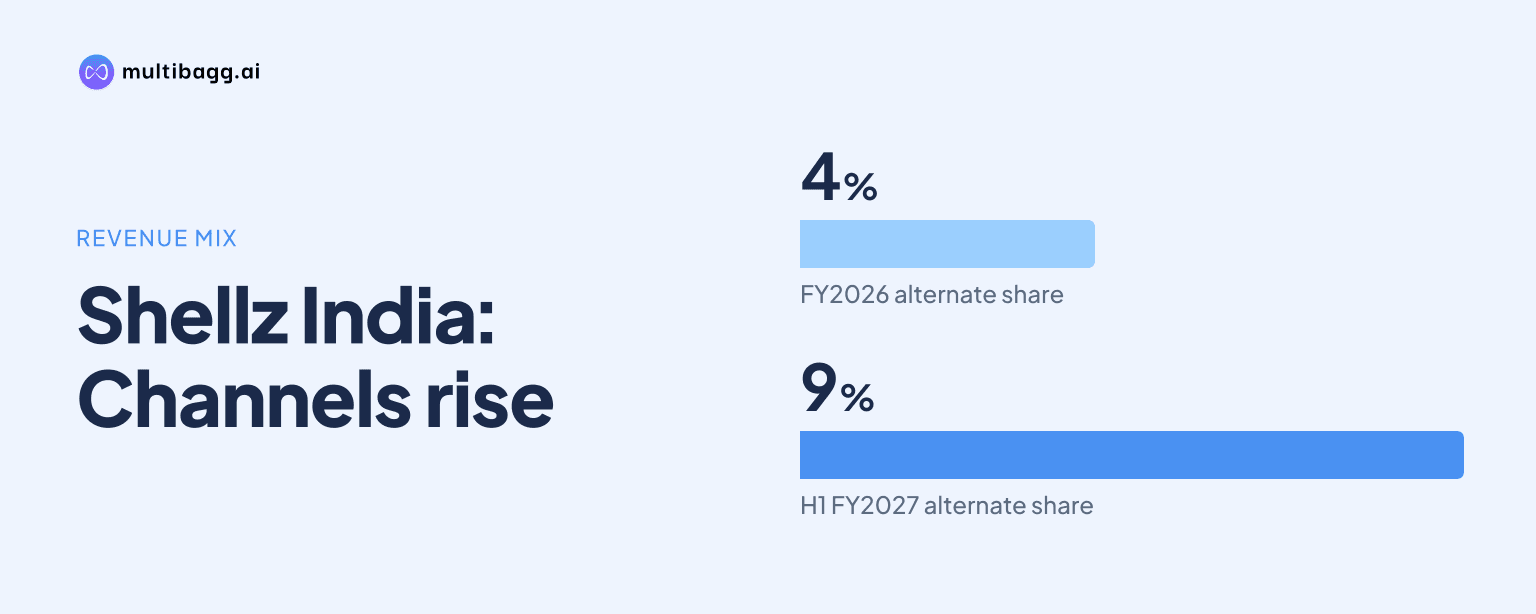
Shellz India Limited said alternate channels accounted for about 9% of H1 FY2027 revenue, up from about 4% in FY2026, as private labelling contributed about 5%; the company reported Rs 95.70 crore of H1 revenue from operations and said the share should rise further by year-end.
Know Shellz India inside out
Results, valuation, peers and who's buying, in one view.
How much revenue did Shellz India generate through alternate channels?
Shellz India generated about 9% of H1 FY2027 revenue through alternate channels, while 91% came through its super-stockist model. Management said the comparable alternate-channel contribution was about 4% in the full FY2026. The mix therefore increased by about 5 percentage points between the two disclosed periods, although FY2026 is a full-year period and H1 FY2027 covers six months.
Private labelling was the largest separately identified alternate channel, accounting for about 5% of Shellz India’s H1 FY2027 revenue. The other roughly 4% came from quick commerce, exports, food ingredients, online sales and modern trade combined. Shellz India did not disclose the individual H1 revenue contribution from any of those remaining channels.
Management said Shellz India was on track to double alternate channels in FY2027 and expected the mix to increase further towards the end of the year. The company also expects FY2027 revenue to be more weighted to H2, when confectionery demand is seasonally higher and Sonipat capacity activation is expected to contribute more.
Why is Shellz India adding private-label business?
Shellz India is adding private-label business because management said its cash conversion cycle can offset a lower contribution margin. Management said private-label contribution margins are lower by single-digit percentage points, but certain arrangements can operate with a negative cash conversion cycle. It also cited the absence of corporate marketing and dedicated sales-team costs for private-label assignments.
Shellz India said it was already working with one large South Asian private-label player and that this business had scaled by a decent amount. Management said the customer had made significant quantity commitments, but did not disclose its name, contract value, volumes or delivery dates. Private labelling accounted for about 5% of total H1 FY2027 revenue.
Future private-label expansion is linked to the Sonipat plant. Management said it aims to make the facility compliant with standards including BRCGS, or Brand Reputation through Compliance Global Standards, and SQF, or Safe Quality Food. It also said several multinational and Indian companies with revenue above US$1 billion in India had expressed interest, with one prospective customer visit scheduled for the first week of December.
Which channels are included in Shellz India’s 9% mix?
Shellz India’s 9% alternate-channel mix includes private labelling, exports, Tosca quick commerce, online sales, modern trade and food ingredients. Management initially listed private label, exports and Tosca before clarifying that modern trade was also included. The 9% figure therefore measures the combined contribution of several channels, not private label alone.
Tosca is Shellz India’s premium brand for quick commerce and online distribution. Management said certain Tosca products received a decent response in the previous Diwali season and generated very good orders, leading it to plan added capacity for selected gifting products. The company is also developing lower-sugar, no-palm-oil and portion-controlled products, including a range designed to contain under 50 calories per pack.
Management plans to expand Tosca first through Blinkit and Swiggy, before adding Zepto and increasing its western-market presence. It said Blinkit has a major presence in Delhi NCR and northern markets, while Swiggy has a foothold in Bengaluru, Hyderabad, Chennai and other southern markets. Management expects quick commerce to reduce brand-building time from five to eight years to one to two years, but this is an expectation rather than a reported result.
Got a follow-up? Ask IRIS
How did Shellz India’s H1 FY2027 financial performance change?
Shellz India reported Rs 95.70 crore of revenue from operations in H1 FY2027, up about 4% on a reported basis and approximately 9% on a like-for-like basis. The company began netting certain customer discounts and schemes from revenue that it had previously recorded as expenses. Prior-year figures were not restated, although management said the presentation change did not affect EBITDA, or earnings before interest, tax, depreciation and amortisation, or profit in absolute terms.
EBITDA increased 21% to Rs 17.60 crore in H1 FY2027 from Rs 14.50 crore in H1 FY2026, while the EBITDA margin rose to 18.4% from 15.8%. Profit after tax increased 31% to Rs 8.20 crore from Rs 6.30 crore, and the profit-after-tax margin reached 8.6% from 6.8%. Management identified the September 2025 reduction in goods and services tax on confectionery as the principal driver of H1 margin expansion.
H1 product mix was weighted towards baked treats, which contributed about 40% of revenue, followed by Choco Delights at about 35%. Jellies and panned sugar candies accounted for the balance. Management described the usual H1-H2 seasonal split as about 40:60 or 45:55, and said FY2027 should be more H2 weighted because Sonipat activation is leaning into the second half.
What capacity plans support Shellz India’s channel expansion?
Shellz India is using its Sonipat project to supply more channels and lower operating costs relative to its Delhi unit. Management said the Sonipat plant was already operating to some extent and that Phase 1 would be completed within six to eight months. Construction work in progress of Rs 65 crore related entirely to Phase 1, according to management.
The existing Delhi facility was operating at about 75% capacity utilisation, and management expects utilisation to move above 90% as new channels activate. Shellz India plans to upgrade the Delhi facility into Sonipat during Phase 1. Management said automation at Sonipat should reduce material wastage and manpower costs, while electricity and steam-generation costs should also be lower than in Delhi.
For Hugs, Shellz India said it already has sales teams and super-stockists in western, central and southern India but has been unable to fully serve them because of capacity constraints. The company plans regional distribution centres to reduce lead times and use new capacity to service those networks. Super-stockist numbers were relatively stable in H1, making capacity availability rather than network additions the stated near-term lever.
Conclusion
Shellz India has reported a clear diversification in its revenue routes: alternate channels increased from about 4% of FY2026 revenue to about 9% in H1 FY2027, with private labelling representing about 5% of H1 revenue. The change occurred alongside EBITDA growth of 21% to Rs 17.60 crore, though management attributed much of the H1 margin expansion to the September 2025 goods and services tax reduction.
The next disclosed milestones are Sonipat Phase 1 completion within six to eight months and prospective customer visits beginning in the first week of December. Shellz India’s stated plans also point to H2 FY2027 as the period to watch for higher seasonal revenue, additional private-label volumes, quick-commerce expansion and utilisation moving from about 75% towards above 90%.

