








Shellz India Limited cuts receivables Rs 10.8 crore in H1
MAX Plan at ₹4,999/yr

Find your next multibaggerBe a Pro Investor
Research stocks and track your picks on the go. Download the app.
Key highlights
- Shellz India reduced trade receivables by Rs 10.8 crore to Rs 37.8 crore between March 31 and September 30, 2026.
- Trade payables increased by Rs 1.7 crore to Rs 37.1 crore, while inventory remained broadly stable.
- H1 FY2027 EBITDA rose 21% to Rs 17.6 crore and EBITDA margin increased to 18.4%.
- Alternate channels contributed about 9% of H1 FY2027 revenue, compared with about 4% in FY2026.
powered by IRIS
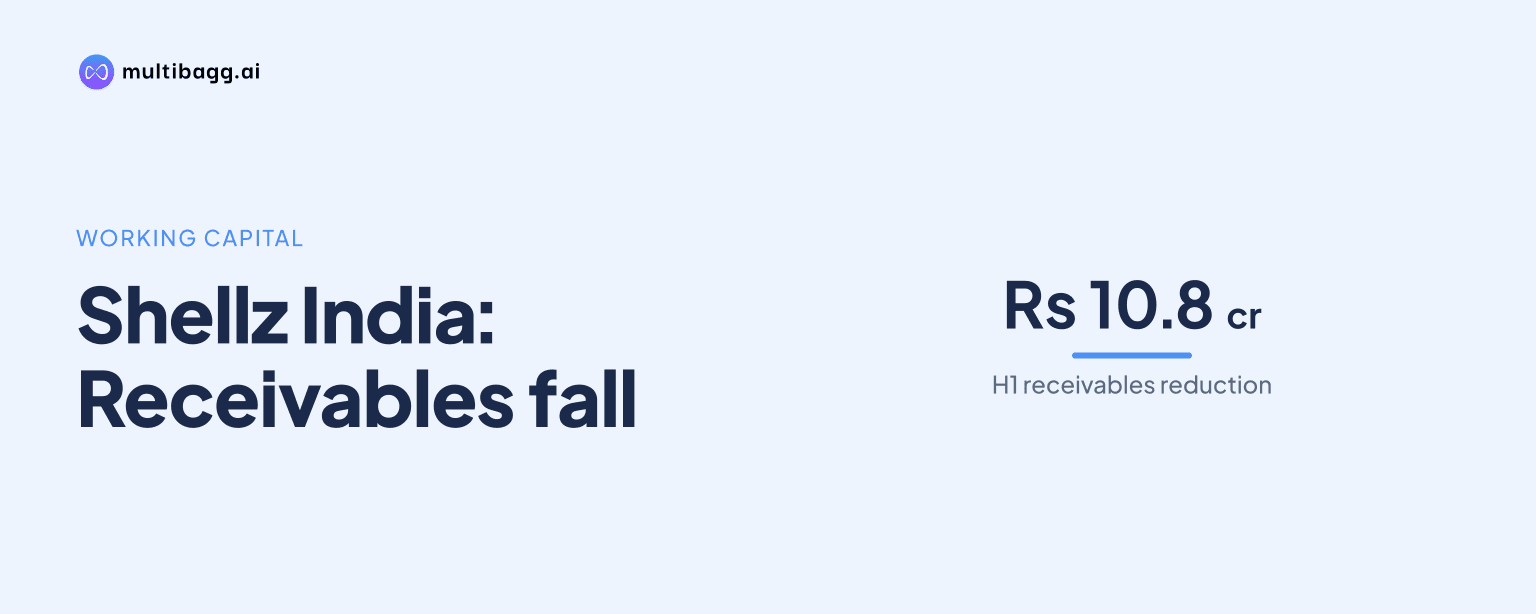
Shellz India Limited reduced trade receivables by Rs 10.8 crore to Rs 37.8 crore between March 31, 2026 and September 30, 2026, while trade payables increased Rs 1.7 crore to Rs 37.1 crore. Management said these balance-sheet movements reflected its focus on working-capital efficiency and cash conversion during expansion.
Know Shellz India inside out
Results, valuation, peers and who's buying, in one view.
Did Shellz India reduce its working-capital cycle?
Shellz India did not disclose a working-capital-cycle measure in days, so a reduction of more than 20 days cannot be verified from the earnings call. It instead reported period-end trade receivables, inventory and trade payables for March 31, 2026 and September 30, 2026.
Receivables fell to Rs 37.8 crore from Rs 48.6 crore, reducing the amount outstanding from customers by Rs 10.8 crore. Trade payables rose to Rs 37.1 crore from Rs 35.4 crore, while management said inventory was broadly stable. The company did not disclose inventory values, receivable days, payable days or cash collected from customers.
Management said its objective is to establish a sustainable pattern of positive operating cash flow through improved collections, disciplined inventory planning and working-capital management. It did not provide a date or rupee target for positive operating cash flow as it funds the Sonipat plant expansion.
How did Shellz India's receivables and payables change?
Shellz India's reported receivables declined 22.2%, while payables increased 4.8%, between March 31, 2026 and September 30, 2026. The difference between receivables and payables narrowed to Rs 0.7 crore from Rs 13.2 crore over that period.
The Rs 12.5 crore narrowing is calculated from Shellz India's disclosed balances, rather than reported operating cash flow. The transcript does not provide customer collections, supplier payments, inventory balances, debt movements or capital-expenditure cash outflows for H1 FY2027.
The company is managing this balance-sheet position alongside Rs 65 crore of capital work in progress, or CWIP, for Sonipat phase 1. Management said the CWIP was entirely related to phase 1, which was already operating to some extent and is expected to be completed in six to eight months.
Which channels could support Shellz India's cash conversion?
Private label could support Shellz India's cash conversion because management described its cycle as extremely good and said certain arrangements could have a negative cash-conversion cycle. Management also said private-label contribution margins are lower by single-digit percentage points than other business.
Private label does not incur corporate marketing or sales-team expenses, according to management. Shellz India groups private label, exports and the Tosca brand as alternate channels, whose revenue contribution increased to about 9% in H1 FY2027 from about 4% in FY2026.
Management said alternate channels were on track to more than double their revenue contribution in FY2027. Tosca is distributed through quick commerce, e-commerce and modern trade, while exports reach the Middle East, South Asia and Europe; however, the company did not disclose payment terms, receivable days or inventory turns for these channels.
Hugs remains the core mass-market brand, with prices primarily from Rs 1 to Rs 10 and distribution through more than 300 super-stockists in 24 states. Management plans regional distribution centres in western, central and southern India to shorten lead times, but did not quantify their investment or working-capital impact.
Got a follow-up? Ask IRIS
How did H1 earnings compare with the balance-sheet movement?
Shellz India reported higher H1 FY2027 profitability while receivables fell Rs 10.8 crore, although the transcript does not establish a direct causal relationship. Earnings before interest, tax, depreciation and amortisation, or EBITDA, increased 21% to Rs 17.6 crore from Rs 14.5 crore in H1 FY2026.
EBITDA margin rose to 18.4% from 15.8%, while profit after tax increased 31% to Rs 8.2 crore from Rs 6.3 crore. The profit-after-tax margin improved to 8.6% from 6.8%. Management said the reduction in goods and services tax, or GST, on confectionery from September 2025 was the major driver of margin expansion.
Revenue from operations was Rs 95.7 crore in H1 FY2027, up about 4% as reported and about 9% on a like-for-like basis, according to management. Customer discounts and schemes are now netted from revenue rather than shown as expenses, while the prior-year figures were not restated; management said this does not affect EBITDA or profit in absolute terms.
What does Shellz India expect from Sonipat capacity?
Shellz India expects Sonipat phase 1 to increase installed capacity from 17,000 metric tonnes per annum to more than 26,000 metric tonnes per annum. Management said phase 1 is under activation and should be fully completed within six to eight months, followed by phase 2 over the next 12 to 18 months.
Phase 2 is expected to raise capacity to about 35,000 metric tonnes per annum. Management said phases 1 and 2 could support annual revenue of about Rs 350 crore and Rs 500 crore, respectively, which are capacity-linked expectations rather than FY2027 revenue guidance.
Management expects Sonipat to support a stronger H2 FY2027 through added capacity and lower operating costs than the Delhi site. It cited automation-led lower wastage and manpower costs, plus lower electricity and steam-generation costs, but did not quantify savings or specify a commissioning date beyond the six-to-eight-month phase 1 completion window.
Conclusion
Shellz India's clearest reported working-capital movement was the Rs 10.8 crore decline in trade receivables to Rs 37.8 crore by September 30, 2026, alongside a Rs 1.7 crore increase in payables and broadly stable inventory. These changes narrowed the receivables-less-payables gap by Rs 12.5 crore, while H1 FY2027 EBITDA rose 21% to Rs 17.6 crore. The company did not disclose a reduction in working-capital days.
The next matters to watch are phase 1 completion at Sonipat within six to eight months, phase 2 over the following 12 to 18 months, and management's effort to establish positive operating cash flow. Shellz India also aspires to reach 2 to 2.5 times FY2026 revenue by FY2029 through capacity expansion, portfolio development and channel diversification.

