








Shellz India says Sonipat automation should lift margins
MAX Plan at ₹4,999/yr

Find your next multibaggerBe a Pro Investor
Research stocks and track your picks on the go. Download the app.
Key highlights
- Sonipat phase 1 has Rs 65 crore of CWIP and is expected to be completed within six to eight months.
- Shellz India expects Sonipat automation to reduce material wastage, manpower costs, electricity costs and steam-generation costs.
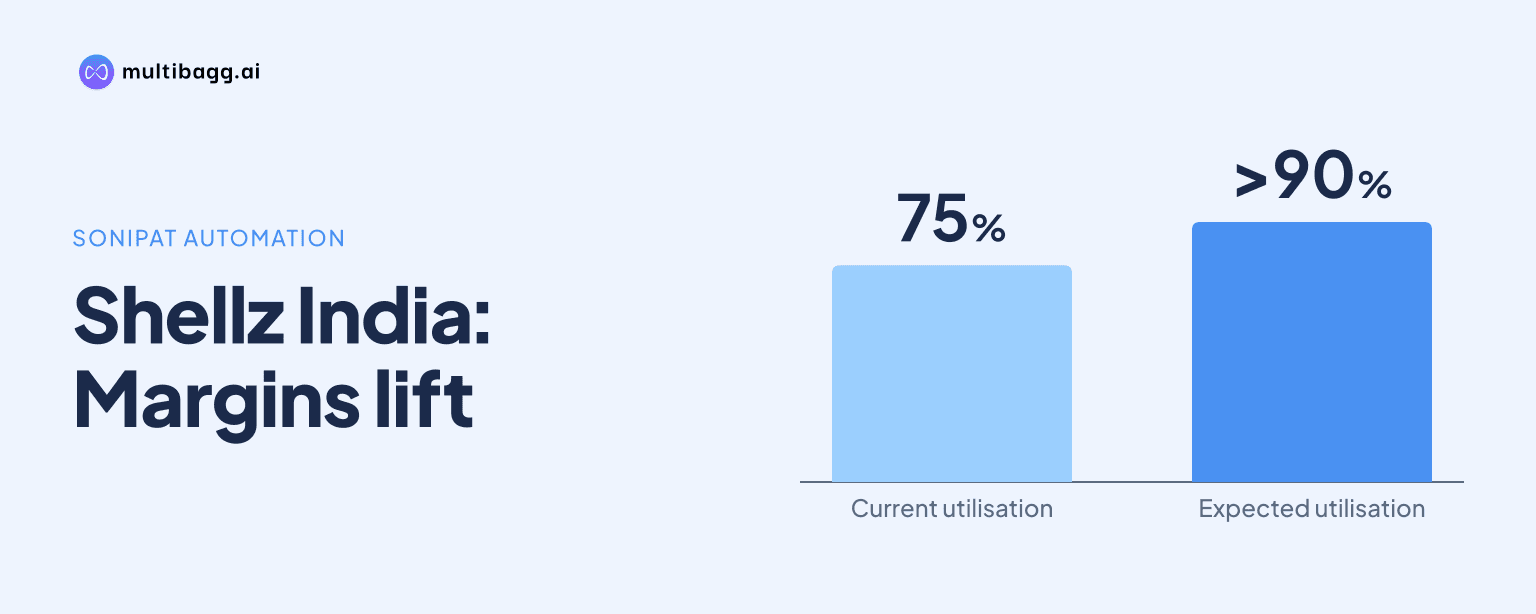
- Current capacity utilisation is about 75%, and management expects it to exceed 90% as channels are activated.
- Alternate channels contributed about 9% of H1 revenue, compared with about 4% in the prior full fiscal year.
powered by IRIS
Shellz India Limited said Sonipat automation should support further profitability-margin growth by reducing material wastage, manpower costs and electricity and steam-generation expenses versus Delhi. Management said Rs 65 crore of construction work in progress, or CWIP, relates entirely to Sonipat phase 1, which it expects to complete within six to eight months.
Know Shellz India inside out
Results, valuation, peers and who's buying, in one view.
How will Sonipat automation reduce Shellz India’s costs?
Shellz India said Sonipat will lower costs through automation that reduces material wastage, manpower requirements and power expenses. Management identified electricity and steam generation as specific profit-and-loss cost lines expected to be lower at Sonipat than at the Delhi facility, describing the change as structural rather than a one-time saving.
The material-cost mechanism is lower production waste once automated processes are in place, while the labour mechanism is a reduced manpower requirement. Management did not disclose a rupee amount or percentage for either saving, so the financial effect cannot yet be measured against the Delhi unit’s cost base.
Shellz India also expects scale to lower the fixed-cost burden per unit of revenue. Management said a larger revenue base at Sonipat would spread fixed costs over more sales, separately from the anticipated savings on material, labour, electricity and steam. This means the projected margin expansion depends both on automation and on capacity utilisation rising after the plant ramp-up.
The company said its existing Delhi unit complies with Indian standards, while Sonipat is being built to resemble a global food factory. Management cited BRCGS and SQF as top-tier food-safety guidelines it intends the facility to meet, with the aim of enabling visits and possible discussions with international retail, export and private-label counterparties.
When will Shellz India complete Sonipat phase 1?
Shellz India said Sonipat phase 1 is already operating to some extent and should be completed in the next six to eight months. Management clarified that the Rs 65 crore CWIP balance is entirely for phase 1, rather than including expenditure on a second phase.
The six-to-eight-month timetable applies to completion of phase 1, not the start of activation. Management said the facility is already midway through activation, which is why it expects additional capacity to support a stronger second half of FY 2027, or H2 FY 2027.
Shellz India said its usual sales seasonality is broadly 40:60 or 45:55 between the first half and second half. For FY 2027, management expects a greater H2 skew because Sonipat activation is moving into the second half, making the timing of completed capacity relevant to the year’s sales and cost absorption.
Management also said the plan is to upgrade the Delhi facility into Sonipat during phase 1. The transcript did not provide a capacity figure for the new site, a commissioning date within the six-to-eight-month period, or a quantified estimate of the output that will transfer from Delhi.
Will Sonipat improve Shellz India’s profit margins?
Shellz India said it foresees further profitability-margin growth as Sonipat comes up, but it did not provide a numerical margin target. The response came after an analyst asked whether a profit-after-tax margin of 8.5% to 9% could be sustained, and management instead cited lower manufacturing costs and fixed-cost absorption.
The analyst’s question referred to a prior reduction in goods and services tax, or GST, as one potential reason for margins. Shellz India’s response distinguished the expected Sonipat benefit from that issue by pointing to lower waste, labour, electricity and steam costs, all of which management said should improve the profit-and-loss structure over time.
The expected benefit remains contingent on execution. Phase 1 must be completed, automation must operate as intended, and additional capacity must be filled with revenue before fixed costs can be spread over a larger sales base. Management did not quantify the cost gap between Sonipat and Delhi or specify a timeframe for a margin outcome.
Working-capital movements provide a separate view of financial execution during the expansion. Trade receivables declined to Rs 37.80 crore on September 30, 2026, from Rs 48.60 crore on March 31, 2026, while trade payables increased to Rs 37.10 crore from Rs 35.40 crore and inventory remained broadly stable.
Shellz India said these movements reflect its focus on working-capital efficiency and cash conversion as the business scales. Management’s stated objective is sustainable positive operating cash flow through collections, inventory planning and working-capital management while it balances capital expenditure and expansion needs.
Got a follow-up? Ask IRIS
What capacity and channels could support Sonipat’s ramp-up?
Shellz India said current capacity utilisation is about 75% and management expects it to exceed 90% as new channels are activated. The company linked that expectation to Sonipat capacity and channel development, without disclosing a time-bound utilisation target or a plant-by-plant utilisation split.
Alternate channels accounted for about 9% of H1 revenue, compared with about 4% in the prior full fiscal year. Private labelling represented about 5% of H1 revenue, while quick commerce, exports, food ingredients and modern trade comprised the balance of alternate-channel sales.
The super-stockist model accounted for 91% of H1 revenue, leaving Shellz India reliant on its established distribution structure even as alternate channels expanded. Management said private-label contribution margins are lower by single-digit percentage points, but cited faster cash conversion, potentially negative cash-conversion cycles and no corporate marketing or sales-team expense in some private-label arrangements.
Management gave broad product-mix figures for H1: baked treats contributed about 40% of revenue and Choco Delights about 35%, with jellies and panned sugar candies providing the balance. It said the H1 mix tilts toward baked treats because the chocolate season begins around the festive period.
Shellz India said it is in contact with distributors and dealers serving large global retail stores and that they are interested in arranging visits to the new plant. These are discussions rather than disclosed customer agreements, and management did not name a contracted global retailer or provide revenue associated with the opportunity.
What are Shellz India’s growth plans after Sonipat?
Shellz India aspires to scale revenue to two to 2.5 times its FY 2026 level by FY 2029. Management said this ambition rests on capacity expansion, portfolio development, distribution and diversification of revenue channels, while acknowledging that manufacturing, working capital and product execution will be required.
For Tosca, management said it plans first to expand business through Blinkit and Swiggy, then seek onboarding with Zepto and move into Western markets. It said quick commerce may reduce the time needed to establish a brand from five to eight years previously to one to two years, which is management’s assessment rather than a disclosed company forecast.
For Hugs, Shellz India said it sees growth scope in Western, Central and Southern India and intends to use regional distribution centres to reduce lead times. Management also said it is developing Tosca products with lower sugar, no palm oil or calorie-controlled formats, including a range in which every pack would contain under 50 calories.
Conclusion
Shellz India’s stated margin-expansion case is based on the shift from Delhi toward a more automated Sonipat facility. Management expects lower material waste, manpower, electricity and steam costs, while higher sales could distribute fixed costs across more revenue. The reduction in receivables by Rs 10.80 crore between March 31, 2026 and September 30, 2026 adds a working-capital improvement alongside the manufacturing plan.
The next disclosed milestone is completion of Sonipat phase 1 within six to eight months and the expected stronger H2 FY 2027 capacity ramp. Management’s subsequent markers include capacity utilisation moving from about 75% to above 90%, further growth in alternate channels from their 9% H1 revenue share, and progress toward its FY 2029 aspiration of two to 2.5 times FY 2026 revenue.

