










Shivalik Bimetal Controls Limited lists Rs 1,600 crore capacity
Key highlights
- SBCL lists Rs 1,600 crore of post-expansion revenue capacity across three Solan plants.
- Plant 1 has Rs 700 crore of capacity for EB-welded shunt resistors.
- Plant 2 lists Rs 600 crore for thermostatic bimetals and Plant 3 lists Rs 300 crore for electrical contacts.
- Pune Phase I has operating consent until June 30, 2032, while Phase II approvals were pending in Q2FY27.
powered by IRIS
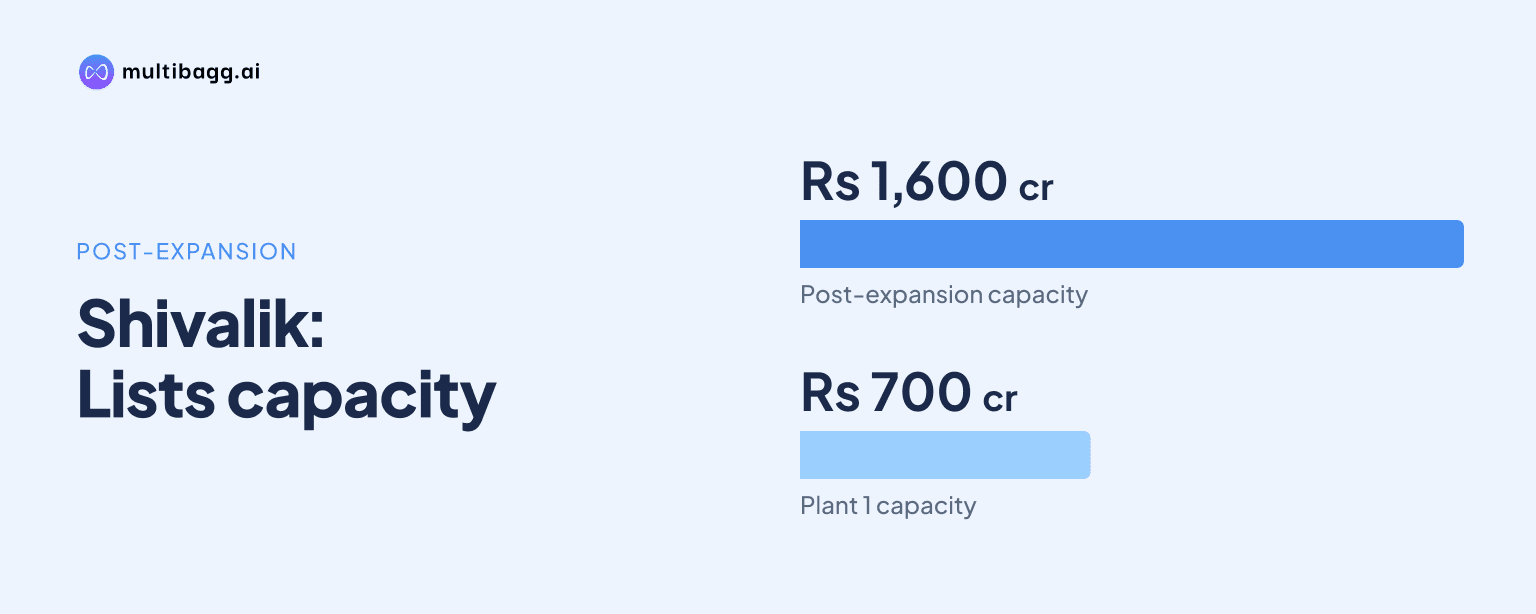
Shivalik Bimetal Controls Limited lists Rs 1,600 crore of post-expansion revenue capacity across three Solan plants, led by Rs 700 crore for electron-beam-welded shunt resistors. The Q2FY27 presentation assigns Rs 600 crore to thermostatic bimetals and Rs 300 crore to electrical contacts, while Pune remains an assembly project with no disclosed capacity.
Know Shivalik Bimetal Controls inside out
Results, valuation, peers and who's buying, in one view.
What capacity does SBCL list at its Solan plants?
SBCL lists Rs 1,600 crore of post-expansion revenue capacity across three plants in Solan, Himachal Pradesh. Plant 1 is assigned Rs 700 crore for electron-beam, or EB, welded shunt resistors; Plant 2 has Rs 600 crore for thermostatic bimetals; and Plant 3 has Rs 300 crore for electrical contacts.
The Rs 700 crore shunt-resistor platform is Rs 100 crore larger than the Rs 600 crore bimetal platform and Rs 400 crore above the Rs 300 crore electrical-contact platform. These are revenue-capacity disclosures after expansion, not reported revenue, production volumes or utilisation rates.
SBCL identifies Plant 1 and Plant 2 as Shivalik Bimetal Controls Limited facilities and Plant 3 as Shivalik Engineered Products Pvt. Limited. The presentation also identifies a New Delhi corporate office, an Indore associate named Innovative Clad Solutions Private Limited, and a Pune research and development, or R&D, and Cell Connecting Systems project.
How does SBCL plan to expand into assemblies?
SBCL plans to use its Pune facility for printed circuit board assembly, or PCBA, and busbar connector solutions for automotive and electrification applications. The project, estimated for 2026, is intended to move the company beyond precision materials and individual components into integrated sub-assemblies for original equipment manufacturers, or OEMs, and Tier-1 customers.
The proposed assembly platform combines busbars, connectors and PCBAs into ready-to-use systems. SBCL says busbars distribute power, while PCBAs provide populated control and sensing boards used for switching, monitoring and communication in applications including electric-vehicle battery packs, power distribution units, inverters, converters and energy-management equipment.
This is distinct from the Rs 1,600 crore capacity listed for the three Solan plants. SBCL does not disclose a revenue-capacity figure, capital expenditure amount, production volume, customer order or commissioning date for Pune, so the project’s eventual output is not specified in the presentation.
Management says the Pune location is intended to support closer collaboration, qualification and delivery with automotive and industrial customers. Its stated strategy is to increase the value delivered within customer programmes through integrated products, while the Solan facilities retain their disclosed roles in shunt resistors, thermostatic bimetals and electrical contacts.
Which manufacturing technologies support SBCL’s product platforms?
SBCL identifies EB welding, diffusion bonding, cold bonding, brazing and welding, and high-precision strip processing as R&D-led manufacturing capabilities. The company also lists an in-house stamping shop, reliability testing, tooling and design, supported by a workforce of 1,000 people.
For the Rs 700 crore shunt-resistor platform, SBCL says EB welding joins copper and manganin strips in a vacuum using an electron beam. The company describes this as a process for producing low-ohmic shunt resistors used in electrical-current measurement, and says its EB-welding lines are built in house.
SBCL says in-house machine building can shorten the lead time for adding EB-welding lines compared with procurement-led machine additions. The presentation also says that building these lines internally can reduce expenditure relative to importing machines, but it gives no quantified machine cost, lead-time comparison or unit-cost saving.
For the Rs 600 crore thermostatic-bimetal platform, SBCL uses diffusion bonding, which applies heat, pressure and time to join metals. The company says it develops 77 grades of bimetal and trimetal strips, and also lists cold-pressure bonding, a comparable bonding process performed without heat.
Got a follow-up? Ask IRIS
What does in-house strip processing add to SBCL’s operations?
SBCL says its precision strip processing includes in-house slitting, levelling and tension control of thin metal strip. The company presents this back-integrated process as a mechanism to minimise scrap and support uniform conductivity in the material used across its shunt-resistor and bimetal product platforms.
The presentation links strip processing to material yield and fewer field failures, but does not provide a scrap percentage, yield rate, warranty metric or comparison with third-party processing. Its disclosed evidence is therefore the stated production mechanism rather than a reported operating-performance measure.
SBCL also links diffusion bonding to customer-specific metal combinations for switchgear, heating, ventilation and air-conditioning equipment, electrical appliances and electric-vehicle applications. The company says bimetal and trimetal grades can be developed with specified properties, though it does not disclose the revenue contribution of the 77 grades.
The three Solan platforms differ by product but share a manufacturing model built around specialised joining, strip processing, tooling and reliability testing. The capacity split is Rs 700 crore for shunts, Rs 600 crore for bimetals and Rs 300 crore for contacts, while Pune is designed to add PCBA and busbar assemblies rather than a disclosed fourth capacity figure.
What is the current status of SBCL’s Pune project?
SBCL says Phase I of the Pune R&D and Cell Connecting Systems project holds Consent to Operate from the Maharashtra Pollution Control Board until June 30, 2032. The disclosure is labelled as a Q2FY27 update and applies specifically to Phase I.
Phase II had not received all required permissions at the time of the update. SBCL says it was in the process of obtaining the necessary approvals and permissions for Phase II, and the presentation does not state a completion date, production-start date, investment amount or revenue target for either phase.
Management describes Pune as complementing manufacturing at Chambhaghat and Kather in Solan. SBCL also says its Italy subsidiary, Shivalik Bimetals Europe SRL, supports international customer presence as the company develops more integrated products for OEM and Tier-1 programmes.
Conclusion
SBCL’s disclosed manufacturing base consists of Rs 1,600 crore of post-expansion revenue capacity across three Solan plants, with the Rs 700 crore EB-welded shunt-resistor platform the largest. The Rs 600 crore thermostatic-bimetal and Rs 300 crore electrical-contact platforms are supported by stated in-house capabilities in bonding, welding, strip processing, tooling and machine building.
The next disclosed issue is Pune execution. Phase I has operating consent through June 30, 2032, while Phase II approvals were still being pursued in Q2FY27; management also says its remaining FY27 priorities include core profitability, cash conversion after inventory build and capital allocation to programmes with credible customer adoption and returns.