










Shivalik shunt revenue rises 22% as realisation jumps 46%
Key highlights
- Shivalik’s Q2 FY27 shunt revenue rose 22.43% to Rs 72.18 crore despite a 16.34% volume decline.
- Shivalik reported a 46% increase in average shunt realisation in Q2 FY27.
- Rest of Asia shunt revenue rose 94.25% to Rs 27.87 crore, while Americas revenue fell 47.43% to Rs 8.02 crore.
- Shunts represented 49.8% of Shivalik’s Q2 FY27 product revenue and 38.8% of product volume.
powered by IRIS
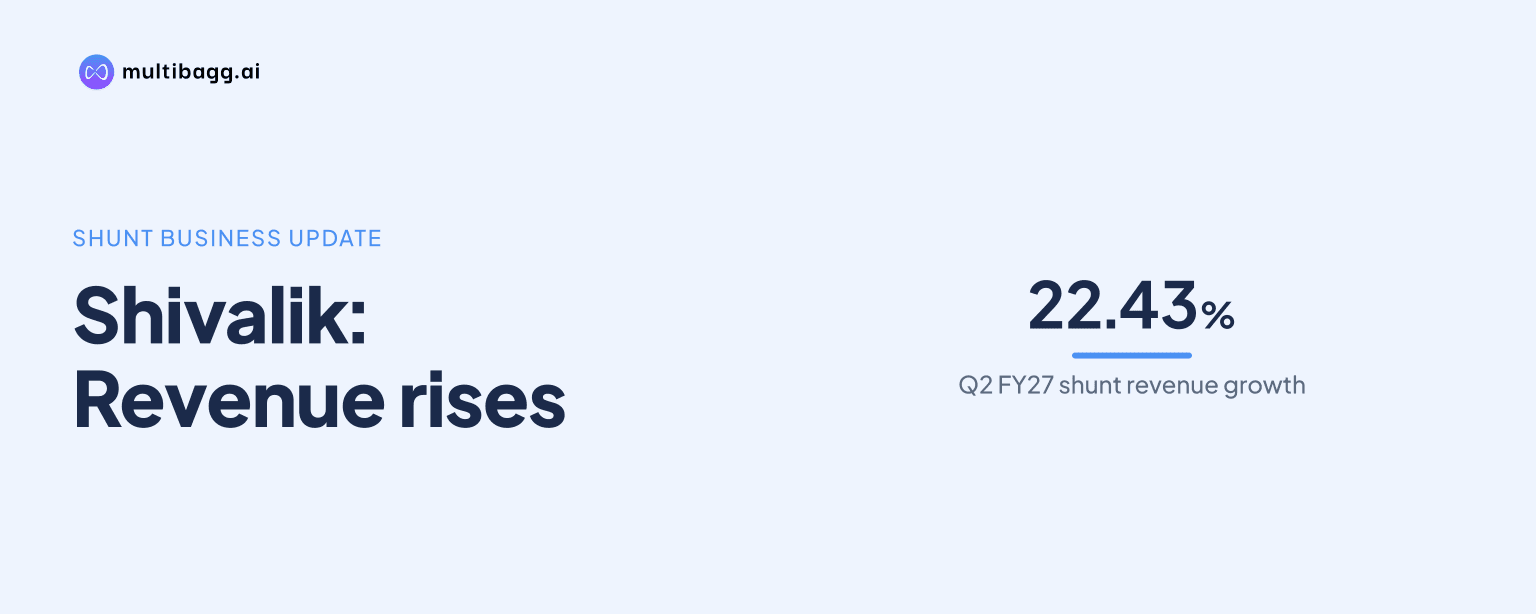
Shivalik’s shunt-resistor revenue rose 22.43% year on year to Rs 72.18 crore in Q2 FY27, as a 46% increase in average realisation outweighed a 16.34% decline in volume to 241,453 kilograms. India, Europe and Rest of Asia added revenue, offsetting a 47.43% decline in the Americas.
Know Shivalik Bimetal Controls inside out
Results, valuation, peers and who's buying, in one view.
Why did Shivalik’s shunt revenue rise despite lower volumes?
Shivalik’s Q2 FY27 shunt revenue rose because average realisation increased 46%, more than compensating for fewer kilograms sold. Shunt volume fell from 288,597 kilograms in Q2 FY26 to 241,453 kilograms in Q2 FY27, while revenue increased from Rs 59 crore to Rs 72 crore in the productwise chart. The accompanying commentary gives the Q2 FY27 revenue figure as Rs 72.18 crore, up 22.43% year on year.
The outcome differed from the volume trend across Shivalik’s two products. Shunts accounted for 38.8% of Q2 FY27 product volume but 49.8% of product revenue. Thermostatic bimetals accounted for 61.2% of volume and 50.2% of revenue, showing that shunts generated almost half of value from less than two-fifths of kilograms shipped.
Total product volume declined 2.15% in Q2 FY27 because the shunt decline exceeded bimetals’ 9.64% gain. Yet bimetal revenue also rose 22.32% to Rs 72.73 crore, almost matching shunt revenue of Rs 72.18 crore. Shivalik disclosed the 46% realisation increase for shunts, but did not quantify a corresponding bimetal realisation change.
Which regions drove Shivalik’s Q2 shunt growth?
Shivalik’s Q2 shunt growth was driven by Rest of Asia, India and Europe, whose gains outweighed the Americas contraction. Rest of Asia revenue rose 94.25% to Rs 27.87 crore, India increased 27.07% to Rs 27.16 crore, and Europe increased 30.26% to Rs 8.37 crore. Americas shunt revenue declined 47.43% to Rs 8.02 crore on softer offtake.
The regional mix changed substantially from Q2 FY26. In the rounded regional presentation, Rest of Asia rose from Rs 14 crore to Rs 28 crore and became the largest shunt market. India increased from Rs 21 crore to Rs 27 crore and Europe rose from Rs 6 crore to Rs 8 crore, while the Americas declined from Rs 15 crore to Rs 8 crore.
India’s combined revenue from both products reached Rs 69.9 crore in Q2 FY27, up 28.0%, and represented about 47% of standalone core-product revenue. The presentation attributes bimetal revenue in India, which rose 28.54% to Rs 42.71 crore, to domestic consumption and industrial demand for switchgear. Export sales still represented 53% of Q2 FY27 sales, compared with 47% for domestic sales.
Got a follow-up? Ask IRIS
Did Shivalik’s first-half shunt trend match the second quarter?
Shivalik’s H1 FY27 shunt revenue also increased while volume remained below the prior-year level. Revenue rose 20.57% to Rs 140.39 crore as volume declined 13.69% to 498,944 kilograms from 578,099 kilograms in H1 FY26. Bimetal revenue increased 14.87% to Rs 136.33 crore, alongside a 7.46% rise in volume to 721,820 kilograms.
Regional H1 data show that the Americas decline was less severe than in Q2, while Europe, India and Rest of Asia continued to expand. Europe shunt revenue increased 50.94% to Rs 19.12 crore, Rest of Asia rose 30.90% to Rs 44.62 crore, and India increased 24.97% to about Rs 53 crore. Americas revenue declined 13.06% to Rs 23.85 crore, which Shivalik attributed to softer export sentiment.
Across both products, total H1 volume declined 2.33%, as bimetals’ 7.46% increase only partly offset lower shunt volume. Shunt revenue of Rs 140.39 crore exceeded bimetal revenue of Rs 136.33 crore by Rs 4.06 crore in H1 FY27. In H1 FY26, the productwise chart showed bimetal revenue of Rs 119 crore and shunt revenue of Rs 116 crore.
How did the product mix coincide with Shivalik’s standalone results?
Shivalik’s standalone revenue from operations increased 22.37% to Rs 144.91 crore in Q2 FY27, broadly in line with the approximately 22% revenue growth reported for each product. Gross profit rose 33.14% to Rs 78.54 crore, and gross margin increased by 438 basis points to 54.20%. Shivalik attributed the margin expansion to a richer product mix and disciplined input-cost management.
Earnings before interest, depreciation, tax and amortisation, or EBITDA, increased 53.46% to Rs 43.26 crore in Q2 FY27. EBITDA margin increased by 605 basis points to 29.85%, while profit after tax rose 37.39% to Rs 28.69 crore and its margin reached 19.80%. Finance cost rose 101.80% to Rs 1.53 crore and depreciation increased 52.73% to Rs 4.35 crore.
For H1 FY27, standalone revenue rose 17.70% to Rs 276.72 crore, EBITDA increased 38.17% to Rs 79.68 crore, and profit after tax rose 31.62% to Rs 55.09 crore. These company-level results do not assign the full margin movement to shunts. However, the reported 46% increase in shunt realisation occurred as shunts reached 49.8% of Q2 product revenue.
What does Shivalik’s product mix and working capital data show?
Shivalik’s Q2 product mix shows shunts approaching parity with bimetals in revenue while remaining the smaller product by volume. Shunts contributed 49.8% of product revenue against bimetals’ 50.2%, but represented 38.8% of volume against 61.2% for bimetals. Management described bimetals as the long-term growth engine and shunts as a fast-growing, meaningful growth driver.
H1 FY27 working-capital measures moved lower alongside revenue growth. Collection days declined to 79 from 84 in H1 FY26, inventory days decreased to 181 from 186, and net working-capital days declined by nine days to 221. Accounts-payable days decreased by one day to 39, from 40 in H1 FY26.
Conclusion
Shivalik generated higher Q2 FY27 shunt revenue from fewer kilograms because the reported 46% increase in average realisation outweighed a 16.34% volume decline. Rest of Asia, India and Europe reshaped the segment’s regional mix as their gains offset a sharp Americas contraction, while shunts reached 49.8% of quarterly product revenue.
The next disclosed issue to watch is whether softer Americas shunt demand persists after Q2 regional revenue declined 47.43% and H1 revenue declined 13.06%. Shivalik’s reported H1 working-capital measures, including net working-capital days of 221, also provide a measure to follow as product revenue and regional demand evolve.