










Shivalik inventory reaches Rs 235 crore as cash falls in H1 FY27
Key highlights
- Shivalik’s consolidated inventory was Rs 235 crore at H1 FY2027, versus Rs 145 crore at H1 FY2026.
- Cash and cash equivalents declined to Rs 59 crore at H1 FY2027 from Rs 101 crore a year earlier.
- Inventory days fell to 181 from 186, while net working-capital days declined to 221 from 230.
- Consolidated revenue from operations increased 38.68% to Rs 379.98 crore in H1 FY2027.
powered by IRIS
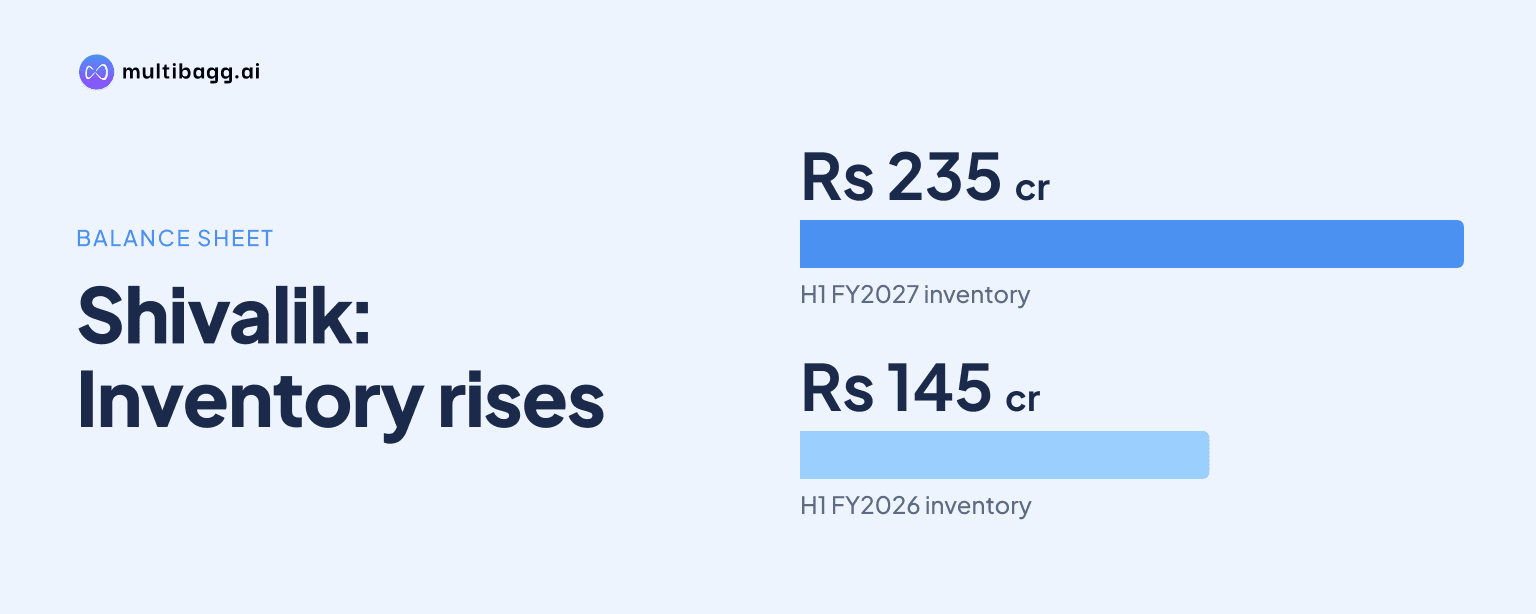
In the first half of financial year 2027 (H1 FY2027), Shivalik reported consolidated inventory of Rs 235 crore, up Rs 90 crore from H1 FY2026, while cash and cash equivalents fell to Rs 59 crore from Rs 101 crore. Inventory days declined five days to 181, and net working-capital days fell to 221.
Know Shivalik Bimetal Controls inside out
Results, valuation, peers and who's buying, in one view.
Why did Shivalik’s inventory reach Rs 235 crore?
Shivalik’s consolidated inventory reached Rs 235 crore at H1 FY2027, compared with Rs 145 crore at H1 FY2026 and Rs 153 crore at FY2026. The H1 year-on-year increase was Rs 90 crore, while the increase from the FY2026 closing balance was Rs 82 crore. The presentation reports the balance-sheet movement but does not provide an inventory split by raw materials, work in progress or finished goods.
Cash and cash equivalents moved in the other direction, declining by Rs 42 crore year on year to Rs 59 crore at H1 FY2027 from Rs 101 crore at H1 FY2026. Cash was also below the Rs 105 crore reported at FY2026. The Rs 90 crore inventory increase was larger than the Rs 42 crore cash decline, but the presentation does not provide a cash-flow statement assigning the cash movement to inventory, capital expenditure or other uses.
The Rs 235 crore inventory balance was the largest individual current-asset movement from H1 FY2026, exceeding the Rs 39 crore increase in trade receivables, which rose to Rs 166 crore from Rs 127 crore. Total current assets increased by Rs 109 crore to Rs 493 crore, while non-current assets increased by Rs 61 crore to Rs 255 crore, including tangible fixed assets of Rs 205 crore.
Did Shivalik’s working-capital days improve in H1 FY2027?
Shivalik reported lower working-capital efficiency days in H1 FY2027 despite the higher closing inventory value: inventory days declined to 181 from 186 in H1 FY2026, and net working-capital days declined to 221 from 230. The five-day inventory improvement and nine-day net-working-capital improvement are ratios for the H1 periods, whereas Rs 235 crore is the closing inventory balance.
Collection days fell to 79 in H1 FY2027 from 84 in H1 FY2026, a five-day reduction. Accounts payable days declined by one day to 39 from 40. The reduction in net working-capital days reflected lower inventory and collection days, partly offset by the one-day decline in payable days.
The lower day counts do not mean that the absolute inventory balance declined. H1 FY2027 consolidated revenue from operations increased 38.68% year on year to Rs 379.98 crore, while cost of goods sold rose 42.12% to Rs 210.91 crore. The presentation does not disclose the calculation methodology for the day ratios, so it does not establish how much of the inventory balance change came from sales growth, product mix or stocking levels.
Got a follow-up? Ask IRIS
How did sales growth compare with the working-capital increase?
Shivalik’s consolidated revenue from operations rose Rs 105.98 crore year on year to Rs 379.98 crore in H1 FY2027, while inventories increased Rs 90 crore over the same H1 comparison. Cost of goods sold increased Rs 62.51 crore to Rs 210.91 crore. These movements show that both operating scale and inventory on the balance sheet were higher than a year earlier.
Product revenue growth was reported in both major segments in H1 FY2027. Shunt revenue rose 20.57% to Rs 140.39 crore, while bimetal revenue increased 14.87% to Rs 136.33 crore. Shunt volume declined 13.69% to 498,944 kilograms, whereas bimetal volume increased 7.46% to 721,820 kilograms; the presentation attributes Shunt revenue growth to a 46% increase in average realisation.
Revenue by geography also changed across the segments. In thermostatic bimetals, India revenue increased 28.83% to Rs 77.89 crore in H1 FY2027, while Americas revenue declined 8.67% to Rs 22.96 crore. In shunt resistors, Rest of Asia revenue rose 30.90% to Rs 44.62 crore and Europe revenue rose 50.94% to Rs 19.12 crore, while Americas revenue fell 13.06% to Rs 23.85 crore.
What changed in Shivalik’s funding and liabilities?
Shivalik’s total borrowings increased to Rs 76 crore at H1 FY2027, comprising Rs 12 crore of long-term borrowings and Rs 64 crore of short-term borrowings. At H1 FY2026, long-term borrowings were Rs 3 crore and short-term borrowings were Rs 45 crore, for total borrowings of Rs 48 crore. Finance cost rose to Rs 3.40 crore in H1 FY2027 from Rs 2.16 crore a year earlier.
Trade payables increased to Rs 81 crore from Rs 40 crore at H1 FY2026, while total current liabilities increased Rs 58 crore to Rs 173 crore. Other current liabilities were Rs 28 crore, down from Rs 30 crore. These balance-sheet movements occurred alongside the inventory increase, but the presentation does not state that the additional borrowings or payables directly funded inventory.
Net worth rose to Rs 536 crore at H1 FY2027 from Rs 444 crore at H1 FY2026, led by other equity of Rs 525 crore versus Rs 433 crore. Total assets increased Rs 170 crore to Rs 748 crore, matching total equity and liabilities of Rs 748 crore. Consolidated profit after tax rose 40.45% to Rs 66.54 crore, and earnings before interest, depreciation, tax and amortisation (EBIDTA) increased 48.46% to Rs 93.57 crore.
Conclusion
Shivalik’s H1 FY2027 balance sheet shows a Rs 235 crore inventory balance alongside Rs 59 crore of cash, while reported inventory days and net working-capital days were lower than in H1 FY2026. Revenue increased to Rs 379.98 crore, and the balance sheet also recorded higher receivables, payables and borrowings, showing that the expansion in current assets occurred with changes across both operating assets and funding lines.
The key unresolved matter is the composition and purpose of the Rs 235 crore inventory balance, because the presentation does not disclose product-level inventory, inventory ageing or a cash-flow reconciliation. Subsequent disclosures should show whether inventory, receivables and cash move closer to the H1 FY2027 working-capital ratios of 181 inventory days, 79 collection days and 221 net working-capital days.