










Shivalik H1 FY27 EBITDA rises 49% as operating margin expands
Key highlights
- Shivalik reported H1 FY27 consolidated revenue of Rs 380.0 crore, up 38.7% year on year.
- H1 FY27 EBITDA increased 48.5% to Rs 93.6 crore and EBITDA margin rose 162 bps to 24.6%.
- H1 FY27 PAT grew 40.4% to Rs 66.5 crore, with PAT margin rising 22 bps to 17.5%.
- Q2 FY27 revenue increased 43.9% to Rs 197.8 crore and EBITDA rose 61.6% to Rs 50.2 crore.
powered by IRIS
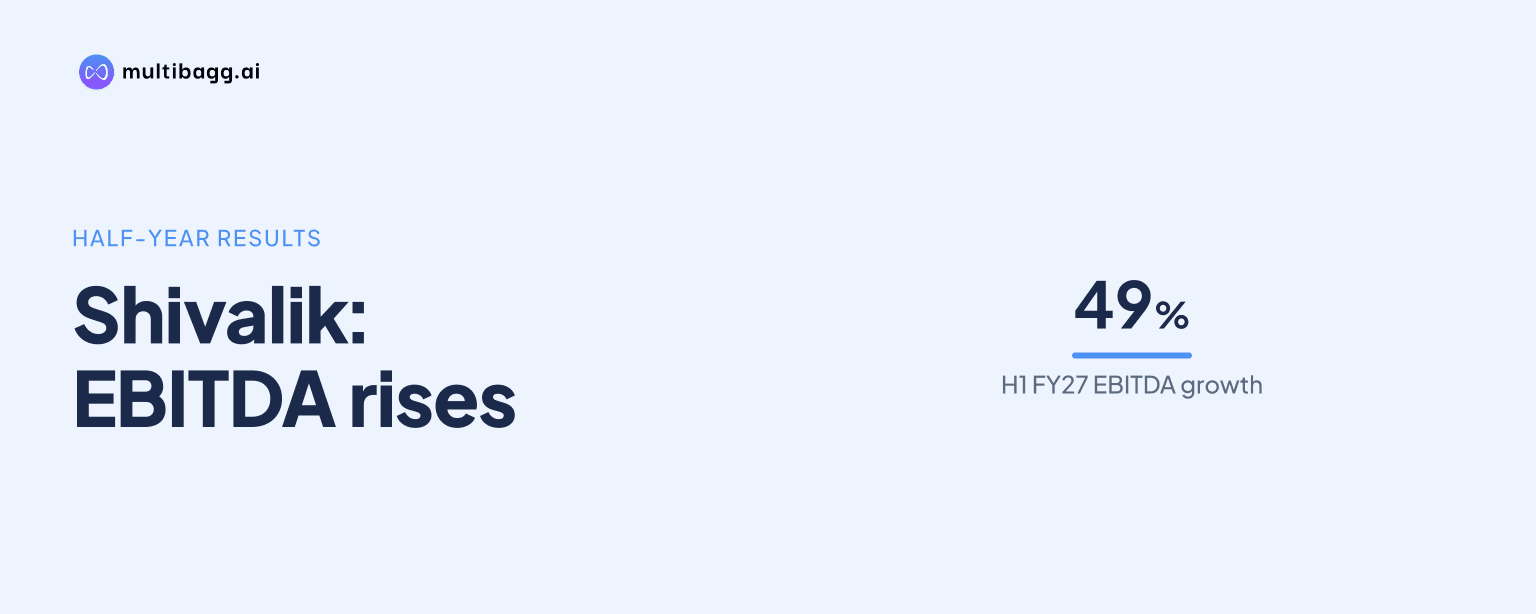
Shivalik Bimetal Controls Limited reported consolidated H1 FY27 revenue of Rs 380.0 crore, up 38.7% year on year, and earnings before interest, tax, depreciation and amortisation (EBITDA) of Rs 93.6 crore, up 48.5%, lifting its EBITDA margin by 162 basis points to 24.6% for the half year ended 30 September 2026.
Know Shivalik Bimetal Controls inside out
Results, valuation, peers and who's buying, in one view.
How did Shivalik perform in H1 FY27?
Shivalik increased revenue from operations by Rs 106.0 crore to Rs 380.0 crore in H1 FY27 from Rs 274.0 crore in H1 FY26. EBITDA rose by Rs 30.6 crore to Rs 93.6 crore from Rs 63.0 crore, while profit after tax (PAT) increased 40.4% to Rs 66.5 crore from Rs 47.4 crore in the consolidated results announced on 4 November 2026.
The half-year figures show EBITDA growing faster than revenue, while gross profit grew more slowly than both. Gross profit increased 34.6% to Rs 169.1 crore from Rs 125.6 crore, and profit before tax (PBT) rose 43.0% to Rs 89.5 crore from Rs 62.6 crore.
Shivalik's reported growth sequence was 38.7% for revenue, 48.5% for EBITDA, 43.0% for PBT and 40.4% for PAT during H1 FY27. This means operating profit increased more quickly than sales over the six-month period, although the release does not give a detailed reconciliation of operating costs.
Did Shivalik improve margins despite lower gross margin?
Shivalik improved EBITDA and PAT margins in H1 FY27 despite a lower gross margin. Gross margin declined 134 basis points, or bps, to 44.5% from 45.8%, while EBITDA margin rose 162 bps to 24.6% from 23.0% and PAT margin increased 22 bps to 17.5% from 17.3%.
The absolute profit figures show gross profit increasing by Rs 43.5 crore and EBITDA by Rs 30.6 crore in H1 FY27. Shivalik reported the margin movements but did not disclose a numerical bridge between gross profit and EBITDA, so the announcement does not specify the cost or expense factors behind the EBITDA-margin increase.
The quarterly pattern differed at the net-profit level. In Q2 FY27, gross margin fell 157 bps to 45.5% from 47.1%, and EBITDA margin rose 277 bps to 25.4% from 22.6%; however, PAT margin declined 95 bps to 17.0% from 17.9%.
How did Shivalik's Q2 FY27 compare with Q2 FY26?
Shivalik reported Q2 FY27 revenue from operations of Rs 197.8 crore, up 43.9% from Rs 137.4 crore in Q2 FY26. Q2 EBITDA increased 61.6% to Rs 50.2 crore from Rs 31.1 crore, while PAT rose 36.3% to Rs 33.5 crore from Rs 24.6 crore for the quarter ended 30 September 2026.
Q2 growth exceeded the H1 rate for both revenue and EBITDA. Revenue growth was 43.9% in Q2 against 38.7% in H1, while EBITDA growth was 61.6% against 48.5%; PAT growth of 36.3% in Q2 was below the 40.4% H1 increase.
Shivalik's Q2 FY27 contribution to H1 FY27 was Rs 197.8 crore of revenue and Rs 50.2 crore of EBITDA, compared with half-year totals of Rs 380.0 crore and Rs 93.6 crore respectively. The difference implies first-quarter revenue of Rs 182.2 crore and EBITDA of Rs 43.4 crore, calculated from the disclosed consolidated H1 and Q2 figures rather than separately reported Q1 results.
Got a follow-up? Ask IRIS
What products and markets does Shivalik serve?
Shivalik manufactures thermostatic bimetal and trimetal strips, low-ohmic shunt resistors and electrical contacts. It is also developing integrated components and assemblies, including printed circuit board assembly (PCBA) and busbar assemblies, for electrical, electronics, automotive, industrial, switchgear, smart-metering, battery-management and energy-management applications.
Its disclosed process capabilities include Electron Beam Welding, Diffusion Bonding, Cold Bonding and precision strip processing. Management said its strategy is to use proprietary materials and process expertise to provide more integrated components and assemblies within customer development and production programmes.
Shivalik has facilities in Chambhaghat and Kather, Solan, and Pune, with approximately 1,000 employees and more than 300 customers globally. Founded in 1984 and headquartered in New Delhi, Shivalik described its materials and components operations as the technical foundation for its move into integrated assemblies.
What is Shivalik focusing on for the rest of FY27?
Shivalik management said execution in the rest of FY27 will centre on sustaining core profitability, improving cash conversion after an inventory build and deploying capital towards programmes with credible customer adoption and good returns. The 4 November 2026 announcement did not quantify the inventory build, provide a cash-conversion target or disclose a capital-expenditure amount.
Managing Director Kabir Ghumman said Shivalik is developing customer relationships across current sensing, thermal control and switching applications. He said India provides a growing domestic base alongside established international relationships, with the company managing differing demand cycles across regions.
Management also cited a 100% interim dividend and a proposed 2:1 bonus issue in its commentary. The release did not state the dividend per share, a record date, a timetable for the proposed bonus issue, or FY27 guidance for revenue, EBITDA or PAT.
Conclusion
Shivalik's H1 FY27 results combined 38.7% revenue growth to Rs 380.0 crore with a 48.5% rise in EBITDA to Rs 93.6 crore. The EBITDA-margin increase to 24.6% occurred even as gross margin fell to 44.5%, while PAT grew 40.4% to Rs 66.5 crore.
The next disclosures should indicate whether Shivalik improves cash conversion following the inventory build and advances its integrated PCBA and busbar assembly programmes. Investors will also watch for implementation details of the proposed 2:1 bonus issue and management's subsequent updates on capital deployment and customer adoption.