










Shivalik sees contacts capacity use reach 55% this year
Key highlights
- Shivalik expects electrical-contacts utilisation of about 55% by the end of the year discussed on its Q2 and H1FY27 call.
- Shivalik said its new electrical-contacts facility was fully functional by late June or early July.
- Shivalik put electrical-contacts revenue potential at about Rs 400 crore at the silver value cited on the call.
- A contacts product type representing nearly 50% of revenue was operating at 50% to 60% capacity.
powered by IRIS
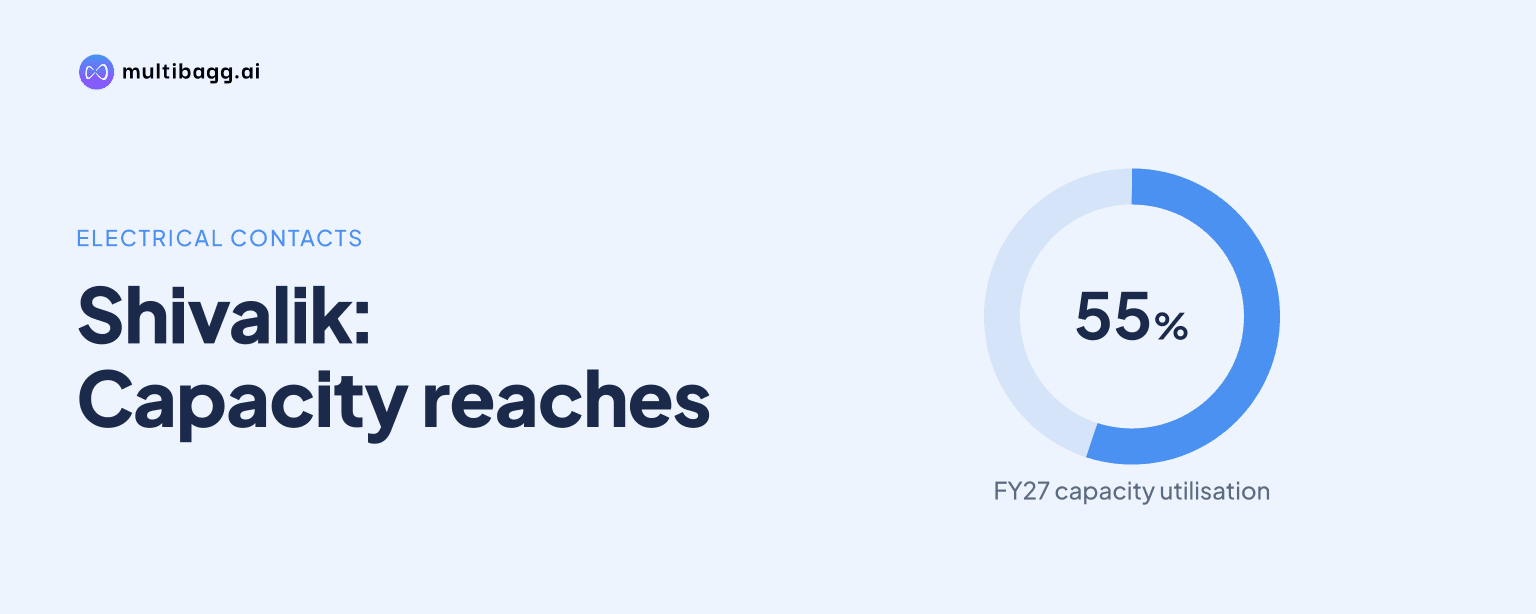
Shivalik Bimetal Controls Limited expects its electrical-contacts business to reach about 55% capacity utilisation by the end of the year discussed in its Q2 and H1FY27 call, after its new facility became fully functional by late June or early July. Management said installed capacity equates to about Rs 400 crore of revenue potential at the prevailing silver value.
Know Shivalik Bimetal Controls inside out
Results, valuation, peers and who's buying, in one view.
What capacity utilisation does Shivalik expect this year?
Shivalik expects electrical-contacts capacity utilisation to be about 55% by the end of the year. Management described a blended current position of roughly 50% to 60%, after the added facility began contributing to revenue following its full commissioning around late June or early July.
The 55% estimate does not mean each electrical-contacts process will run at the same rate. Shivalik said the business comprises four or five product types, with a core process and eight or nine preparatory, downstream or finishing processes. It principally measures capacity at the core process because that equipment is more difficult and costly to add at short notice.
The company began shifting to the new facility about two quarters before the Q2 and H1FY27 call. Management said the added capacity is now showing up in operating numbers because existing customers wanted to increase their wallet share, or the portion of their purchases sourced from Shivalik.
How much electrical-contacts capacity is still available?
Shivalik said substantial electrical-contacts capacity remains available without major additional capital expenditure in its core processes. For one product type that contributes nearly 50% of electrical-contacts revenue, capacity utilisation is 50% to 60% after including the added revenue from the new facility.
Management said the revenue attached to that product category could potentially double without additional capital expenditure. That statement applies to the identified category, representing nearly half of contacts revenue, rather than to the full electrical-contacts portfolio of four or five product types.
A separate process in the contacts business is operating at around 30% capacity, according to management. The difference between the 30% process and the product category at 50% to 60% explains why Shivalik uses a blended utilisation estimate instead of stating a single uniform plant-wide rate.
How did the new facility change Shivalik’s revenue capacity?
Shivalik said the new electrical-contacts facility was originally designed for revenue potential of about Rs 300 crore to Rs 350 crore, calculated when silver was at roughly half its then-current value. At the silver value cited on the call, management said the same facility translates to about Rs 400 crore of revenue potential.
This increase from Rs 300 crore to Rs 350 crore to about Rs 400 crore reflects the metal-linked revenue value assigned to the installed capacity, rather than a doubling of physical output capability. Management said some contacts pricing remains linked to silver, so reported revenue can change with the metal price even when manufacturing capacity is unchanged.
The plant’s operational start is also supporting customer development. Management said the facility was fully functional by June-end or early July, and that customers seeking greater wallet share have begun to use the added capacity. Shivalik therefore expects the growth trajectory to continue until it reaches a certain level with existing customers or new product developments.
Got a follow-up? Ask IRIS
How are volumes and silver prices affecting Shivalik contacts?
Shivalik said silver-price movements have a limited effect on electrical-contacts margins because it has deliberately moved away from products with high silver consumption. Management said its core competence is joining complicated materials and making complex components with difficult tooling, rather than manufacturing or trading silver.
Revenue can nevertheless move with silver because part of pricing is connected to the metal. Management said silver was still about double its level in the corresponding quarter a year earlier, while the contacts business had grown by more than 100%. It attributed about 40% to 50% of that growth to material values, with the balance coming from customer development and product growth.
Management said a sharp rise in silver can have a slight margin effect, citing an example from the prior year when silver moved from Rs 1.5 lakh to Rs 3.5 lakh in one quarter. It also said a decline would have limited effects unless silver fell to 25% of its value, because most profitability comes from the manufacturing process rather than the metal component.
Where will Shivalik spend on capacity next?
Shivalik plans to direct further capital expenditure towards downstream parts-level and assembly-level processes, automation, calibration and testing. Management said the principal metal-diffusion or metal-merging processes across its core product categories have sufficient capacity, while downstream additions can be made on a relatively quick cycle as demand or orders require.
The company is also spending on end-of-line calibration and testing as it moves further into integrated assemblies. Management said the complexity and importance of these systems rises with more integrated products. It additionally identified planned expansion and capital expenditure in printed circuit board, or PCB, and PCB-assembly operations.
In a wider capacity discussion, management said an earlier Rs 1,300 crore capacity figure would probably increase after enhancements already made in faster-growing areas. It cautioned that capacity and revenue do not move in a simple one-for-one relationship: a higher volume of one component may require more downstream processing while the capital-intensive core process still has spare capacity.
Why does downstream capacity matter more than core-process capacity?
Shivalik said downstream capacity matters because product mix can create bottlenecks in finishing, assembly or testing before the core metal-joining equipment is fully used. Its planned additions are therefore aimed at processes that can be expanded at lower cost and in shorter cycles, rather than immediately adding heavy-capital core equipment.
Management said it has enough room in the capital-intensive processes to avoid over-utilisation while it makes selective additions in faster-growing areas. For the electrical-contacts business, the range from about 30% in one process to 50% to 60% in a product category shows why the Rs 400 crore revenue-capacity estimate should be read alongside individual process constraints.
Conclusion
Shivalik’s stated target of about 55% electrical-contacts utilisation this year indicates that the facility fully functional by early July is beginning to support customer wallet-share gains while leaving capacity in the principal processes. The comparison between the original Rs 300 crore to Rs 350 crore revenue potential and about Rs 400 crore at the cited silver value also shows how metal prices affect reported capacity value without changing installed equipment.
The next items to watch are whether existing customers continue to increase wallet share, how quickly individual product processes move beyond the stated 30% to 60% range, and the pace of downstream additions in assembly, calibration and testing. Management’s disclosed plan is to retain room in capital-intensive core processes while making quicker downstream investments as orders, demand and integrated-assembly requirements develop.