










Shivalik sees Rs 100-200 crore FY28 assembly opportunity
Key highlights
- Shivalik sees a Rs 100 crore to Rs 200 crore assembly-business opportunity in FY28, subject to customer-programme conversion.
- Management expects assembly EBITDA margin of 15% to 16%, versus about 26% to 27% in shunts.
- A higher assembly mix could reduce Shivalik's EBITDA margin by 1.5 to 2.5 percentage points while revenue and absolute profit rise.
- Shivalik has one CCS programme in mass production and two or three more in advanced stages.
powered by IRIS
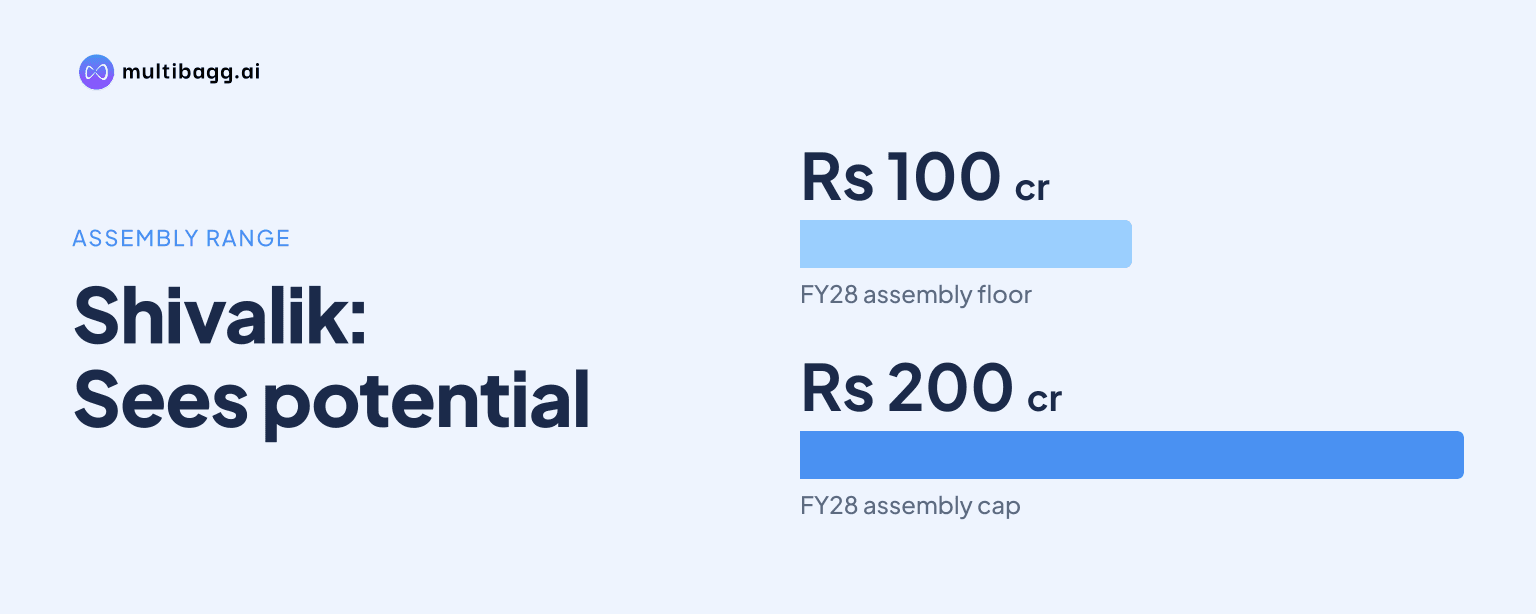
Shivalik Bimetal Controls Limited sees a Rs 100 crore to Rs 200 crore assembly-business opportunity in FY28 if customer programmes convert, while management expects the lower-margin revenue mix could reduce EBITDA margin by 1.5 to 2.5 percentage points despite higher revenue and absolute profit.
Know Shivalik Bimetal Controls inside out
Results, valuation, peers and who's buying, in one view.
What is Shivalik's FY28 assembly-business opportunity?
Shivalik said opportunities available from its assembly business could translate into Rs 100 crore to Rs 200 crore in FY27-28, but management did not describe that range as secured revenue. Whole-Time Director Sumer Ghumman said the outcome depends on which developments materialise into business and on several execution factors.
The opportunity includes printed circuit board assembly, or PCBA, work that combines Shivalik's cladded and electron-beam-welded components into customer-required assemblies. Management said PCBA is not intended to become a separate core product category. Instead, it is an extension of the shunt-resistor business where components need to be supplied in assembled form.
Management also said that even Rs 200 crore to Rs 250 crore of PCBA business by the end of FY27-28 could represent only about 15% to 18% of total revenue. That assessment rests on growth continuing in shunts, bimetal and other existing product lines alongside the assembly ramp-up.
Why could Shivalik's EBITDA margin decline as revenue grows?
Shivalik expects the mix effect because the assembly business may deliver earnings before interest, tax, depreciation and amortisation, or EBITDA, margin of 15% to 16%, compared with about 26% to 27% in shunts. Management also described electrical contacts as a 15% to 16% EBITDA-margin business, meaning higher sales from these categories could lower the blended percentage.
If the higher end of the Rs 200 crore assembly opportunity materialises and the company maintains around 30% to 35% growth, management said total profit could rise even as EBITDA margin falls by about 1.5 to 2.5 percentage points. It attributed the possible decline to product mix, rather than an expected reduction in profitability within established standalone verticals.
Over a roughly three-year horizon, management outlined a possible revenue mix split between businesses earning 26% to 27% EBITDA margins and those earning 15% to 16%. On that illustrative basis, it indicated a blended margin around 20% to 22%, though it said the result would depend on the eventual size and composition of each business.
Can Shivalik's existing products partly offset the mix impact?
Shivalik said it sees no reason for margins in legacy product verticals to decline and expects greater volumes to improve them. Management therefore expects shunts and other established products to partly compensate for lower-margin assembly and electrical-contact revenue as the product portfolio expands.
In shunts, management said kilograms shipped can be misleading because the company is moving from supplying wider and thicker strip material to producing finished resistors. Finished resistors involve more processes and value addition, so less material by weight can generate more revenue and profitability than earlier strip shipments.
Management estimated that, if commodity values were held unchanged between comparable periods, component-shipment growth would still be about 25% to 26%. It said most commodity costs, including copper and silver, are passed through to customers, limiting the effect on the bottom line even though material-price movements can affect reported revenue.
Managing Director Kabir Ghumman said finished automotive components can have a more embedded supply-chain position than input strip. Replacing a board-level component during a vehicle programme requires validation cycles, while switching input material is easier, which management said can support component supply for the life of an approved programme.
Got a follow-up? Ask IRIS
What needs to happen for Shivalik to capture the opportunity?
Shivalik must convert customer qualifications into production programmes and expand downstream assembly capabilities. The company has one CCS programme in mass production, while two or three other programmes are at advanced stages, with initial prototyping completed and some products undergoing testing.
Management said validation can take time because CCS and related battery supply chains are still developing in India, where some materials and complete packs were previously imported from China. It sees a growing domestic opportunity as battery packs, battery-management systems and related assemblies are increasingly made or assembled locally.
The near-term activity is faster in electric two-wheelers than in four-wheelers, according to management. It cited recent industry registrations indicating roughly 30% to 40% of two-wheelers sold were electric, while saying four-wheeler adoption was not at a comparable level; discussions with four-wheeler original equipment manufacturers, or OEMs, are continuing.
Shivalik plans spending on downstream processing, part-level and assembly-level capacity, automation, end-of-line calibration, testing systems and PCBA-related expansion. Management said core metal-diffusion processes have sufficient capacity, while downstream additions can be made more quickly based on demand and orders.
How is Shivalik preparing its organisation for expansion?
Shivalik said a new chief financial officer was expected to join by the end of December, following the finalisation of the appointment. Management is also seeking a chief operating officer-type executive so that strategic work on new product verticals can receive more attention from senior management.
The company is additionally looking for senior research and development and electronics-focused marketing and sales talent. Management linked those hires to Shivalik's shift from specialised metalwork toward metal components for electronics, including assembly opportunities that require development, testing and customer qualification.
Conclusion
Shivalik's Rs 100 crore to Rs 200 crore FY28 assembly opportunity represents a potential scale addition rather than committed revenue. Management is prepared for EBITDA margin to decline by 1.5 to 2.5 percentage points if lower-margin assembly and contact businesses grow, because those businesses can increase revenue and absolute profit while extending its component offering.
The next milestones are conversion of the two or three CCS programmes in advanced stages, the ramp-up of PCBA and downstream capacity, and the growth rate of legacy shunts and other products. Management's plan to add a chief financial officer by the end of December and recruit operations, research and electronics-sales leadership will also indicate how it is organising for the expansion.