










Shri Kanha working-capital cycle widens 15 days in H1FY27
Key highlights
- Shri Kanha’s net working-capital cycle increased to 140 days at 30 September 2026 from 125 days at 31 March 2026.
- Shri Kanha reported net debt of Rs 64.03 crore at 30 September 2026, up from Rs 50.52 crore at 31 March 2026.
- Inventories used Rs 22.2322 crore of cash and trade receivables used Rs 12.4299 crore in H1FY27.
- Shri Kanha reported H1FY27 profit after tax of Rs 5.6193 crore, up 32.0% year on year.
powered by IRIS
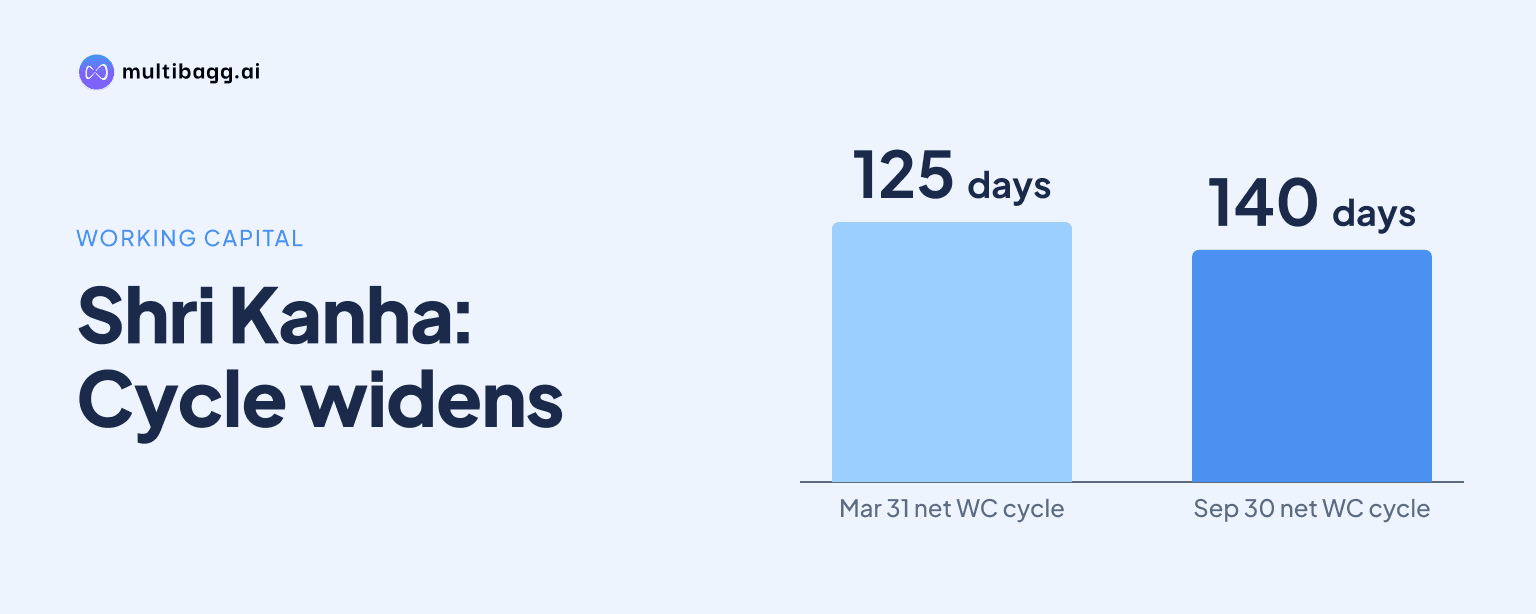
Shri Kanha Stainless Limited’s net working-capital cycle widened by 15 days to 140 days at 30 September 2026, while net debt rose to Rs 64.03 crore from Rs 50.52 crore at 31 March 2026 as inventories, receivables and loans and advances used cash despite higher profit.
Know Shri Kanha Stainless inside out
Results, valuation, peers and who's buying, in one view.
Why did Shri Kanha’s working-capital cycle widen?
Shri Kanha’s net working-capital cycle widened to 140 days at 30 September 2026 from 125 days at 31 March 2026. The company measures the cycle on revenue, adding inventory and receivable days and deducting payable days. Inventory days rose to 125 from 86, while receivable days increased to 111 from 89. Payable days rose to 96 from 49, but did not fully offset the other increases.
The balance sheet shows inventory increasing to Rs 70.4522 crore at 30 September 2026 from Rs 48.2201 crore at 31 March 2026. Trade receivables increased to Rs 62.5873 crore from Rs 50.1574 crore over the same period. Trade payables also rose, to Rs 54.2772 crore from Rs 27.8737 crore, providing supplier funding but not preventing the 15-day extension in the net cycle.
Short-term loans and advances reached Rs 26.2949 crore at 30 September 2026, compared with Rs 20.2564 crore at 31 March 2026. This additional Rs 6.0385 crore cash outflow is also recorded in H1FY27 operating cash-flow movements, alongside increases in inventories and receivables.
What used Shri Kanha’s operating cash in H1FY27?
Shri Kanha reported net cash from operating activities of negative Rs 3.9531 crore in H1FY27 despite profit before tax of Rs 6.5907 crore. Operating profit before working-capital changes was Rs 9.4752 crore, after including Rs 0.875 crore of depreciation, Rs 2.2818 crore of finance cost and negative Rs 0.2722 crore of interest income and other adjustments.
Inventories used Rs 22.2322 crore of cash in H1FY27, trade receivables used Rs 12.4299 crore and loans and advances used Rs 6.0385 crore. These movements were partly offset by a Rs 26.4034 crore increase in trade payables and Rs 1.5823 crore from other working-capital items. The presentation reports cash generated from operations of negative Rs 12.7148 crore and direct taxes paid of Rs 0.7136 crore before reporting net operating cash flow of negative Rs 3.9531 crore.
Investing activities used Rs 7.9713 crore in H1FY27, including Rs 3.5114 crore of capital expenditure, net of disposals, and Rs 4.6736 crore of loans and advances given. Capital work-in-progress stood at Rs 3.6289 crore at 30 September 2026, whereas no amount was displayed for 31 March 2026. Cash and cash equivalents fell to Rs 42.16 lakh from Rs 3.6738 crore at the preceding financial year-end.
Got a follow-up? Ask IRIS
How did Shri Kanha finance the cash requirement?
Shri Kanha’s total debt was Rs 66.60 crore at 30 September 2026, and its debt-to-equity ratio was 0.99 times, compared with 0.91 times at 31 March 2026. Net debt increased by Rs 13.51 crore to Rs 64.03 crore during the six-month period, according to the company’s leverage summary, which attributes the increase to cash being drawn down for working capital.
Short-term borrowings were Rs 57.526 crore at 30 September 2026, compared with Rs 53.2574 crore at 31 March 2026. Long-term borrowings were Rs 9.0764 crore, up from Rs 2.3912 crore. Shri Kanha states that 86% of debt was short term, meaning near-term borrowings accounted for most of the Rs 66.60 crore debt total.
Financing activities generated net cash of Rs 8.6721 crore in H1FY27. The cash-flow statement records Rs 6.9056 crore of net long-term borrowings and Rs 4.0483 crore of net short-term borrowings, offset by Rs 2.2818 crore of interest paid. In FY26, net financing cash was Rs 40.7756 crore, including Rs 40.4875 crore of net initial public offering proceeds that were not recorded in H1FY27.
Did Shri Kanha’s earnings improve while working capital expanded?
Shri Kanha’s profit after tax increased 32.0% year on year to Rs 5.6193 crore in H1FY27 from Rs 4.2561 crore in H1FY26, even as operating cash flow was negative. Revenue from operations declined 6.8% to Rs 102.7097 crore from Rs 110.2253 crore, while earnings before interest, tax, depreciation and amortisation, or EBITDA, increased 2.4% to Rs 9.4679 crore.
EBITDA margin rose by 83 basis points to 9.22% in H1FY27 from 8.39% in H1FY26, while profit-after-tax margin rose by 161 basis points to 5.47% from 3.86%. The presentation states that EBITDA excludes other income. Finance cost declined 7.6% to Rs 2.2818 crore from Rs 2.4697 crore, although total debt rose between 31 March 2026 and 30 September 2026.
Shri Kanha reported interest cover of 4.1 times in H1FY27, compared with 3.7 times in H1FY26. It defines interest cover as EBITDA divided by finance cost. Annualised return on equity was 17.5%, calculated by multiplying H1 profit after tax by two and dividing it by average net worth; net worth increased to Rs 67.0059 crore from Rs 61.3866 crore.
What expansion spending is relevant to Shri Kanha’s cash use?
Shri Kanha reported H1FY27 capital expenditure of Rs 3.6366 crore and capital work-in-progress of Rs 3.6289 crore at 30 September 2026. The company’s expansion plan is to increase capacity to 2.5 times its current 14,000 metric tonnes per annum, or MTPA, capacity.
The planned equipment includes a new 1,150 millimetre four-high automatic gauge control mill. Management identifies shaving-blade strip as its primary target and states a 90% utilisation target for the new mill. The presentation does not disclose a commissioning date or a timetable for attaining that utilisation level.
Conclusion
Shri Kanha’s higher inventory, receivables and loans and advances extended the working-capital cycle to 140 days and produced negative operating cash flow in H1FY27, despite a 32.0% increase in profit after tax. Higher payables funded part of the increase, but debt also rose, taking net debt to Rs 64.03 crore and leaving 86% of total debt in short-term borrowings.
The next disclosed item to watch is execution of the capacity expansion from 14,000 MTPA to 2.5 times that level. Management reported Rs 3.6289 crore of capital work-in-progress and a 90% utilisation target for the new mill, while the presentation leaves its commissioning and utilisation timeline unresolved.