










Shyam Metalics Targets 15-16% EBITDA Margin Through Mix
Key highlights
- Shyam Metalics targets a 15% to 16% EBITDA margin versus the 11% to 12% range management cited for several quarters.
- Management cited EBITDA of about Rs 13,000 to Rs 15,000 per tonne in stainless steel, Rs 6,000 to Rs 7,000 in carbon steel and Rs 40,000 in aluminium.
- Projects expected over the next two years include 1.6 million tonnes of HR, 0.8 million tonnes of auto steel and 0.6 million tonnes of stainless steel.
- The Maharashtra proposal contemplates a 9-million-tonne crude-steel plan over 8 to 10 years, with the first 4.5-million- to 5-million-tonne phase after 2029 or 2030.
powered by IRIS
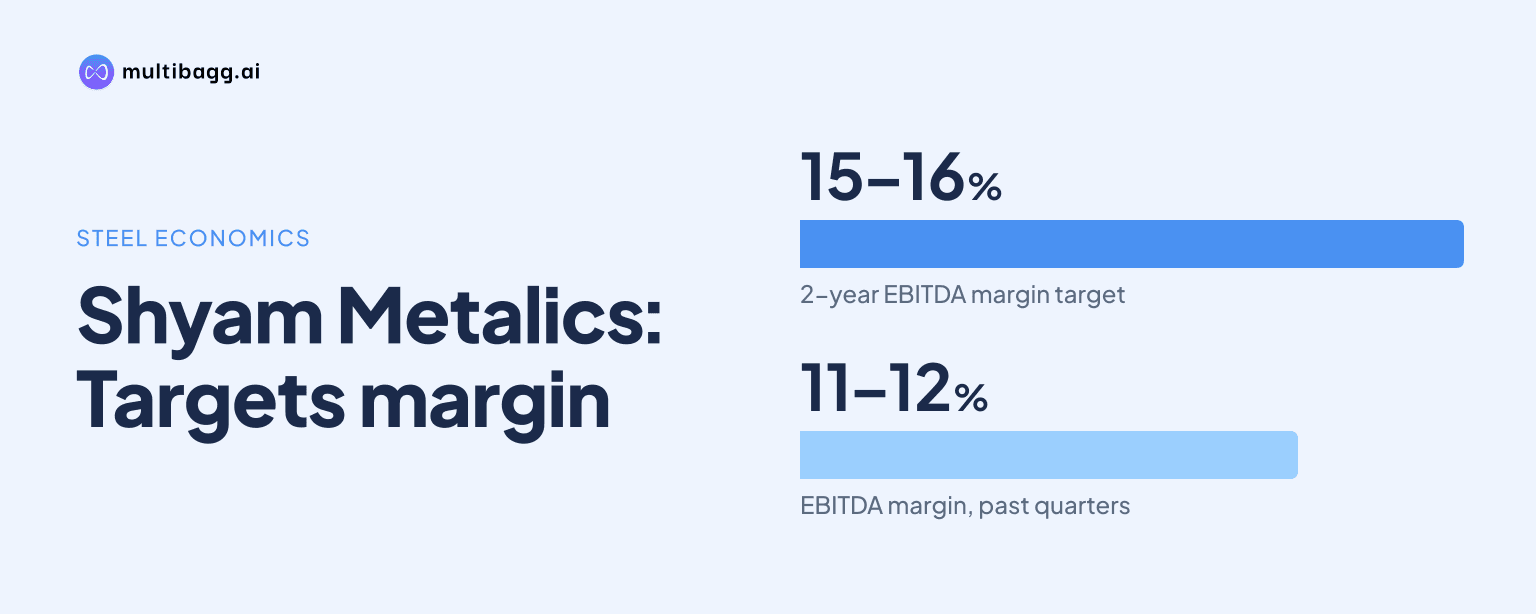
Shyam Metalics and Energy Limited is targeting a 15% to 16% group EBITDA margin, compared with the 11% to 12% range management said it had maintained for several quarters, by adding higher-value stainless steel, aluminium and downstream carbon-steel capacity. Management said more than 3 million tonnes of projects are expected over the next two years.
Know Shyam Metalics & Energy inside out
Results, valuation, peers and who's buying, in one view.
How does Shyam Metalics plan to raise EBITDA margins?
Shyam Metalics plans to lift its EBITDA margin through a broader product mix rather than by concentrating capital in one business. Management described 14.5% plus as its goal, with a stated ambition of 15% to 16%, against a group range of about 11%, 11.5% and 12% maintained for several quarters. The strategy combines stainless steel, aluminium foil, hot-rolled, or HR, coil and downstream products including auto steel.
Management gave distinct EBITDA-per-tonne benchmarks for the portfolio: stainless steel at about Rs 13,000 to Rs 15,000 per tonne, carbon steel at around Rs 6,000 to Rs 7,000 per tonne, and aluminium at around Rs 40,000 per tonne. Aluminium's benchmark is the highest of the three, but management said its volume and contribution to the bottom line are smaller than the other operations. The planned mix therefore relies on both per-tonne profitability and scale.
Management presented the 15% to 16% level as a goal and did not provide a timetable for reaching it. It said each business must meet a decent margin and internal rate of return, or IRR, but rejected putting all investment into one segment. That approach reflects the differing economics of aluminium and the larger carbon-steel volume base.
Which projects could change Shyam Metalics' product mix?
Shyam Metalics said projects under execution could add more than 3 million tonnes over the next two years. The additions include 1.6 million tonnes of HR coil, about 0.8 million tonnes of auto steel and 0.6 million tonnes of stainless steel. Management said these projects are on the ground rather than at the memorandum-of-understanding, or MOU, stage.
The 1.6-million-tonne HR addition is intended to create a platform for downstream lines. Management said colour-coated, corrugated and finishing lines for white goods would follow HR production, while auto steel is another planned growth area. This would extend carbon steel from a standalone product to an integrated chain from ore to coated products.
Stainless steel is already moving toward downstream output, according to management. It cited specialty wires and pipes as products supporting value extraction, while saying the plant is stabilising through modifications, product changes and continuous improvement. In aluminium foil, management attributed demand to Middle East disruptions, plant shutdowns there, Indian demand growth and exports rather than to one factor.
Management said all the businesses being added have EBITDA of more than Rs 10,000 per tonne. This is separate from its stated average carbon-steel benchmark of Rs 6,000 to Rs 7,000 per tonne. The call did not provide individual project-level margin estimates or commissioning dates within the two-year period.
Got a follow-up? Ask IRIS
Why is Shyam Metalics still investing in carbon steel?
Shyam Metalics said carbon-steel expansion remains part of its plan because HR coil supports value-added processing and the company does not intend to become only a stainless-steel producer. Management said there is a current shortage of HR and expects demand to rise as India grows, while arguing that a coated-steel producer needs its own HR supply over the long term.
The Jamuria HR plant is expected to be commissioned by 2028, management said. It described the coated-steel model as end-to-end, from ore to colours, and cited backward integration, its brand and exports in responding to an analyst's question about new coated-line capacity in West Bengal. Management did not quantify coated-steel margins or forecast their direction.
Mittal Corp, acquired by Shyam Metalics, illustrates the downstream emphasis in long products. Management said capacity utilisation is close to 85%, and the business has started wire and bright-bar production as well as wire exports. It estimated return on capital employed, or RoCE, at more than 20% to 25% on the investment's net block and said it was not planning major long-product expansion there, preferring downstream investment.
Management corrected the EBITDA-per-tonne figure for Mittal Corp from an initial Rs 8,000 estimate to Rs 10,000 per tonne. The revised figure is above the Rs 6,000 to Rs 7,000 average cited for carbon steel and below the Rs 13,000 to Rs 15,000 stated for stainless steel. These were management estimates on the call, not separately reported segment results.
How will Shyam Metalics fund its higher-value expansion?
Shyam Metalics said it intends to fund growth step by step from internal equity and financial flows, without adding debt unless management considers it necessary. Management said a funding shortfall of Rs 400 crore, Rs 500 crore or Rs 1,000 crore would not materially concern it because it believes it has balance-sheet cushion, but it supplied no reported net-debt figure on this call.
The Maharashtra proposal is not an immediate call on capital, according to management. The company has signed an MOU for a 9-million-tonne crude-steel business plan over 8 to 10 years, but said land allocation could take one to 1.5 years and engineering about six months. Management therefore sees no execution decision maturing for roughly 1.5 to two years.
Management said the first Maharashtra phase would be 4.5 million to 5 million tonnes, not the entire 9 million tonnes. It expects the project only after 2029 or 2030, after major current capital expenditure is capitalised and existing businesses generate value. The plan remains conditional on land processes and the start of mining in Maharashtra, separate from the more than 3-million-tonne additions cited for the next two years.
Conclusion
Shyam Metalics is seeking to move group EBITDA margin from the 11% to 12% range cited for several quarters toward 15% to 16% by balancing HR and carbon-steel scale with higher-value stainless products, aluminium foil and downstream processing. Management's disclosed benchmarks show the intended mix: about Rs 40,000 per tonne in aluminium, Rs 13,000 to Rs 15,000 in stainless steel and Rs 6,000 to Rs 7,000 in average carbon steel.
The next disclosed milestones are delivery of the 1.6-million-tonne HR, 0.8-million-tonne auto-steel and 0.6-million-tonne stainless-steel additions expected over the next two years. Management has also scheduled the Jamuria HR plant for 2028 commissioning, while Maharashtra depends on land allocation, mining progress and planning for expansion after 2029 or 2030.