










Sigachi says 100 kL API unit could generate Rs 150 crore
Key highlights
- Sigachi said its existing 100 kL API unit could generate Rs 100 crore of revenue, rising to Rs 120 crore to Rs 150 crore with value-added products.
- API revenue was Rs 38 crore in H1 FY27, including Rs 16.67 crore in Q2 FY27.
- Sigachi completed trials of sparsentan and bempedoic acid and proposed sales in Q3 and Q4 FY27.
- MCC contributed Rs 91.22 crore of Q2 FY27 revenue, compared with Rs 16.67 crore from API.
powered by IRIS
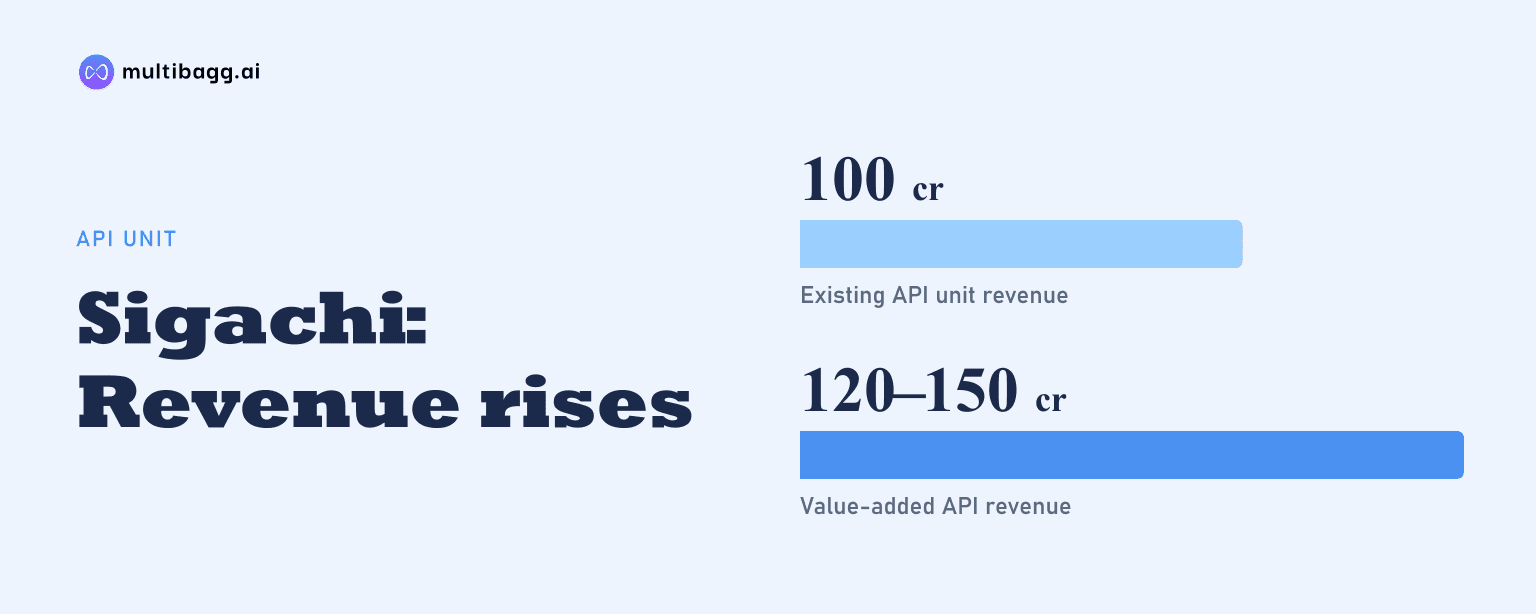
Sigachi Industries Limited said on October 31, 2026 that its existing 100 kL active pharmaceutical ingredient, or API, unit could generate up to Rs 150 crore of revenue with value-added products, compared with Rs 38 crore reported by the API business in H1 FY27. Management identified sparsentan and bempedoic acid as products intended to raise revenue and margins.
Know Sigachi Industries inside out
Results, valuation, peers and who's buying, in one view.
How much revenue can Sigachi's 100 kL API unit generate?
Sigachi said its 100 kL API capacity can generate up to Rs 100 crore of revenue, with a potential range of Rs 120 crore to Rs 150 crore if it manufactures value-added products. Chief Financial Officer O. Subbarami Reddy gave the estimate during the Q2 and H1 FY27 earnings call, while also stating that the 100 kL capacity is already in place.
The Rs 150 crore upper end is linked to product mix rather than a disclosed expansion in API capacity. Sigachi reported Rs 38 crore of API revenue in H1 FY27, while its Q2 FY27 API revenue was Rs 16.67 crore. The gap between first-half sales and management's capacity estimate shows the scale of revenue that management believes could be addressed through greater utilisation and higher-value manufacturing.
Which API products does Sigachi plan to add?
Sigachi plans to sell sparsentan and bempedoic acid in Q3 and Q4 FY27 after completing trials of both API products. Management said these products offer higher margins and described them as part of the value-added mix that could lift revenue from the existing 100 kL facility beyond the Rs 100 crore level.
The call did not disclose production volumes, selling prices, customer identities, regulatory approvals or confirmed purchase orders for sparsentan and bempedoic acid. The reported Rs 38 crore H1 FY27 API revenue therefore remains the confirmed sales figure, while the Rs 120 crore to Rs 150 crore range is management's estimate conditional on manufacturing and selling value-added products.
Sigachi is also pursuing a higher-value mix in its larger microcrystalline cellulose, or MCC, business. Management said co-processed and special MCC grades should increase during the final six months of FY27, alongside proposed API sales of sparsentan and bempedoic acid. This places the API plan within a wider strategy focused on product mix rather than only volume growth.
Why does Sigachi expect API revenue to improve in H2 FY27?
Sigachi expects API revenue to improve in H2 FY27 because some customers requested that dispatches be moved from Q2 into Q3. Management said this deferred revenue contributed to API sales of roughly Rs 35 crore to Rs 40 crore in H1 FY27, a range consistent with the Rs 38 crore figure later provided on the call.
Management said it expects nearly Rs 100 crore of API revenue for FY27. It also said API revenue could reach Rs 120 crore if a good order is received in Q4 FY27, including a further Rs 10 crore to Rs 20 crore of sales. That makes the higher outcome a possibility cited by management, not a firm forecast supported by a disclosed order book.
When asked about the API order book, management did not provide a numerical amount. It instead pointed to deferred Q2 dispatches, expected Q3 and Q4 sales, and value-added products as the basis for the outlook. The key commercial mechanism is therefore conversion of customer demand and product trials into billed dispatches during the second half.
Got a follow-up? Ask IRIS
How does API compare with Sigachi's other businesses?
API was smaller than MCC in Q2 FY27, when Sigachi reported Rs 16.67 crore of API revenue against Rs 91.22 crore from MCC. The operations and maintenance, or O&M, segment contributed Rs 13.93 crore, while total operating income was Rs 130.45 crore for the quarter, showing that MCC remained the principal source of revenue.
Management said MCC will remain Sigachi's major contributor in the near future, with API expected to increase next and O&M contributing about 10% to 12% of overall revenue. In H1 FY27, the company said MCC and allied products produced and sold totalled 7,128 metric tonnes, underlining the much larger operating base of the core excipient business.
The API expansion plan is intended to supplement, rather than replace, MCC-led growth. Sigachi's Q2 FY27 earnings before interest, tax, depreciation and amortisation, or EBITDA, was Rs 19.2 crore, equal to a 14.72% margin. Management attributed expected H2 margin improvement to fixed-cost absorption and a greater share of specialised, co-processed and value-added products.
What could affect Sigachi's API revenue plan?
Sigachi's API revenue plan depends on commercial execution because the company did not disclose API capacity utilisation, an order-book value or committed sales volumes for the two new products. While management said the 100 kL unit can potentially deliver Rs 100 crore to Rs 150 crore, actual H1 FY27 revenue was Rs 38 crore and planned Q3 and Q4 sales remain central to the full-year result.
The wider capital-spending programme also has an unresolved funding structure. Sigachi said it had spent about Rs 29 crore to Rs 30 crore on its MCC and CCS projects, and estimated total capital expenditure of roughly Rs 200 crore, including Rs 100 crore for MCC and Rs 90 crore for CCS. Management said debt and equity were both options, but no final decision had been announced.
The 12,000-metric-tonne-per-year MCC expansion at Dahej Special Economic Zone and the CCS facility are expected to be commissioned and commercialised in Q2 FY28. Management said the timeline could vary by one or two months. These projects do not add to the stated 100 kL API capacity, but they are part of the same broader plan to expand manufacturing and alter sales mix.
Conclusion
Sigachi's disclosed API strategy centres on increasing revenue from its existing 100 kL unit through a richer product mix. The Rs 38 crore reported in H1 FY27 is below management's Rs 100 crore base capacity estimate, while sparsentan and bempedoic acid are intended to support the Rs 120 crore to Rs 150 crore potential. MCC nevertheless remained substantially larger in Q2 FY27, contributing Rs 91.22 crore versus Rs 16.67 crore from API.
The next point to watch is H2 FY27 API dispatches, as management expects deferred Q2 sales and proposed sales of the two value-added APIs to contribute in Q3 and Q4. Management also plans to update investors next quarter, while the MCC expansion and CCS commercialisation remain scheduled for Q2 FY28 and the funding mix for roughly Rs 200 crore of capital expenditure has not been finalised.