










Sigachi fast-tracks Dahej-2 expansion toward 30,000 MTPA MCC
Key highlights
- Sigachi’s Dahej-2 project will add 12,000 MTPA of MCC, taking planned total capacity to 30,000 MTPA.
- MCC accounted for 70% of Sigachi’s Q2 FY27 revenue mix, up from 60% in Q2 FY26.
- Sigachi’s Hyderabad API R&D centre is fully operational and complements laboratories in Dahej and Jhagadia.
- FY26 R&D investment reached Rs 6.759 crore, while Q2 FY27 revenue rose 18.09% year on year to Rs 130.5 crore.
powered by IRIS
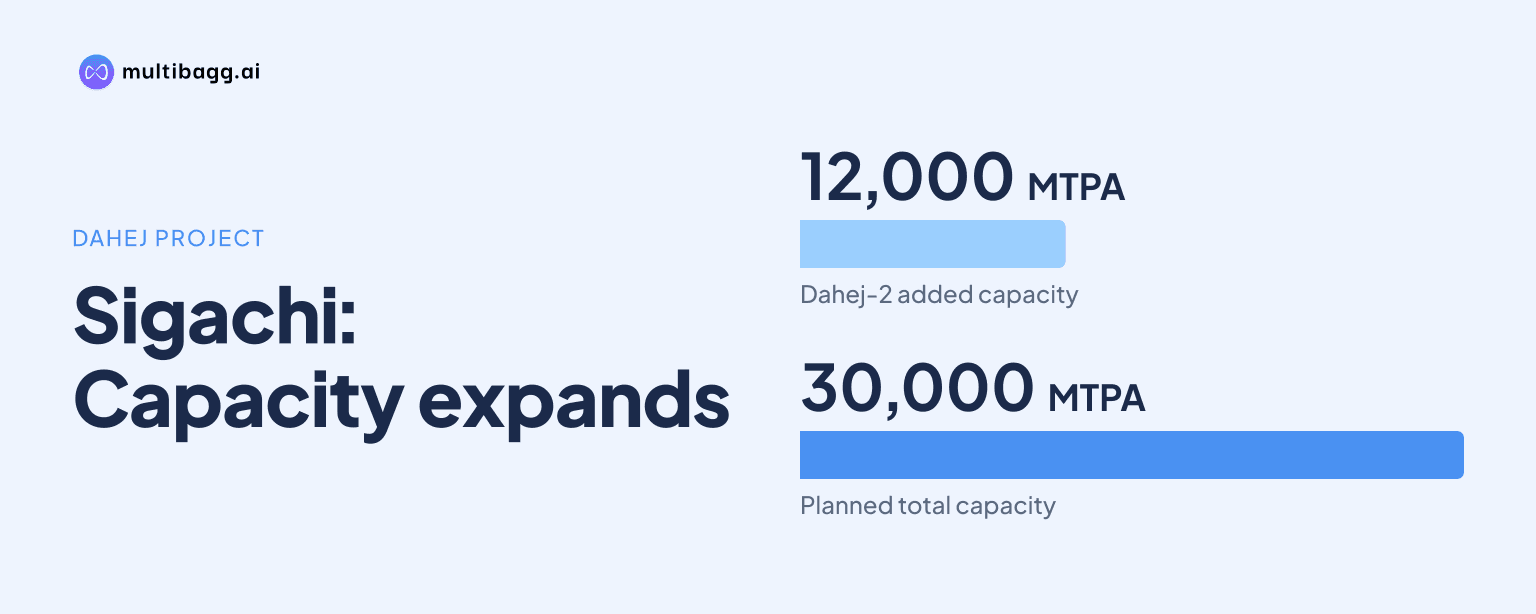
Sigachi Industries Ltd has fast-tracked a 12,000 metric tonnes per annum (MTPA) expansion at Dahej-2 that is intended to raise total microcrystalline cellulose (MCC) capacity to 30,000 MTPA. Its new Hyderabad active pharmaceutical ingredient (API) research and development (R&D) centre is also fully operational, while R&D investment reached Rs 6.759 crore in FY26.
Know Sigachi Industries inside out
Results, valuation, peers and who's buying, in one view.
What will Sigachi’s Dahej-2 expansion add?
Sigachi’s Dahej-2 project will add 12,000 MTPA of MCC and take total MCC capacity to 30,000 MTPA. The company says it has fast-tracked the expansion, identifying it as a capacity plan within its pre-formulation excipients operations.
The stated capacity target implies an existing MCC base of 18,000 MTPA before the Dahej-2 addition. On that basis, the 12,000-MTPA project represents a two-thirds increase from the implied pre-expansion capacity, although Sigachi does not disclose a commissioning date, capital expenditure amount or production ramp-up schedule.
Sigachi has four operational manufacturing facilities across Gujarat, Telangana and Karnataka. Its Dahej facility is in a Special Economic Zone and is dedicated to premium exports, while its Sultanpur facility is dedicated to nutritional premix manufacturing, separating the Dahej-2 MCC plan from the nutritional-premix operation.
MCC was Sigachi’s largest reported revenue contributor in Q2 FY27, accounting for 70% of the mix compared with 60% in Q2 FY26. The expansion therefore targets the product category whose share of reported revenue increased by 10 percentage points over the year.
How does the Hyderabad centre change Sigachi’s API work?
Sigachi’s new API R&D centre in Hyderabad is fully operational and brings critical API development and analytical efforts under one roof. The presentation identifies the facility as operational rather than proposed, but does not name molecules under development, development milestones or commercial launch dates.
The Hyderabad centre complements two R&D application laboratories in Dahej and Jhagadia that focus on performance-oriented approaches and in-house technologies. Sigachi also states that its Dahej laboratory is accredited by the Department of Science and Industrial Research, adding a disclosed accreditation to its research infrastructure.
Sigachi presents its pharmaceutical ecosystem as spanning APIs and intermediates, excipients, formulators, doctors and end customers. Management says it is moving up the value chain by introducing value-added and margin-accretive products, while the Hyderabad centre supplies development and analytical capacity for the API part of that stated strategy.
API contribution to Sigachi’s revenue mix was 13% in Q2 FY27, down from 17% in Q2 FY26. That four-percentage-point reduction contrasts with MCC’s rise to 70%, showing that the new API R&D infrastructure became operational while MCC represented a larger reported share of revenue.
How has Sigachi’s R&D investment changed?
Sigachi’s R&D investment rose to Rs 6.759 crore in FY26 from Rs 3.741 crore in FY23, an increase of Rs 3.018 crore over three financial years. Investment increased in every reported year, moving from Rs 4.96 crore in FY24 to Rs 6.604 crore in FY25 before reaching the FY26 level.
The increase was Rs 1.219 crore in FY24 and Rs 1.644 crore in FY25, followed by Rs 0.155 crore in FY26. The FY26 amount was the highest in the four-year series disclosed in the presentation.
Sigachi also reports 46 trademarks, seven patents filed and four CEP filings. These figures describe its reported intellectual-property and filing activity, but the presentation does not state how many patents have been granted, the products covered by the CEP filings or the timing of any commercial outcome.
Got a follow-up? Ask IRIS
How does the Dahej-2 plan relate to Sigachi’s revenue mix?
Sigachi’s MCC contribution increased to 70% of revenue in Q2 FY27 from 60% in Q2 FY26, while API contribution declined to 13% from 17%. The mix change places the 12,000-MTPA Dahej-2 expansion alongside a larger reported role for MCC in the business.
Operations and management represented 11% of Q2 FY27 revenue, compared with 12% a year earlier, and allied trades accounted for 7%, compared with 11%. All three non-MCC categories shown in the revenue-mix table either declined or remained below their Q2 FY26 contribution.
Revenue from operations rose 18.09% year on year to Rs 130.5 crore in Q2 FY27 from Rs 110.5 crore in Q2 FY26. Earnings before interest, tax, depreciation and amortisation (EBITDA) increased to Rs 19.2 crore from Rs 7.5 crore, and EBITDA margin rose to 14.72% from 6.78%.
Profit after tax was Rs 8.9 crore in Q2 FY27, compared with Rs 10.5 crore in Q2 FY26, despite the rise in revenue and EBITDA. The presentation shows a 6.82% Q2 FY27 profit-after-tax margin versus 9.59% a year earlier, while MCC remained the largest reported revenue category.
What manufacturing and research network supports Sigachi’s plans?
Sigachi’s operating network includes facilities in Gujarat, Telangana and Karnataka, with locations identified as Dahej, Jhagadia, Sultanpur, Hyderabad and Raichur. The Dahej site serves premium exports from a Special Economic Zone, while Sultanpur is designated for nutritional premix manufacturing.
Its R&D footprint combines the fully operational Hyderabad API centre with application laboratories at Dahej and Jhagadia. The company also reports four CEP filings, seven patents filed and 46 trademarks, alongside R&D investment of Rs 6.759 crore in FY26.
The company identifies itself as a manufacturer of pre-formulation excipients and says it has a growing API product portfolio with CEP filings in the pipeline. Its disclosed capacity plan, however, is specific to MCC: 12,000 MTPA at Dahej-2 toward total MCC capacity of 30,000 MTPA.
Conclusion
Sigachi is advancing two disclosed initiatives: a 12,000-MTPA Dahej-2 project intended to lift MCC capacity to 30,000 MTPA, and a fully operational Hyderabad API R&D centre that centralises critical API development and analysis. MCC’s revenue contribution rose to 70% in Q2 FY27 from 60% a year earlier, while R&D investment reached Rs 6.759 crore in FY26.
The next development to watch is execution of the fast-tracked Dahej-2 plan toward its 30,000-MTPA MCC target, as the presentation gives no commissioning or ramp-up schedule. Progress in the four CEP filings, seven patents filed and API work at the Hyderabad centre will also show how Sigachi’s stated value-added product plan develops.