










Skipper shifts export mix after record Q2 export order inflows
Key highlights
- Skipper recorded record Q2 FY27 export order inflows of Rs 1,054 crore for the quarter ended 30 September 2026.
- North America and Australia made up the majority of Skipper’s export order mix, while the Middle East contributed just under 18%.
- Skipper’s total closing order book stood at Rs 10,065.7 crore in September 2026, with domestic orders accounting for 83%.
- Skipper plans to raise installed capacity by 75,000 MTPA, from 375,000 MTPA to 450,000 MTPA, in H2 FY27.
powered by IRIS
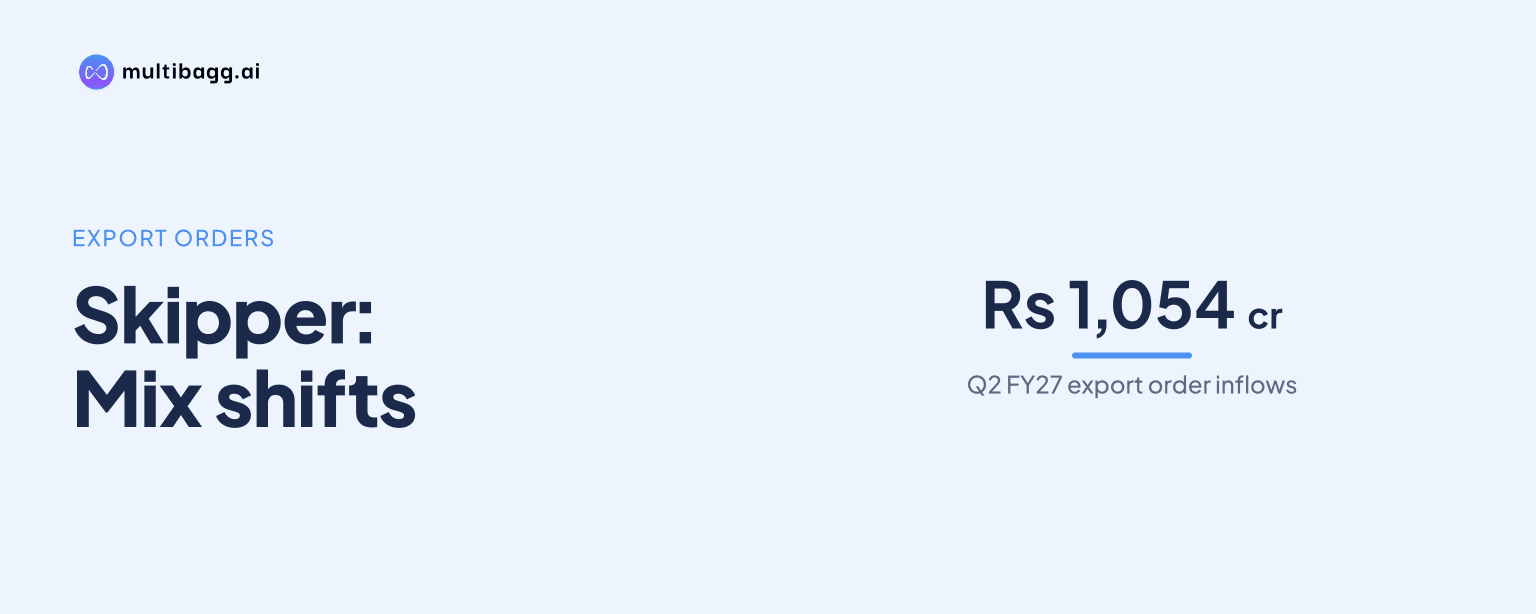
Skipper Limited reported record quarterly export order inflows of Rs 1,054 crore in Q2 FY27, ended 30 September 2026, while saying North America and Australia now form the majority of its export order mix. Skipper also secured its largest North American order to date and established a USA subsidiary to support international expansion.
Know Skipper inside out
Results, valuation, peers and who's buying, in one view.
Why is Skipper shifting towards developed export markets?
Skipper is shifting towards developed export markets because North America and Australia account for the majority of its export order mix, according to its 30 October 2026 announcement. The Middle East now contributes just under 18% of that mix. Skipper did not disclose individual shares for North America or Australia, but identified both as the principal developed-market contributors.
The shift comes alongside a multi-million-dollar contract with a top-tier utility company, described by Skipper as its largest order to date in the North American market. The company did not disclose the customer's name, contract value, scope or delivery timeline. It reported Rs 1,054 crore of export order inflows in Q2 FY27, its highest figure for any quarter.
Director Sharan Bansal said geopolitical developments in West Asia affected exports during the period ended 30 September 2026. Skipper did not quantify the effect on revenue, shipments, orders or profit. Its disclosure nevertheless shows lower stated Middle East concentration alongside a majority export mix from North America and Australia.
What is changing in Skipper's export order book?
Skipper's export order book is becoming more diversified, with developed markets representing the majority share and the Middle East below 18% of the mix. The Rs 1,054 crore quarterly export order inflow was an order measure rather than reported export revenue or a disclosed export order-book balance.
The total closing order book stood at Rs 10,065.7 crore at September 2026, comprising 83% domestic orders and 17% export orders. Domestic work therefore remained the larger component of the overall backlog, despite the geographical change within exports. Skipper did not provide prior-quarter or prior-year export-mix percentages for comparison.
First-half FY27 new order inflows were Rs 3,785.5 crore, including significant domestic engineering, procurement and construction contracts from Power Grid Corporation of India Limited and international orders. Separately, Q2 FY27 order inflow was Rs 211.1 crore, up 70% year on year. The bidding pipeline exceeded Rs 35,000 crore, although that represents prospective bids rather than secured work.
Got a follow-up? Ask IRIS
How will Skipper support North American expansion?
Skipper will support its North American expansion through a newly established USA subsidiary, alongside existing subsidiaries in Brazil and the United Arab Emirates. Management said the USA entity would complement those operations and help deepen Skipper's reach across international markets. The announcement did not state the subsidiary's investment, staffing level or incorporation date.
The company is also expanding installed capacity by 75,000 MTPA, meaning metric tonnes per annum, from 375,000 MTPA to 450,000 MTPA. The project was ongoing on 30 October 2026 and was expected to be commissioned and operational in H2 FY27. Skipper did not allocate the additional capacity between export destinations, products or customers.
Skipper raised Rs 433.5 crore through a preferential equity issue at Rs 470 per share. Participating investors included Smallcap World Fund, American Fund Insurance, Bandhan Small Cap Fund, Cohesion MK Best Ideas and Emerge Private Opportunities Trust. The release did not specify how much of the proceeds would fund capacity expansion, the USA subsidiary or export activity.
What operating and financial figures support Skipper's plan?
Skipper reported standalone Q2 FY27 revenue of Rs 1,384 crore, up 10% from Rs 1,261.8 crore in Q2 FY26, while profit after tax rose 56% to Rs 57.5 crore. Earnings before interest, tax, depreciation and amortisation, or EBITDA, increased 11% to Rs 144.8 crore, and EBITDA margin rose by 10 basis points to 10.5%.
For H1 FY27, revenue reached Rs 2,693.8 crore, up 7% from Rs 2,515.7 crore in H1 FY26, and profit after tax increased 40% to Rs 113.9 crore from Rs 81.6 crore. EBITDA margin was 10.6%, compared with 10.3% a year earlier. Management attributed the margin change to operating leverage and execution of higher-quality transmission and distribution contracts.
Skipper's engineering, procurement and construction division was executing about 5,500 circuit kilometres of extra-high-voltage and high-voltage direct-current transmission-line work at September 2026. During Q2 FY27, it also charged the approximately 144-kilometre Sikar II-Khetri TL 03 765 kilovolt line in Rajasthan.
Conclusion
Skipper's disclosed export strategy combines record Q2 FY27 export order inflows of Rs 1,054 crore, its largest North American order to date and a mix led by North America and Australia within exports. The wider Rs 10,065.7 crore order book remains predominantly domestic, with India accounting for 83% of the reported backlog.
The next disclosed milestone is commissioning and operation of the 75,000 MTPA expansion in H2 FY27, which would lift installed capacity to 450,000 MTPA. Further disclosures on orders secured through the USA subsidiary and the North American utility contract will show how the stated export-market shift develops, as Skipper has not given a regional revenue target or contract value.