










Skipper Limited Q2 Profit Rises 56% as Revenue Hits Record
Key highlights
- Skipper Limited reported record Q2 FY27 revenue of ₹1,384 crore, up 10% year-on-year.
- Q2 FY27 profit after tax rose 56% year-on-year to ₹57.5 crore, while EBITDA margin reached 10.5%.
- Skipper Limited's order book reached ₹10,066 crore as of September 2026.
- Q2 FY27 order inflows rose 70% year-on-year to ₹2,111 crore, including ₹1,054 crore of export orders.
powered by IRIS
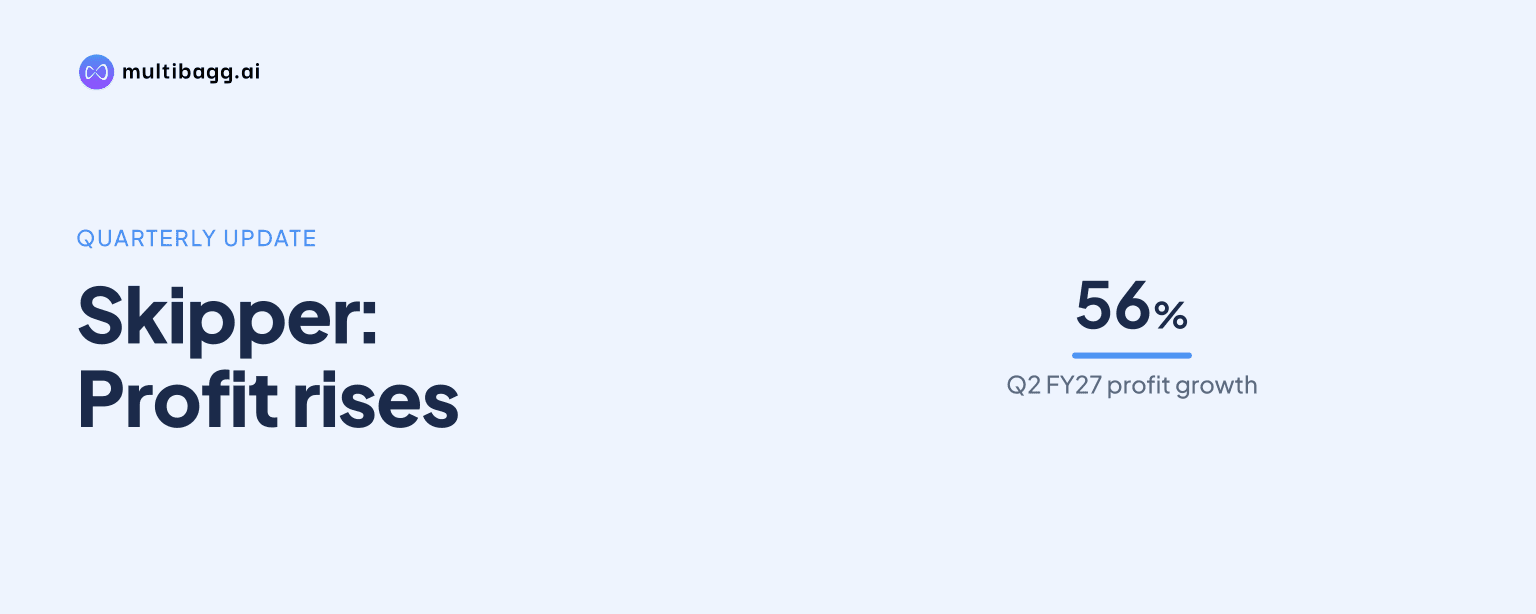
Skipper Limited reported its highest-ever second-quarter revenue of ₹1,384 crore in Q2 FY27, while profit after tax rose 56% year-on-year to ₹57.5 crore, supported by engineering-business growth, improved execution and a stronger contract mix. The quarter also took the order book to ₹10,066 crore as of September 2026.
Know Skipper inside out
Results, valuation, peers and who's buying, in one view.
What did Skipper Limited report for Q2 FY27?
Skipper Limited reported 10% year-on-year growth in Q2 FY27 revenue to ₹1,384 crore, compared with ₹1,261.8 crore in the corresponding quarter of FY26. The company described this as its highest-ever revenue for a second quarter. Its engineering business, particularly transmission and distribution contracts, supported the performance.
Operating profit also increased. EBITDA rose 11% year-on-year to ₹144.8 crore, and the EBITDA margin improved by 10 basis points to 10.5% from 10.4%. Profit before tax grew 25% to ₹77.6 crore. Profit after tax increased faster than revenue and EBITDA, rising to ₹57.5 crore from ₹36.9 crore, while the PAT margin improved by 130 basis points to 4.2%.
Management linked the margin improvement to operating leverage, better execution and a higher-quality mix of transmission and distribution contracts. The company also said its finance cost as a proportion of revenue declined to 3.2% in Q2 FY27 from 4.2% a year earlier, aided by lower borrowings and financial discipline.
How did Skipper Limited perform in the first half of FY27?
Skipper Limited recorded first-half FY27 revenue of ₹2,693.8 crore, up 7% year-on-year, and EBITDA of ₹284.9 crore, up 11%. The first-half EBITDA margin was 10.6%, compared with 10.3% in the year-earlier period, showing that the improvement in operating profitability extended beyond the second quarter.
First-half profit after tax rose 40% year-on-year to ₹113.9 crore. The company termed this its highest-ever half-year profit after tax. Revenue growth for the half year was lower than the Q2 growth rate, but profit growth remained stronger than sales growth due to margin expansion and lower finance-cost intensity.
The balance sheet also improved during the period. Gross debt, including interest-bearing acceptances, declined by about ₹358 crore year-on-year to ₹964 crore. The debt-to-equity ratio improved to 0.38 times. Skipper also cited a ₹433.5 crore preferential equity raise and a CRISIL rating upgrade to A+ Stable as factors that strengthened financial flexibility.
What do Skipper Limited's orders indicate about revenue visibility?
Skipper Limited's order book stood at ₹10,066 crore at the end of September 2026, providing visibility for future execution. New order inflows were ₹2,111 crore in Q2 FY27, a 70% increase year-on-year, taking first-half inflows to ₹3,785.5 crore, up 18%.
The company won contracts from Power Grid Corporation of India and international markets during the first half. Export order inflows reached ₹1,054 crore in the quarter, which management described as its highest quarterly export order inflow. It said about ₹1,100 crore of export orders had been booked against its full-year export order inflow guidance of ₹1,500 crore.
Got a follow-up? Ask IRIS
What is affecting Skipper Limited's FY27 outlook?
Skipper Limited said geopolitical developments in West Asia and elevated global shipping freight rates affected export activity during the period. Management said some customers deferred shipments while waiting for freight rates to ease. These factors affected the timing of export execution rather than the reported order inflow.
Whole-Time Director Sharan Bansal said the company remained largely on track for its 15% full-year revenue growth target. However, he noted that growth could be 1 to 2 percentage points below that target in a downside scenario because of export shipment deferrals. This implies a possible growth range of about 13% to 14%, based on management's comments.
Management said newer orders were largely structured on an FOB basis or with freight terms fixed at shipment, limiting freight-escalation exposure. It also pointed to domestic market opportunities and a full-year order inflow target of ₹7,500 crore. Separately, the company announced a proposed acquisition of a South India manufacturing company for about ₹15 crore to ₹16 crore.
Why do the Q2 results matter for investors?
The Q2 outcome shows that Skipper Limited expanded profit and margins faster than revenue despite export disruption. The 56% increase in profit after tax, alongside a 10% rise in revenue, reflects the importance of contract selection, execution and lower financing costs to the company's reported earnings profile.
The ₹10,066 crore order book is significant because it offers a sizeable base for future project execution, while strong Q2 inflows demonstrate continued demand in transmission and distribution. At the same time, the company has identified shipping costs and geopolitical uncertainty as immediate constraints on export shipments. Investors will therefore distinguish between order wins and the timing of revenue recognition from export projects.
Conclusion
Skipper Limited delivered record Q2 FY27 revenue of ₹1,384 crore and lifted profit after tax 56% to ₹57.5 crore, supported by improved operating margins, execution in higher-quality contracts and lower finance-cost intensity. The ₹10,066 crore order book and ₹2,111 crore quarterly order inflow provide a substantial reported pipeline for its engineering operations.
The next key issue is whether deferred export shipments resume as freight conditions and geopolitical developments evolve. Management has retained its 15% FY27 revenue-growth objective but acknowledged a potential 1 to 2 percentage point shortfall in a downside case, while targeting ₹7,500 crore of full-year order inflows and ₹1,500 crore of export order inflows.