










Skipper cuts debt plus acceptances by Rs 358.3 crore
Key highlights
- Skipper's gross debt plus interest-bearing acceptances fell Rs 358.3 crore year on year to Rs 964.2 crore at September 30, 2026.
- Interest-bearing acceptances declined Rs 323.4 crore to Rs 228.9 crore, while short-term debt fell Rs 274.7 crore to Rs 114.7 crore.
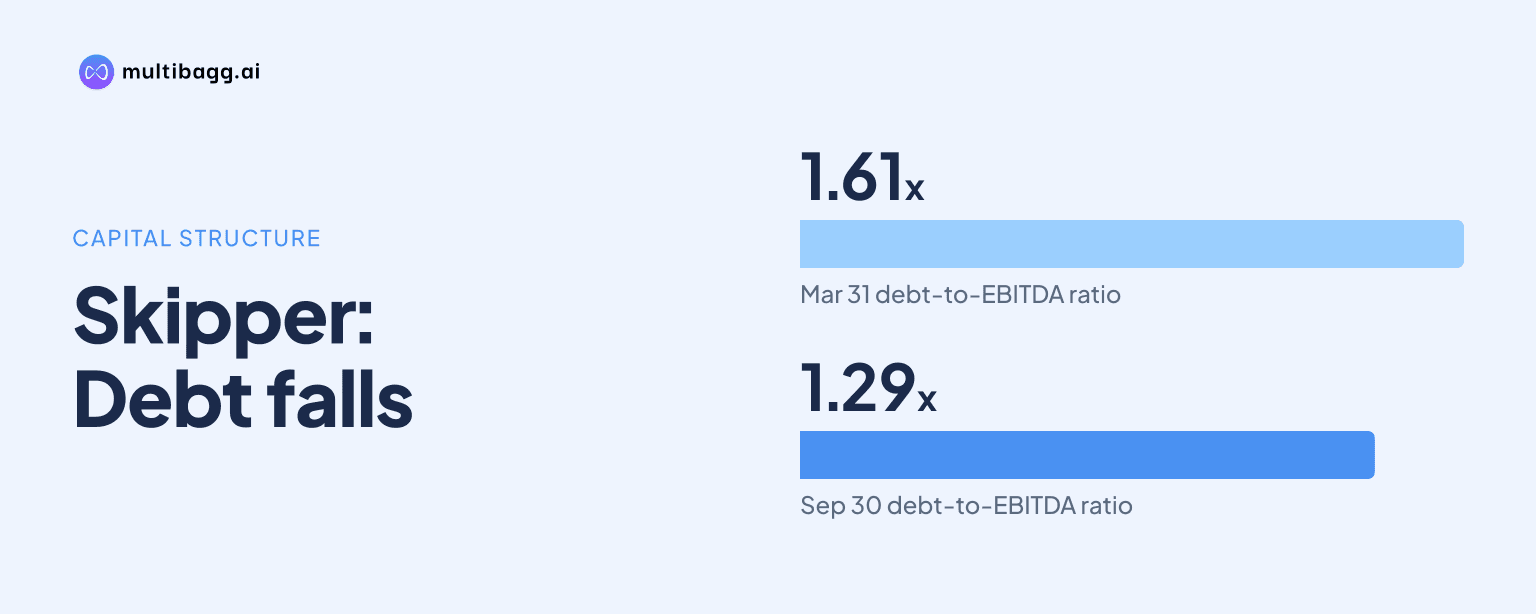
- Skipper's debt-to-EBITDA ratio improved to 1.29 times from 1.49 times a year earlier and 1.61 times at March 31, 2026.
- Skipper's order book reached a record Rs 10,065.7 crore in September 2026, up 18.4% from March 2026.
powered by IRIS
SKIPPER Limited cut gross debt plus interest-bearing acceptances by Rs 358.3 crore year on year to Rs 964.2 crore at September 30, 2026. Lower short-term debt and interest-bearing acceptances more than offset a Rs 239.8 crore increase in total long-term debt, while net working-capital days fell to 93 from 109.
Know Skipper inside out
Results, valuation, peers and who's buying, in one view.
How did Skipper's debt and acceptances change year on year?
Skipper's gross debt plus interest-bearing acceptances fell by Rs 358.3 crore from Rs 1,324.5 crore at September 30, 2025 to Rs 964.2 crore at September 30, 2026. Gross debt excluding interest-bearing acceptances declined by Rs 34.9 crore to Rs 735.3 crore, while interest-bearing acceptances decreased by Rs 323.4 crore to Rs 228.9 crore.
The combined balance was also below the March 31, 2026 level of Rs 1,266.2 crore. Between March 31 and September 30, 2026, gross debt fell by Rs 186.5 crore and interest-bearing acceptances declined by Rs 113.5 crore, producing a Rs 302 crore reduction in the combined measure over six months.
What drove Skipper's lower combined debt balance?
Skipper's lower combined debt balance reflected reduced short-term debt and interest-bearing acceptances. Short-term debt declined by Rs 274.7 crore year on year to Rs 114.7 crore, while interest-bearing acceptances fell by Rs 323.4 crore to Rs 228.9 crore. These two movements exceeded the increase in long-term obligations.
Total long-term debt increased by Rs 239.8 crore year on year to Rs 620.6 crore. Long-term debt rose by Rs 200.5 crore to Rs 504.9 crore, and current maturities of long-term debt increased by Rs 39.3 crore to Rs 115.7 crore. This changed the composition of the disclosed funding balance toward long-term debt and away from short-term debt and acceptances.
The same pattern appeared against March 31, 2026. Total long-term debt increased by Rs 78 crore in six months, while short-term debt declined by Rs 264.5 crore and acceptances reduced by Rs 113.5 crore. The gross debt level consequently fell from Rs 921.8 crore at March 2026 to Rs 735.3 crore at September 2026.
How did Skipper's working-capital indicators change?
Skipper reduced net working-capital days excluding bills payable to 93 days at September 30, 2026 from 109 days a year earlier, a decline of 16 days. Management attributed the year-on-year movement to efficient working-capital management and said cash flows and working capital were expected to improve considering the quality of order intake.
Debtor days declined to 94 from 95 a year earlier, while trade payable days excluding interest-bearing acceptances increased to 84 from 68. Inventory days increased by one day to 83. Compared with March 31, 2026, however, net working-capital days increased from 84 to 93 as inventory days rose from 70 to 83 and trade payable days declined from 90 to 84.
Skipper reported a record closing order book of Rs 10,065.7 crore at September 2026, up 18.4% from Rs 8,501.9 crore at March 2026. Q2 FY27 order inflow reached Rs 2,111.1 crore, up 70% year on year, while H1 FY27 inflow was Rs 3,785.5 crore, up 18% year on year.
Got a follow-up? Ask IRIS
What happened to Skipper's leverage ratios?
Skipper's debt-equity ratio declined to 0.38 times at September 30, 2026 from 0.61 times at September 30, 2025 and 0.62 times at March 31, 2026. Its debt-to-EBITDA ratio declined to 1.29 times from 1.49 times a year earlier and 1.61 times at March 2026. EBITDA means earnings before interest, tax, depreciation and amortisation.
The movement in the leverage ratios coincided with the lower Rs 964.2 crore gross debt-plus-acceptances balance. The presentation does not disclose the debt, equity or EBITDA amounts used in these calculations, so the underlying contribution of each component to the ratios cannot be identified from the disclosed data.
Skipper said its focus remained on strengthening performance and leverage ratios, with expected cash-flow and working-capital improvements supported by a robust order book and the quality of new order intake. The company did not disclose a numerical debt-equity or debt-to-EBITDA target for a future period.
What is Skipper's balance-sheet plan?
Skipper plans to fund its investment cycle while holding leverage within an internal comfort band and improving shareholder return ratios. Management did not disclose the numerical level of that internal leverage band, but listed balance-sheet discipline and capital return ratios among its strategic priorities.
The investment plan includes commissioning an additional 75,000 metric tonnes of capacity, optimising throughput at 450,000 metric tonnes per annum, and progressing toward targeted capacity of 600,000 metric tonnes per annum by FY29. Skipper also plans to build substation and high-voltage direct-current capability to widen its addressable transmission market.
Skipper's September 2026 order book was 73% domestic transmission and distribution, 17% exports and 10% non-transmission-and-distribution domestic products. The export order book was led by North America at 44% and Australia at 19%, while the Middle East represented 18% and Africa 17%.
Conclusion
Skipper's Rs 358.3 crore year-on-year reduction in gross debt plus interest-bearing acceptances resulted primarily from Rs 274.7 crore lower short-term debt and Rs 323.4 crore lower acceptances. Those reductions outweighed the Rs 239.8 crore increase in total long-term debt, while debt-equity declined to 0.38 times and net working-capital days improved by 16 days year on year.
The next measures to watch are whether Skipper can improve from its 93-day net working-capital position while executing its Rs 10,065.7 crore order book and funding expansion. Management's disclosed milestones are commissioning 75,000 metric tonnes of additional capacity and progressing toward 600,000 metric tonnes per annum by FY29 while maintaining leverage within its undisclosed internal comfort band.