










Skipper diversifies exports as North America reaches 44%
Key highlights
- Skipper said North America accounts for almost 44% of its export order book.
- Developed markets account for more than 60% of Skipper's export order book, while Middle East exposure is below 18%.
- Skipper's second-quarter FY27 export order inflow was Rs 1,055 crore, above its entire FY26 export order inflow.
- Skipper expects to add 75,000 metric tonnes per annum of capacity in the second half of FY27, reaching 450,000 metric tonnes per annum.
powered by IRIS
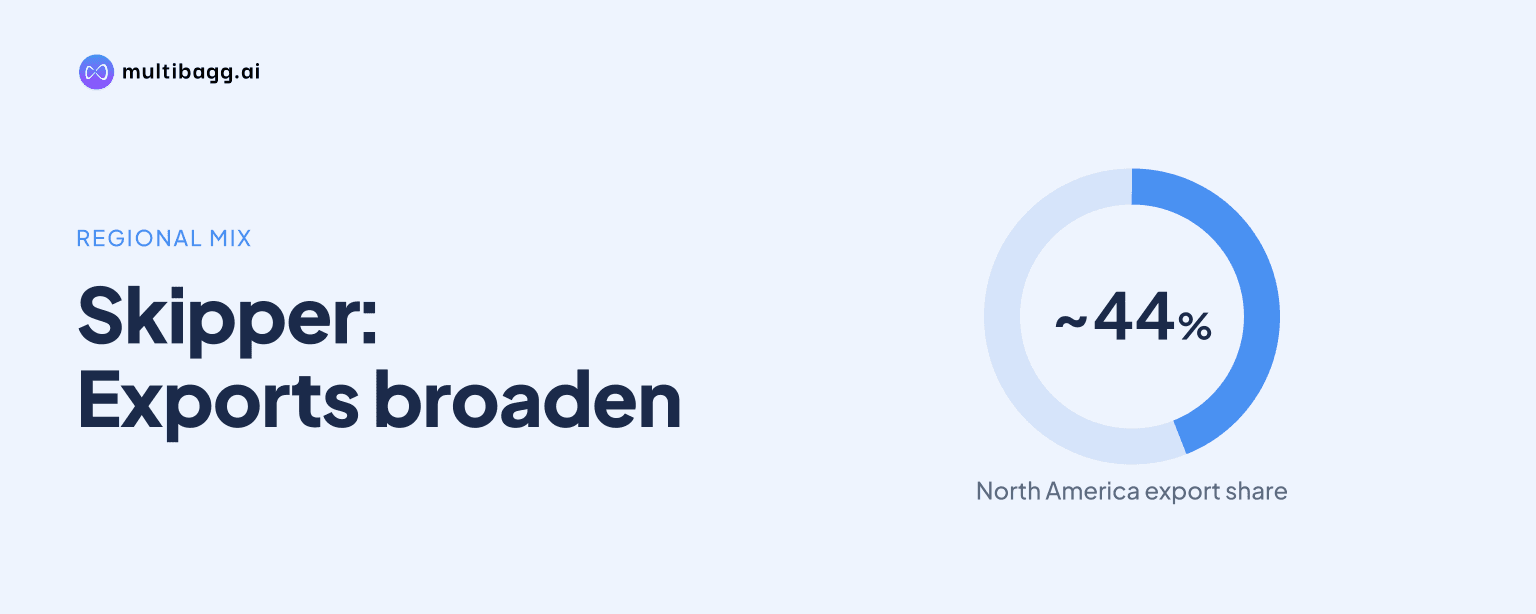
Skipper Limited said on October 30, 2026 that North America accounted for almost 44% of its export order book, helping lift developed markets above 60% while Middle East exposure fell below 18%. The shift comes as elevated global freight rates have led some customers to defer shipments.
Know Skipper inside out
Results, valuation, peers and who's buying, in one view.
How has Skipper changed its export order book?
Skipper has shifted its export order book towards developed markets, with North America contributing almost 44% and Australia almost 18% to 19%. Management said it began financial year 2027 (FY27) with a focus on diversification because the Middle East was its traditional export market and remained affected by geopolitical uncertainty.
More than 60% of Skipper's export order book now comes from developed markets, including the United States, Canada, Australia and Europe, management said. Middle East exposure has fallen below 18%, compared with its earlier role as the company's principal international geography. Management said it was not very optimistic about the Middle East while the war situation continued, although it expects the region could revive if conditions improve.
The disclosed mix shows a change in Skipper's regional concentration rather than a recovery in Middle East demand. Management described the developed-market mix as improving the resilience of the export portfolio, while stating that the Middle East remains challenging. The call did not disclose the absolute value of export orders by geography.
What orders are supporting Skipper's developed-market push?
Skipper recorded export order inflow of Rs 1,055 crore in the second quarter of FY27, exceeding its entire export order inflow for FY26. Management linked the record quarterly intake to customer engagement and order opportunities in developed markets, particularly the United States and Australia.
The total order book stood at Rs 10,066 crore as of September 2026, while second-quarter order inflows were Rs 2,111 crore, up 70% year on year. Order inflows for the first half of FY27, or the six months ended September 2026, were Rs 3,786 crore, up 18% from the corresponding period. Management also cited a bidding pipeline above Rs 35,000 crore, without providing a regional split.
Management pointed to investment in United States power transmission linked to artificial-intelligence-led data centres as a source of opportunity. That is a market observation rather than booked revenue. Skipper said customer qualification initiatives in developed markets were continuing, so future order conversion depends on qualification and bidding results as well as existing order-book execution.
Why are Skipper's export shipments being deferred?
Skipper said customers have deferred some shipments because global shipping freight remains elevated and customers are waiting for prices to fall. Management retained its FY27 revenue-growth target of 15%, but said growth could be 1% to 2% lower at worst if export-shipment conditions do not improve.
First-half FY27 revenue rose 7% year on year to Rs 2,694 crore, while second-quarter revenue increased 10% to Rs 1,384 crore. Management said first-quarter growth was about 4% to 5%, and that the second half is normally heavier for execution. It expects infrastructure projects to be the principal revenue-growth driver in the second half, while engineering revenue faces the effects of muted ordering in the previous year and current export obstacles.
Management said Skipper can pursue domestic orders if export shipment disruption continues. Its FY27 order-inflow target is Rs 7,500 crore, and management said domestic order inflows were robust in the first half after muted domestic ordering in the preceding year. This can support factory utilisation, but does not remove the risk that freight conditions delay export revenue recognition.
Got a follow-up? Ask IRIS
How is Skipper managing freight-rate exposure?
Skipper said most new export orders are on a free-on-board (FOB) basis, under which the customer handles ocean freight, or provide for sea freight to remain variable until shipment. Management therefore said the company is covered against further freight-rate escalation on most new contracts.
For the existing export order book, management estimated that less than 25% to 30% was on a cost, insurance and freight (CIF) basis, where Skipper may carry freight obligations. The call did not state the value of CIF orders or quantify any potential profit effect from freight increases. Management added that it believed shipping rates had more or less peaked and could decline, which was its expectation rather than a confirmed outcome.
Skipper said domestic and export working-capital requirements are broadly comparable despite different cash-conversion patterns. In some export markets, letters of credit are discounted upon shipment; in developed markets without letters of credit, payment can be made against shipment or through other discounting options. Management said exports generally have faster collections but longer inventory, inspection, production and shipping cycles, while domestic business has shorter inventory cycles but slower collections.
Can Skipper's capacity support additional export orders?
Skipper's 75,000 metric-tonnes-per-annum expansion is on track for commissioning and operation in the second half of FY27, management said. It would take installed capacity to 450,000 metric tonnes per annum from 375,000 metric tonnes per annum, supporting the ability to serve larger domestic and international orders.
The current phase is largely a brownfield expansion at existing plants, following the move from 300,000 to 375,000 tonnes in the prior phase. Skipper aims to reach 600,000 tonnes of capacity by FY29. Management said annual capital expenditure has been around Rs 250 crore to Rs 300 crore and that the current expansion costs about that amount.
Skipper cited a Rs 433.5 crore preferential equity raise and a debt-to-equity ratio of 0.38 times in discussing funding capacity additions. Management also said it expects operating cash flow to be at least 75% of total cash flow in FY27. These plans support available capacity and funding, but the expansion itself does not guarantee conversion of the developed-market bidding pipeline.
Conclusion
Skipper's export order book has become less dependent on the Middle East, with North America at almost 44%, Australia at almost 18% to 19%, and developed markets above 60%. The record Rs 1,055 crore export order inflow in the second quarter of FY27 supports that transition, but deferred shipments show that freight costs can still affect the timing of export revenue.
The next indicators are whether shipping rates allow deferred orders to move, whether developed-market bids convert into orders, and whether the 75,000 metric-tonnes-per-annum expansion starts operating in the second half of FY27 as planned. Management's 15% FY27 revenue-growth target, with stated downside of 1% to 2%, also depends on second-half execution and domestic order opportunities.