










Solarworld commits up to Rs 420 crore for 2.4 GW cell JV
Key highlights
- Solarworld has committed up to Rs 420 crore to a 2.4 GW solar-cell joint venture targeted for June 2027 production.
- Solarworld paid a first Rs 26.8 crore equity tranche on 30 October 2026 for the 50:50 cell venture.
- India had about 210 GW of solar module capacity versus about 27 GW of solar cell capacity in December 2025.
- Solarworld's Roorkee module line has 1.552 GW capacity, compared with 2.4 GW planned cell capacity.
powered by IRIS
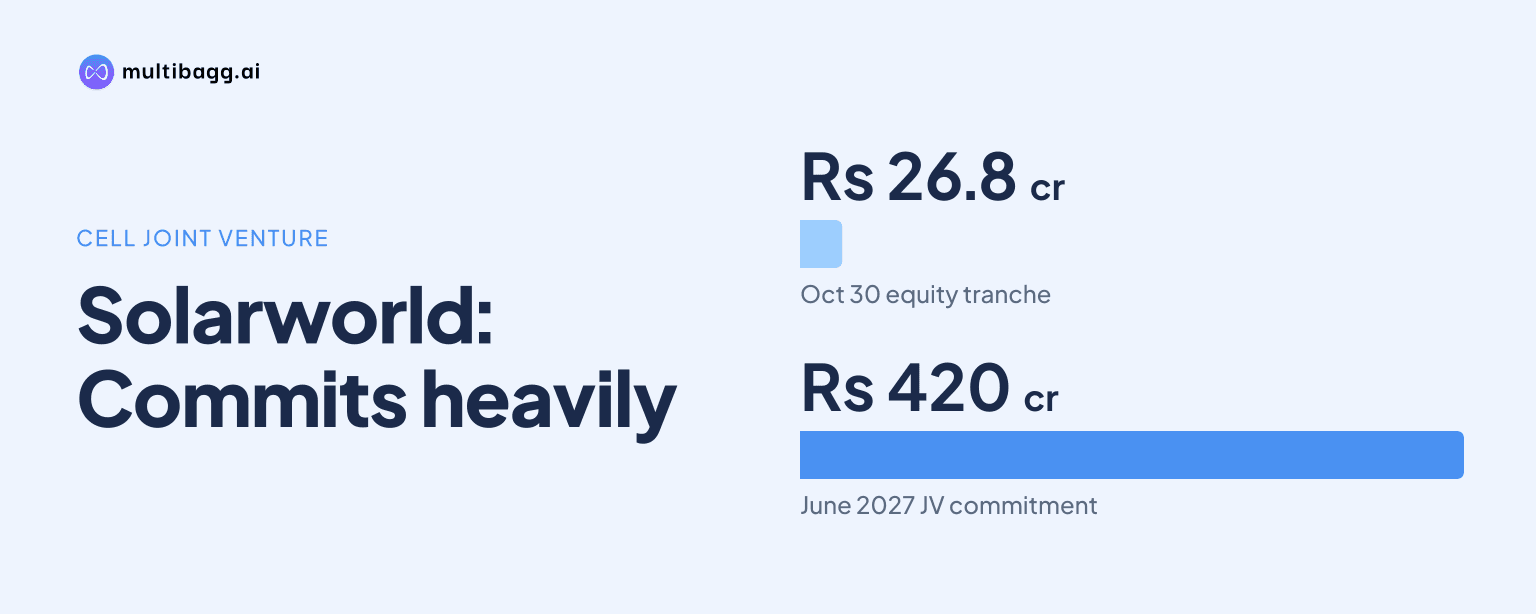
Solarworld Energy Solutions Ltd has committed up to Rs 420 crore to a 50:50, 2.4 GW solar photovoltaic cell joint venture with Rays Power Infra Limited, targeting commercial production in June 2027 after redirecting initial public offering proceeds from the earlier 1.2 GW Pandhurna plan.
Know Solarworld Energy Solutions inside out
Results, valuation, peers and who's buying, in one view.
What is Solarworld's 2.4 GW solar-cell joint venture?
Solarworld's project is a 50:50 joint venture with Rays Power Infra called Rays Green Energy Manufacturing Private Limited, which will build 2.4 GW of solar photovoltaic cell capacity at Mohasa in Madhya Pradesh's Narmadapuram district. The site covers about 41.30 acres, and the planned capacity is double the 1.2 GW Pandhurna facility that Solarworld had previously planned.
Solarworld has disclosed a commitment of up to Rs 420 crore for the venture, with initial public offering proceeds redirected from the Pandhurna project through a board-approved variation. Solarworld paid a first equity tranche of Rs 26.8 crore on 30 October 2026, acquiring 12,600 shares at Rs 21,287 each. That payment is an initial funding step, while the disclosed commitment sets the ceiling Solarworld says it may deploy.
Why is Solarworld building solar cells now?
Solarworld is pursuing cell production because domestic solar cell availability trails module manufacturing capacity and imported cells affected its first-quarter fiscal 2027 margin. India had about 210 GW of solar module capacity but only about 27 GW of solar cell capacity as of December 2025, according to the industry-capacity data cited in the presentation.
The comparison shows that module capacity was nearly eight times cell capacity, making cells the supply-chain constraint identified by Solarworld. The presentation also says tunnel oxide passivated contact, or TOPCon, technology accounted for about 70% of module lines, while domestic cell supply remained the gating item for manufacturers operating those lines.
Domestic-content requirement, or DCR, rules apply to solar projects from December 2026, according to Solarworld. The company says cells from the joint venture can support bids for DCR work, including PM-KUSUM projects. Solarworld also says imported-cell costs and a rupee that was 8% weaker year on year contributed to a first-quarter fiscal 2027 earnings before interest, tax, depreciation and amortisation margin of 11.6%; management presents captive cells as a way to reduce that import exposure.
Got a follow-up? Ask IRIS
How does the cell plant fit Solarworld's existing operations?
The 2.4 GW cell venture is intended to supply Solarworld's 1.552 GW module manufacturing line in Roorkee, Uttarakhand, creating a link between cell production and in-house module assembly. The Roorkee line is listed under the Approved List of Models and Manufacturers, or ALMM, and the cell capacity exceeds the module-line capacity by 0.848 GW.
Solarworld describes the operating model as supply-chain integration: captive cell sourcing supports its own module manufacturing while reducing dependence on externally sourced solar cells. The company also identifies greater control over sourcing, production and quality as expected operating effects. These are management's stated objectives for the 2.4 GW venture rather than reported production results, because commercial operation is still targeted for June 2027.
The cell project sits alongside Solarworld's engineering, procurement and construction, or EPC, and battery energy storage system, or BESS, businesses. As of 31 October 2026, Solarworld reported an Rs 3,856.9 crore combined order book for solar EPC and BESS, comprising Rs 2,718 crore for solar EPC and Rs 1,138.9 crore for BESS projects. The presentation therefore places the new cell capacity within an operating platform that includes modules, EPC execution and storage projects.
What milestones must Solarworld meet before June 2027?
Solarworld has completed major approvals for the Narmadapuram facility, including consent to establish and the factory building approval, while civil works were in progress at the time of the presentation. The next stated milestone is equipment, followed by commercial operation in June 2027. These stages show that the plant had not yet entered equipment installation or production when the update was issued.
The funding sequence is also material to the timetable. Solarworld had paid Rs 26.8 crore of its up-to-Rs-420-crore commitment by 30 October 2026, and the project capacity had been increased from 1.2 GW to 2.4 GW. The presentation does not state an equipment-delivery date, construction-completion date or further equity-tranche schedule, so civil-work progress and equipment procurement are the disclosed steps to monitor before the June 2027 target.
Solarworld's planned production date comes after DCR rules take effect from December 2026. That sequence matters to the company's stated strategy: the plant is intended to provide domestic cells for a 1.552 GW ALMM-listed module line as demand for DCR-eligible projects develops. Whether the venture reaches its June 2027 commercial-operation target will determine when that proposed captive supply mechanism becomes available.
Conclusion
Solarworld is making a defined backward-integration commitment of up to Rs 420 crore through a 50:50 joint venture that would add 2.4 GW of solar cell capacity, against an Indian market with about 27 GW of cell capacity as of December 2025. The project is designed to connect domestic cell production to Solarworld's 1.552 GW Roorkee module line and reduce the imported-cell exposure that management says affected its 11.6% first-quarter fiscal 2027 EBITDA margin.
The next point to watch is execution toward June 2027 commercial operation. Major approvals are complete, but civil works were still in progress and equipment was the next milestone; Solarworld had funded Rs 26.8 crore by 30 October 2026 against its maximum Rs 420 crore commitment. Progress on those steps will indicate whether Solarworld can supply cells into the DCR market after rules take effect in December 2026.