










Solarworld Energy Solutions Ltd Q2 profit fell 55% as margins shrank
Key highlights
- Solarworld's Q2 FY27 total revenue rose 81% year on year to Rs 254.90 crore.
- Solarworld's Q2 FY27 EBITDA margin fell to 5.9% from 12.8% a year earlier.
- Solarworld's Q2 FY27 profit after tax declined 55% year on year to Rs 4.19 crore.
- Solarworld reported NTPC-related order wins worth Rs 1,271.1 crore, with letters of award awaited.
powered by IRIS
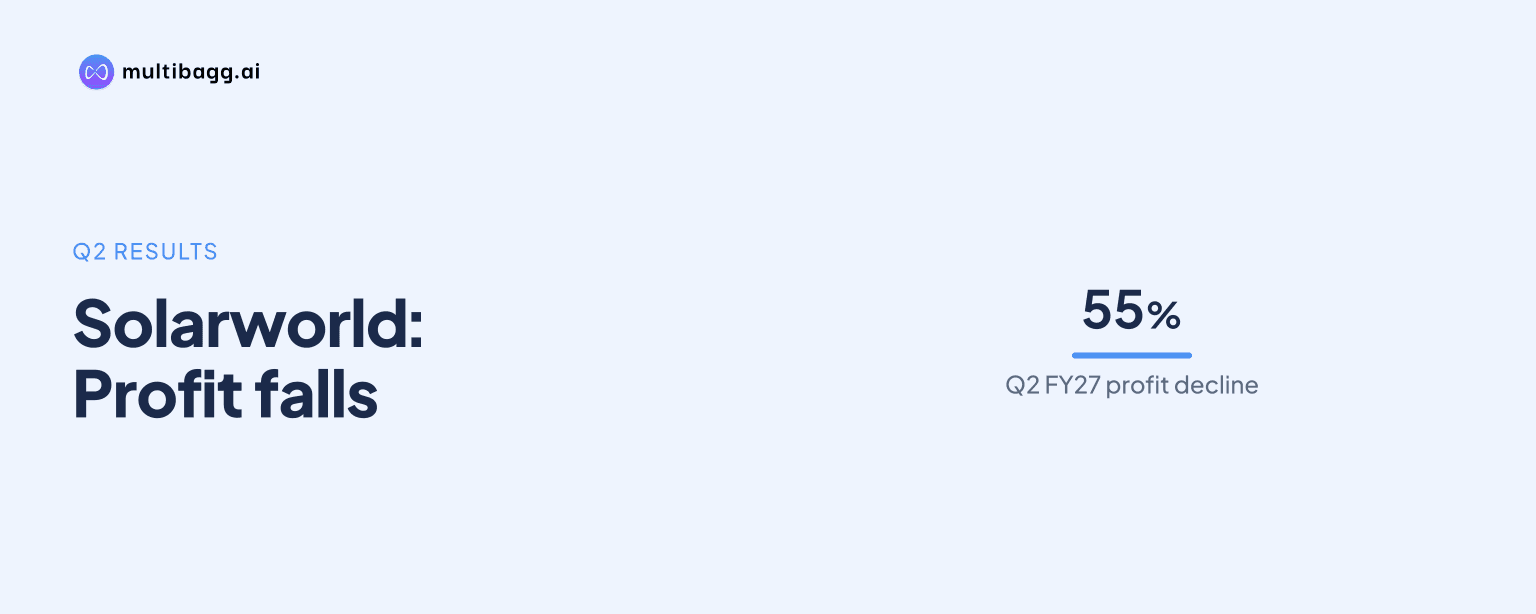
Solarworld Energy Solutions Ltd reported Q2 FY27 profit after tax of Rs 4.19 crore, down 55% year on year, even as total revenue rose 81% to Rs 254.90 crore, because its EBITDA margin contracted to 5.9% from 12.8% amid raw-material inflation, pricing competition and slower engineering, procurement and construction activity.
Know Solarworld Energy Solutions inside out
Results, valuation, peers and who's buying, in one view.
Why did Solarworld's Q2 FY27 profit fall despite revenue growth?
Solarworld's Q2 FY27 profit fell because costs increased faster than revenue and reduced gross and operating margins. Total revenue increased from Rs 140.72 crore in Q2 FY26 to Rs 254.90 crore, while gross profit rose only 8%, from Rs 27.90 crore to Rs 30.14 crore. Gross profit margin therefore declined by 8.0 percentage points to 11.8% from 19.8%.
Total raw material rose to Rs 224.76 crore in Q2 FY27 from Rs 112.82 crore a year earlier. Cost of materials consumed increased to Rs 144.37 crore from Rs 103.53 crore, while changes in inventories of finished goods and work in progress were Rs 63.15 crore, compared with negative Rs 1.95 crore in Q2 FY26. Engineering, procurement and construction, or EPC, project expenses also increased to Rs 15.35 crore from Rs 7.02 crore.
Earnings before interest, tax, depreciation and amortisation, or EBITDA, fell 16% to Rs 15.16 crore from Rs 18.08 crore. Employee expenses rose to Rs 6.42 crore from Rs 5.27 crore, and other expenses increased to Rs 8.56 crore from Rs 4.55 crore. EBITDA margin fell 6.9 percentage points to 5.9%, despite the 81% rise in total revenue.
Profit before tax declined 53% to Rs 5.96 crore from Rs 12.65 crore as finance cost rose to Rs 7.29 crore from Rs 3.83 crore. Tax expense was Rs 1.77 crore, compared with Rs 3.36 crore, resulting in profit after tax of Rs 4.19 crore against Rs 9.29 crore. Profit-after-tax margin narrowed to 1.6% from 6.6%, and basic earnings per share fell to Rs 0.48 from Rs 1.24.
How did Solarworld's Q2 FY27 performance compare with prior periods?
Solarworld's Q2 FY27 revenue increased against both Q2 FY26 and Q1 FY27, but profit and margins declined against both comparison periods. Total revenue rose 43% quarter on quarter from Rs 178.03 crore in Q1 FY27 to Rs 254.90 crore, while EBITDA fell 27% from Rs 20.66 crore and profit after tax fell 56% from Rs 9.50 crore.
Gross profit fell 9% sequentially from Rs 33.12 crore in Q1 FY27 to Rs 30.14 crore in Q2 FY27, even though revenue rose by Rs 76.87 crore. Gross profit margin declined to 11.8% from 18.6%, and EBITDA margin fell to 5.9% from 11.6%. The higher Q2 revenue base therefore produced less gross profit than the preceding quarter.
The first-half comparison also shows lower profitability. H1 FY27 total revenue rose 96% to Rs 432.93 crore from Rs 221.27 crore in H1 FY26, but EBITDA declined 9% to Rs 35.82 crore from Rs 39.22 crore. H1 EBITDA margin fell to 8.3% from 17.7%, while profit after tax decreased 38% to Rs 13.69 crore from Rs 22.20 crore.
Got a follow-up? Ask IRIS
Which costs and market conditions pressured Solarworld's margins?
Solarworld identified higher raw-material prices as a direct margin headwind, with lithium carbonate recording the largest disclosed annual increase. Lithium carbonate was up 67.78% year on year as of 29 September 2026, copper was up 36.26% as of 30 September 2026, and aluminium was up 19.93% as of 29 September 2026. The company tracks aluminium and copper using London Metal Exchange cash monthly averages.
The company also reported that the rupee had declined 8.16% year on year against the US dollar as of 29 September 2026. Its chart shows the monthly-average USD/INR rate at 95.3 in September 2026, compared with a labelled 88.4 level over the displayed October 2025 to September 2026 period. These input and currency movements coincided with Q2 total raw material of Rs 224.76 crore.
Competition added another pressure to pricing. Solarworld said new entrants were increasing competition and pushing prices lower, limiting the ability to offset input inflation. The stated effect in Q2 FY27 was a gross profit margin of 11.8%, down from 19.8% in Q2 FY26, while total revenue increased by Rs 114.18 crore year on year.
Solarworld also cited a significant slowdown in solar EPC activity. It attributed the slowdown to connectivity issues delaying new projects and daytime power surplus causing generation back-down. Against this backdrop, Q2 FY27 EPC project expenses were Rs 15.35 crore, more than twice the Rs 7.02 crore reported in Q2 FY26.
What is Solarworld doing to address EPC margin pressure?
Solarworld said all new solar projects will be paired with battery energy storage systems, or BESS, and that it will pursue standalone utility-scale and commercial-and-industrial BESS opportunities. It launched residential and commercial-and-industrial BESS products at REI 2026, supplied a first 125 kilowatt and 261 kilowatt-hour system to a customer, and expects its first containerised solution to be complete by December 2026.
Management's second response is cost reduction through new approaches intended to retain EPC margins. Solarworld has not quantified savings or given a margin target, but it reported Q2 FY27 EBITDA of Rs 15.16 crore and an EBITDA margin of 5.9%. Its disclosed BESS manufacturing facility capacity is 3.4 gigawatts.
Solarworld is also pursuing data-centre EPC and transmission lines. It said it is in discussions with global players for a technical tie-up in data-centre EPC, without disclosing a signed agreement or revenue contribution. Separately, it reported order wins worth Rs 1,271.1 crore from NTPC REL and NTPC UP Green Energy, while letters of award remain awaited.
The company has a joint venture with Rays Green for a 2.4-gigawatt solar-cell facility at Narmadapuram, Madhya Pradesh, with commercial operations targeted for June 2027. Solarworld also reported 1.552 gigawatts of solar-module capacity and 5 gigawatts of junction-box capacity. Management is evaluating a lithium-ion cell manufacturing line, but disclosed no investment amount or operating timetable.
Conclusion
Solarworld's Q2 FY27 figures show that revenue growth did not translate into earnings growth: total revenue rose to Rs 254.90 crore, but gross profit reached only Rs 30.14 crore and profit after tax fell to Rs 4.19 crore. The comparisons with Q2 FY26, Q1 FY27 and H1 FY26 show margin compression at gross-profit, EBITDA and net-profit levels.
The next disclosed milestones are completion of the first containerised BESS solution by December 2026 and targeted commercial operations at the 2.4-gigawatt solar-cell joint venture in June 2027. Readers can also watch for letters of award on the Rs 1,271.1 crore NTPC-related orders, progress on the proposed data-centre EPC tie-up, and any disclosed effect of cost-reduction measures on EPC margins.