










Solarworld Energy Solutions Ltd has 582 MW BESS orders due June 2027
Key highlights
- Solarworld has 582 MW/1,164 MWh of BESS orders in execution, all due by 30 June 2027.
- Solarworld has submitted 1,140 MW/4,560 MWh of BESS bids valued at Rs 7,600 crore.
- India's BESS capacity requirement is presented as rising from 6 GW in FY27E to 80 GW in FY36E.
- Solarworld lists 3.4 GW of BESS capacity with Rs 1,950 crore of maximum annual revenue potential.
powered by IRIS
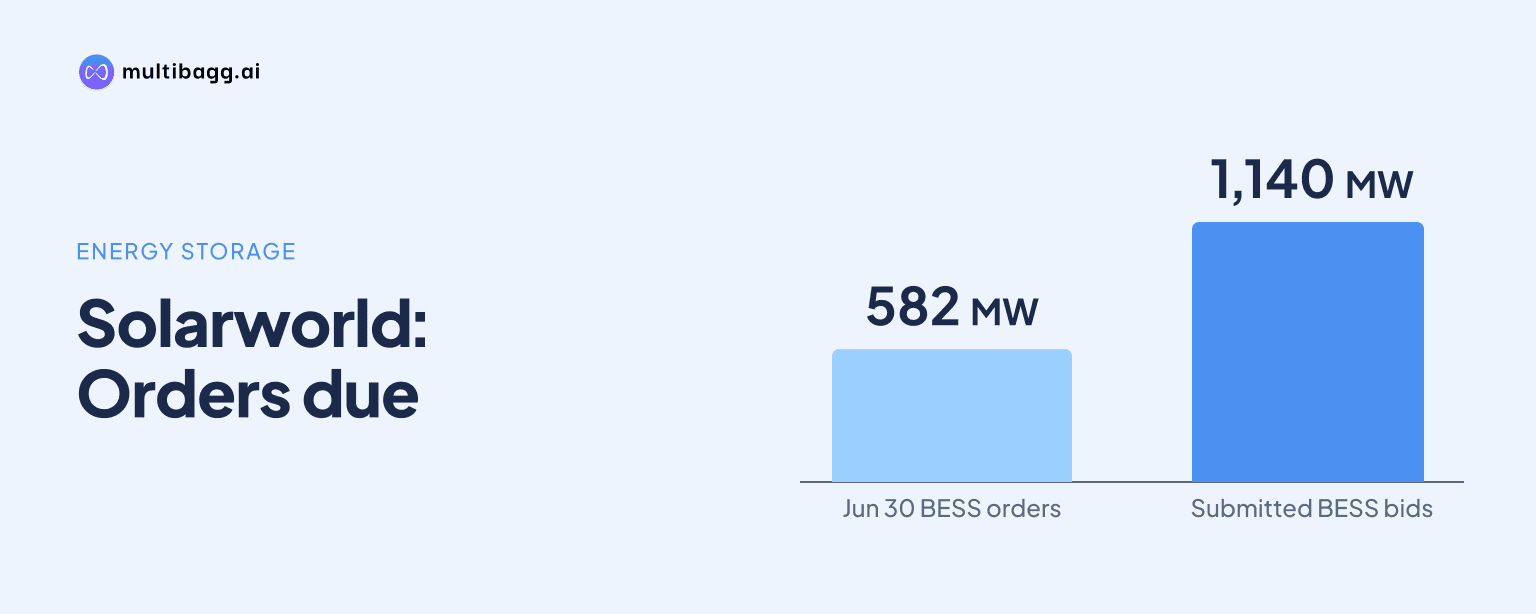
Solarworld has 582 megawatts (MW)/1,164 megawatt-hours (MWh) of battery energy storage system (BESS) orders in execution, all due by 30 June 2027, and submitted a further 1,140 MW/4,560 MWh of bids valued at Rs 7,600 crore. The execution book gives Solarworld a disclosed storage-delivery programme, though its bids are not confirmed contracts.
Know Solarworld Energy Solutions inside out
Results, valuation, peers and who's buying, in one view.
What BESS orders must Solarworld deliver by June 2027?
Solarworld must deliver five BESS contracts totalling 582 MW and 1,164 MWh by 30 June 2027. The book includes a 200 MW/400 MWh order for Gujarat Urja Vikas Nigam Limited in Gujarat, a 125 MW/250 MWh project for Rajasthan Rajya Vidyut Utpadan Nigam Limited in Rajasthan, and three engineering, procurement and construction (EPC) assignments for NTPC Ltd totalling 257 MW/514 MWh.
The five contracts each provide two hours of storage, based on the relationship between their MW and MWh capacities. GUVNL is the largest single order at 200 MW/400 MWh, while the three NTPC Ltd EPC packages represent 257 MW, or about 44% of Solarworld's 582 MW execution book, across Maharashtra and Uttar Pradesh.
How large is Solarworld's BESS bid pipeline?
Solarworld has submitted BESS bids for 1,140 MW/4,560 MWh with a stated value of Rs 7,600 crore. That submitted pipeline is about twice the 582 MW capacity of orders in execution and nearly four times their 1,164 MWh energy-storage capacity, but submitted bids are not awarded contracts.
The largest submitted package is 550 MW/2,200 MWh, with a stated value of Rs 3,666.7 crore, or about 48% of the reported bid value. All four bid packages provide four hours of storage, unlike the two-hour structure of the 582 MW order book, showing that Solarworld is bidding for longer-duration projects than those currently in execution.
Why is BESS demand expanding in India?
Solarworld identifies policy, tariffs and renewable-generation expansion as drivers of BESS demand, with India's required BESS capacity shown rising from 6 GW in FY27E to 80 GW in FY36E. Its presentation also shows solar capacity rising from 176 GW to 509 GW across that FY27 to FY36 period.
The presentation cites a 33.2% compound annual growth rate for India's BESS market, from $2.0 billion in 2026 to $8.59 billion by 2031, and expected national storage demand of 411 gigawatt-hours by 2032. These are market estimates included in Solarworld's presentation rather than company guidance.
Since February 2025, new solar photovoltaic projects must include BESS equal to at least 10% of installed solar capacity for a minimum of two hours, according to the presentation. It also cites Rs 14,500 crore of viability-gap funding for 92 GWh of grid-scale energy-storage systems under the Power System Development Fund.
Solarworld says imported battery cells face a 2.5% duty when assembled in India, compared with a 22% duty on imported battery containers. It also cites solar-plus-BESS tariffs near Rs 5.5 per unit, versus thermal power at about Rs 6 per unit, and notes diesel-generator curbs as a further source of backup-power demand.
Got a follow-up? Ask IRIS
How is Solarworld building BESS manufacturing capability?
Solarworld launched BESS and commercial-and-industrial products at REI 2026 and describes a model of importing lithium-ion cells, assembling packs in India and supplying containerised systems. Its fully automated cell-to-pack line uses KUKA robotics, and Solarworld may also undertake transmission, switchyard and approval-related EPC work.
Solarworld says about 1.4 GW of line capacity is covered by orders in hand and about 2.4 GW is open to third parties. It separately lists BESS manufacturing capacity of 3.4 GW and maximum annual BESS revenue potential of Rs 1,950 crore; the presentation does not reconcile the 3.4 GW figure with the 1.4 GW and 2.4 GW line-capacity descriptions.
For projects held through build-own-operate contracts, Solarworld says BESS packs go to project subsidiaries while it also manages related EPC activities. This arrangement links its assembly operation to project delivery, including the five contracts totalling 582 MW/1,164 MWh due by 30 June 2027.
What does BESS mean for Solarworld's growth plan?
Solarworld's stated strategy is to target a 60:40 BESS-to-solar EPC revenue mix, supported by in-house engineering, operations and maintenance, partnerships and capacity scale-up. This is a management target rather than reported revenue composition, and the presentation gives no date for reaching that mix.
Solarworld lists maximum annual revenue potential of Rs 5,400 crore across current and planned manufacturing capacities, compared with FY26 revenue from operations of Rs 1,376.2 crore. BESS represents Rs 1,950 crore of that potential, compared with Rs 1,200 crore for operating 1.552 GW module capacity and Rs 150 crore for operating 5 GW junction-box capacity.
Solarworld also plans a 2.4 GW solar-cell joint venture with Rays Power Infra Limited, targeted for commercial production in June 2027. The cell venture is separate from BESS but forms part of the wider backward-integration plan; Solarworld has committed up to Rs 420 crore and paid a first Rs 26.8 crore tranche on 30 October 2026.
Conclusion
Solarworld's storage expansion has progressed from a product launch at REI 2026 to five BESS orders totalling 582 MW/1,164 MWh, all scheduled for delivery by 30 June 2027. Its Rs 7,600 crore bid pipeline exceeds the execution book in capacity, while mandatory storage requirements, funding support and cited tariff comparisons form the demand context presented by Solarworld.
The next disclosed milestones are delivery of the five BESS orders by June 2027, outcomes from the 1,140 MW/4,560 MWh submitted bids and progress toward management's 60:40 BESS-to-solar EPC revenue target. Solarworld also plans commercial production from its separate 2.4 GW solar-cell joint venture in June 2027.