










Sonata shifts to $2m-$4m deals amid large-deal delays
Key highlights
- Sonata reported 1% growth in the latest quarter after four to six quarters of headwinds from large-account ramp-downs.
- Sonata classifies large deals as contracts over $5 million and targets key deals typically worth $2 million to $4 million.
- Management cited a $4.2 million latest-quarter deal as a significant key-deal example.
- About 30% of Sonata’s large-deal opportunities are in its top 10 accounts.
powered by IRIS
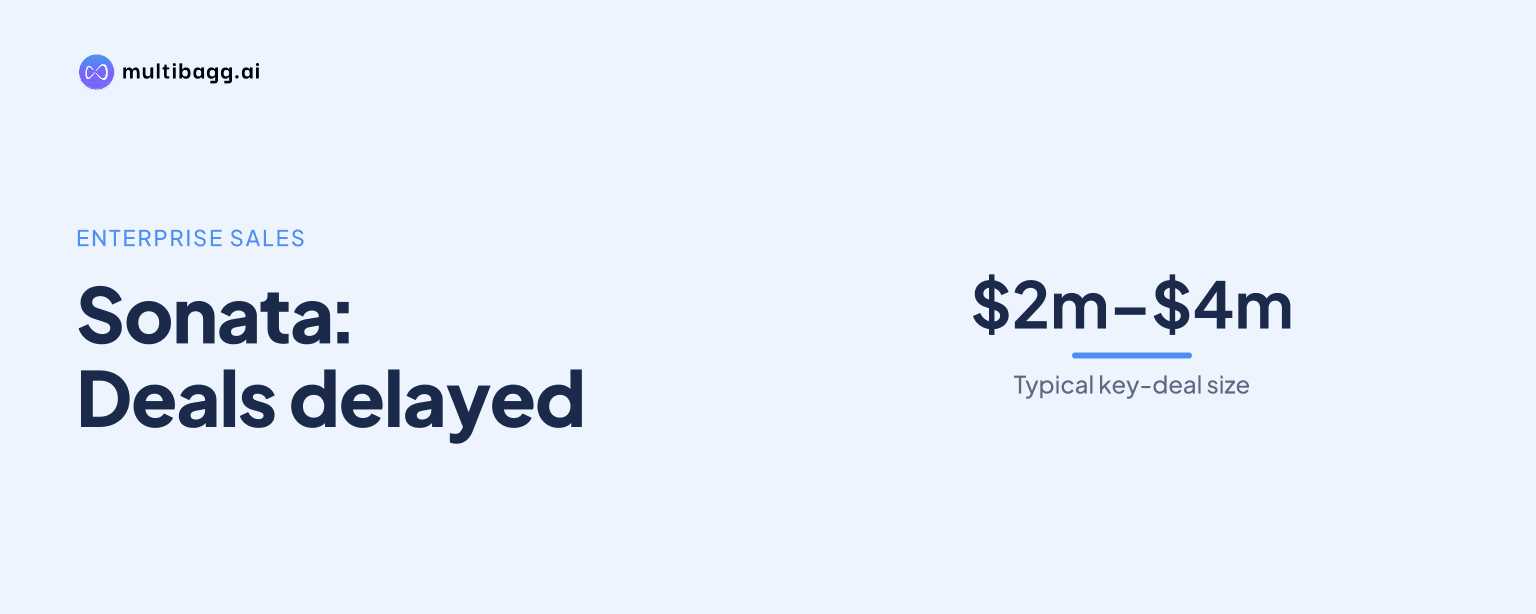
Sonata Software Limited reported 1% growth in the latest quarter and said it is shifting toward $2 million to $4 million key deals to reduce reliance on delayed decisions for contracts above $5 million. Management cited a $4.2 million deal in the quarter as evidence that these mid-sized contracts remain material to its sales pipeline.
Know Sonata Software inside out
Results, valuation, peers and who's buying, in one view.
Why is Sonata changing its deal strategy?
Sonata is changing its approach because it says large contracts, defined as deals over $5 million, involve decision-making delays and complexities that have affected performance. Management said the company does not want to depend only on large deals and is instead building a wider base of substantial contracts. It began identifying “key deals” as an indicator of that broader pipeline.
The stated key-deal range is typically $2 million to $4 million, although management said some deals can be slightly below $5 million. A $4.2 million contract won in the latest quarter was not classified as a large deal but remained significant for Sonata. Management’s objective is to mitigate the risk that delayed approvals for a smaller number of large contracts affect quarterly performance.
What supports Sonata’s focus on key deals?
Sonata’s 1% growth in the latest quarter is the immediate backdrop to the sales change. Management said the prior four to six quarters included headwinds from large-account ramp-downs while the company built a steadier base business. It described the 1% increase as an early indicator of a move from stability toward growth, rather than confirmation that account-specific pressures have ended.
Large deals remain relevant to the plan because management said about 30% of its large-deal opportunities are within the top 10 accounts. However, mid-sized accounts are scaling faster in some cases through an artificial intelligence, or AI, go-to-market model. Sonata said it proves a use case for two or three months before scaling it, while larger organisations can take longer because of security and regulatory considerations.
Which offerings could create more Sonata deal opportunities?
Sonata identified AI-native service delivery, legacy modernisation and service-delivery transformation as three demand areas supporting its growth plans. Its AI-native delivery proposition is built around an enterprise workbench, while its Harmoni.ai assets support business transformation with AI, legacy modernisation and delivery transformation. Management said these offerings are creating positive customer traction.
Legacy modernisation expands the addressable demand pool because it covers work that management said was not previously available to Sonata. The company cited opportunities across data, cloud applications and business processes. The prove-and-scale mechanism is also progressing faster in mid-sized accounts, which aligns with the move toward $2 million to $4 million contracts.
Partnerships are another sales channel in the plan. Sonata said it has strengthened ties with Microsoft and Amazon Web Services, or AWS, and has other partnerships in development. Management said Dynamics business has started growing again through new bids and described its data pipeline as strong, although the revenue contribution is not yet visible.
Sonata’s AWS strategic collaboration agreement is a five-year contract, but management said the first two to three quarters are intended for building a competency team and go-to-market capability. It expects execution to most probably start in the first quarter of the next financial year. Management said the programme is intended to accelerate AWS customer acquisition and gradually double earnings from AWS technology areas.
Got a follow-up? Ask IRIS
Which industries could support Sonata’s sales growth?
Sonata expects technology, media and telecommunications, or TMT, banking, financial services and insurance, or BFSI, and healthcare to support growth. Management said healthcare and life sciences, or HLS, has been growing consistently. BFSI improved in the latest quarter after the run-down of an account associated with Quant, though management flagged a possible headwind in the third quarter.
TMT has account-level variability rather than broad-based pressure, according to management. It said a recent decline was isolated to one top account and expects positive momentum there from the next quarter. Management also cautioned that another TMT account could see a slight ramp-down in the coming quarter, even as it expects top 10 accounts overall to show accretion.
The second TMT account’s order book has increased significantly, management said, but revenue will be spread over a longer period. Management’s longer-term view for that account covers eight to 10 quarters, compared with the potential near-term quarterly impact. This distinction illustrates why Sonata is seeking a broader mix of key deals alongside top-account opportunities.
Retail may take one or two quarters to recover, management said, while logistics has shown signs of recovery. Sonata also cited wins in agriculture and mature prospects in life sciences under its sub-vertical strategy. In BFSI, it is building propositions for mortgage and lending, with management saying life sciences is closest among these initiatives to revenue contribution.
How does the key-deal plan change Sonata’s account exposure?
The key-deal plan is intended to build a more resilient revenue base, but top accounts remain important to Sonata’s near-term outlook. Management expects the top 10 accounts to show accretion despite isolated pressures and said it is continuing to build pipeline in those accounts. It also said a program ramp-down at a top account reduced revenue in the past quarter but that the company has moved into new areas.
The comparison is between a concentrated set of larger opportunities and a wider deal pool that may convert on shorter proof cycles. About 30% of large deals sit in the top 10 accounts, while management said mid-sized accounts are scaling faster through AI-led engagements. Sonata is not abandoning contracts over $5 million; it is seeking to balance their slower decision process with more $2 million to $4 million contracts and new-account opportunities.
Conclusion
Sonata’s sales shift is a direct response to the timing risk it associates with contracts over $5 million. The company reported 1% growth after four to six quarters of headwinds, and management pointed to faster scaling in some mid-sized accounts and a $4.2 million latest-quarter deal as signs that a broader key-deal pipeline can support its move from stability toward growth.
The next disclosures to watch are whether expected positive momentum returns at the affected top TMT account, whether the other anticipated TMT ramp-down is offset by top-10 accretion, and whether retail improves within the one- to two-quarter timeframe management cited. Sonata also plans to complete AWS team and platform preparation over the next quarter, with execution most probably beginning in the first quarter of the next financial year.