










Sonata Software AI-led order book rises 13.5% in Q2 FY27
Key highlights
- Sonata Software reported a $24.18 million AI/AI-led order book in Q2 FY27, up 13.5% quarter on quarter.
- Sonata Software’s AI-led pipeline reached $358 million in Q2 FY27, up 5% quarter on quarter.
- Sonata Software won three key deals and added four clients in HLS, Hi-Tech and RMD during Q2 FY27.
- 35% of Sonata Software’s active pipeline consisted of large deals, and 30% of that large-deal pipeline involved Fortune 500 clients.
powered by IRIS
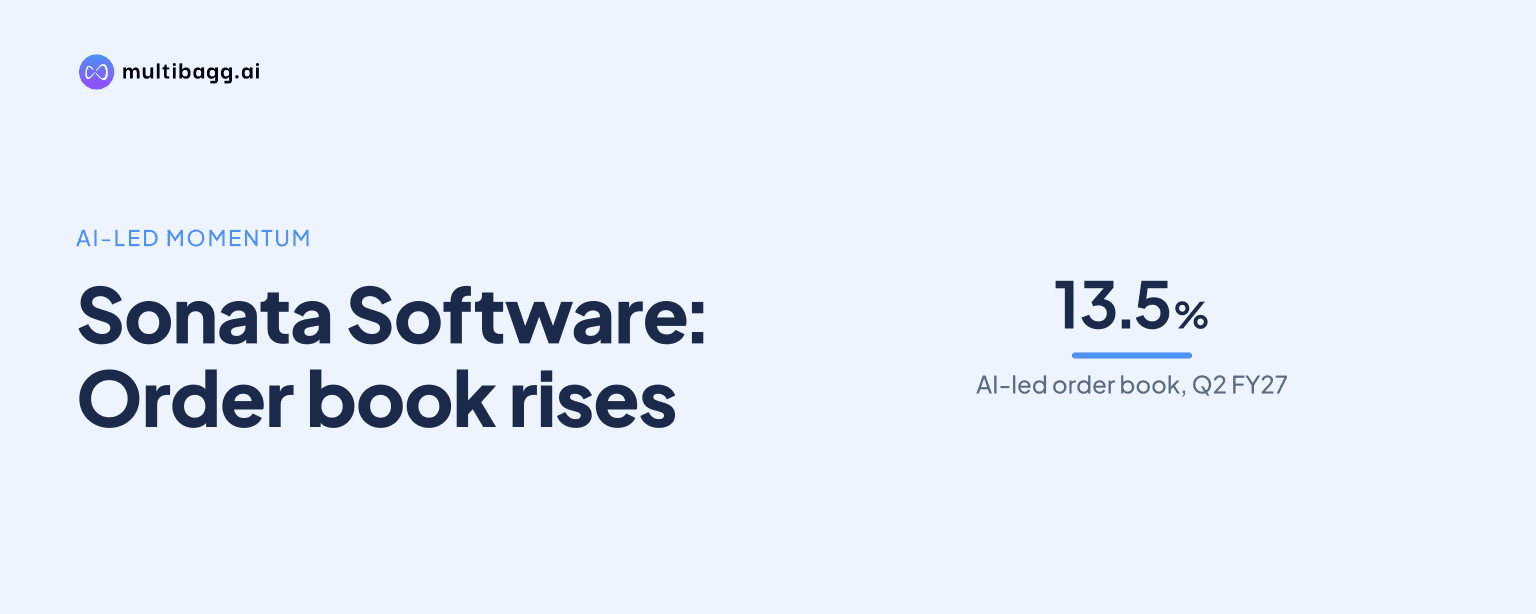
Sonata Software Ltd. reported an artificial intelligence (AI)/AI-led order book of $24.18 million in Q2 FY27, up 13.5% quarter on quarter, alongside an AI-led pipeline of $358 million, up 5%. Sonata Software also reported three key deal wins and client examples covering engineering productivity, managed services and legacy modernization.
Know Sonata Software inside out
Results, valuation, peers and who's buying, in one view.
What was Sonata Software’s AI-led order book in Q2 FY27?
Sonata Software’s AI/AI-led order book (OB) was $24.18 million in Q2 FY27, a 13.5% quarter-on-quarter (QoQ) increase. The presentation places the measure within AI and modernization rather than identifying it as the company’s total order book, making it a disclosed measure of AI-linked commercial activity.
Sonata Software’s AI-led pipeline was $358 million in Q2 FY27, growing 5% QoQ. The pipeline was substantially larger than the $24.18 million AI/AI-led OB, distinguishing opportunities under development from work included in the reported order-book measure. Management said traction in AI-led offerings was visible through both OB and wins.
How is Sonata Software’s large-deal pipeline distributed?
Sonata Software said 35% of its active pipeline consisted of large deals, while 30% of the large-deal pipeline involved Fortune 500 clients. These metrics relate to the active pipeline discussed with the Q2 FY27 wins and are separate from the company’s stated $358 million AI-led pipeline.
Sonata Software listed 13 large deals across four industry groups: four in technology, media and telecommunications (TMT), and three each in retail, manufacturing, travel and distribution (RMD), banking, financial services and insurance (BFSI), and healthcare and life sciences (HLS). TMT therefore had one more large deal than each of the other three disclosed groups, which were evenly represented.
Sonata Software added four clients in its focus segments during Q2 FY27, naming HLS, Hi-Tech and RMD. Its AI portfolio includes vertical AI solutions, platformized service delivery and ecosystem partnerships, with Harmoni.AI intellectual property, Workbench and AgentBridge identified as capabilities. The company also describes outcome-linked commercial models.
Which Q2 FY27 deals did Sonata Software win?
Sonata Software said it won three key deals in Q2 FY27, including one large deal. The presentation provides details on the large cloud-modernization mandate but does not name the client or disclose contract values for any of the three wins.
The large-deal client is described as a United States-headquartered leader in personal, facility and food-safety systems operating in North America within retail and manufacturing. Sonata Software’s scope is to design, build, manage and maintain a kitchen-automation platform using Microsoft, Android and iOS technologies, including a cloud-based platform and data transformation.
That mandate aligns with Sonata Software’s stated partner ecosystem, which includes Microsoft Azure, Amazon Web Services (AWS), Google Cloud, Snowflake, Microsoft Fabric, SAP Joule, ServiceNow and Agentforce. The company describes its Microsoft relationship as more than 30 years old and reported more than 3,500 team members on Microsoft technologies, alongside more than 500 Dynamics deployments and multi-country roll-outs.
Got a follow-up? Ask IRIS
What AI outcomes has Sonata Software reported for clients?
Sonata Software reported six-times faster delivery cycles for a home-lending and mortgage-servicing client using AI-powered engineering productivity tools. The example cited about 83% less time on testing and code review, with AI agents used for root-cause analysis and release planning, and said the delivery team used the tools daily.
For a leisure, travel and tourism company, Sonata Software reported a 30% service-delivery improvement using Enterprise Workbench and AI-led automation. The presentation describes the work as a shift to managed services, with automation intended to increase operational efficiency, but it does not provide a before-and-after revenue or cost figure.
Sonata Software also reported a 40% reduction in time to deliver for a global quick-service restaurant brand using AI-led legacy modernization. The company separately cited 30% more efficiency from Enterprise Workbench, alongside a stronger foundation for scaled operations, wider franchise reach and embedded AI.
How does Sonata Software plan to develop its AI offering?
Sonata Software’s stated AI positioning combines outcome-led business transformation, AI-first technology platforms and AI-native service delivery. Its platform approach includes legacy modernization, AI-ready data and a resilient AI command center, while its delivery model includes AI-powered engineering and autonomous operations.
Sonata Software also disclosed collaborations with the Wharton AI & Analytics Initiative and the Indian Institute of Science Foundation of Science Innovation and Development. The Wharton collaboration aims to bring academic and industry perspectives to enterprise-grade agentic-AI orchestration, while the Indian Institute of Science collaboration covers AI-driven scientific research, educational outreach, infrastructure upgrades and AI-startup incubation. The company reported more than 6,200 AI-ready engineers.
Conclusion
Sonata Software’s Q2 FY27 disclosures show AI-linked commercial activity across order book, pipeline, deal wins and client delivery examples. The $24.18 million AI/AI-led OB rose faster than the $358 million pipeline, at 13.5% QoQ versus 5%, while the broader active pipeline included 13 disclosed large deals across four industry groups.
The next measure to watch is conversion of the $358 million AI-led pipeline and the 35% large-deal share of active pipeline into further wins and order-book growth. Management’s disclosed plan relies on Harmoni.AI, outcome-linked models, ecosystem partnerships and AI-native delivery, but the presentation does not provide deal values, revenue targets or conversion timelines.