










Sonata Expects Higher Top-10 Contribution Despite Q3 Pressure
Key highlights
- Sonata said about 30% of its large deals are within top-10 client accounts.
- Management expects top-10 client contribution to rise despite isolated BFSI and TMT headwinds in Q3.
- One TMT account may see a slight Q3 ramp-down, but management said its order book has increased and extends over eight to 10 quarters.
- Sonata reported Q2 2027 consolidated revenue of Rs 2,445.2 crore, up 15.4% year on year.
powered by IRIS
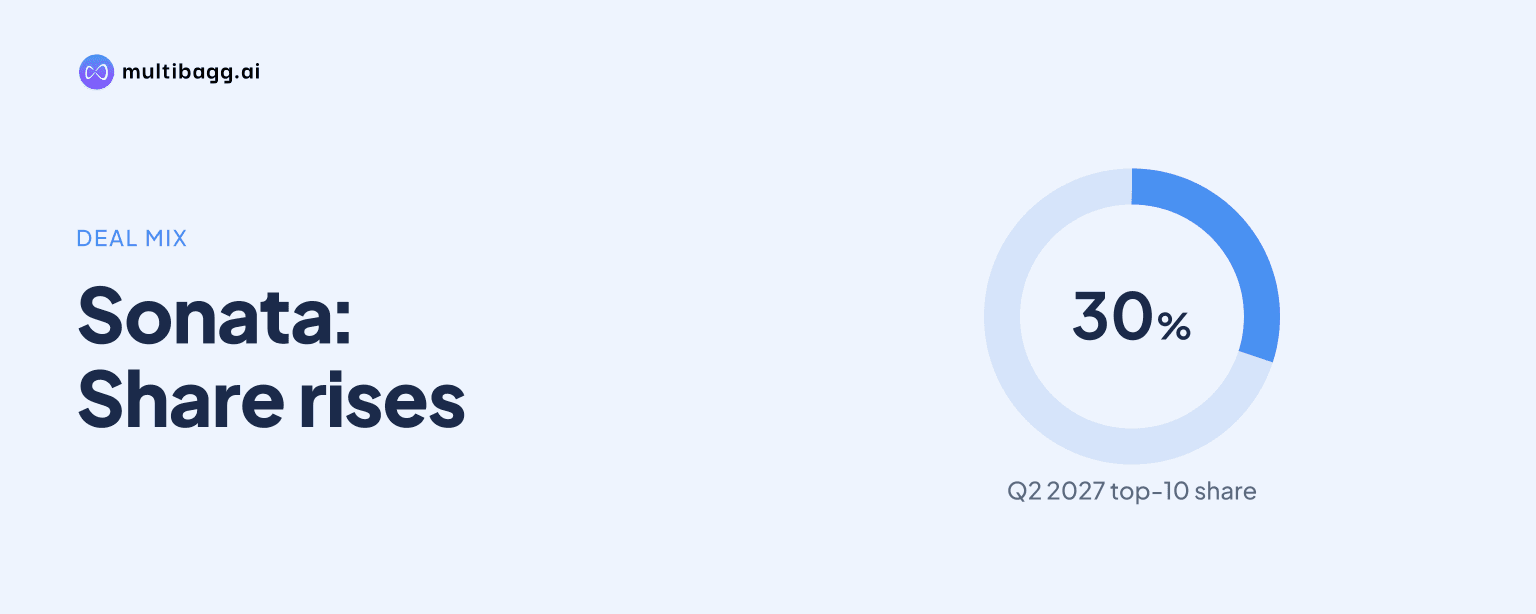
Sonata Software Limited expects its top-10 clients to contribute more revenue despite isolated Q3 pressure in banking, financial services and insurance, or BFSI, and technology, media and telecommunications, or TMT, management said on November 6, 2026, citing large-deal activity, of which about 30% sits in these accounts, and completion of the largest-account ramp-down.
Know Sonata Software inside out
Results, valuation, peers and who's buying, in one view.
Will Sonata's top-10 client contribution increase despite Q3 headwinds?
Yes. Sonata said its top-10 accounts should contribute more than in the past despite isolated headwinds expected in Q3, particularly in BFSI and TMT. Management did not provide a percentage growth target, the top-10 revenue share, or account-level projections.
The outlook follows a revenue decline at the largest account in the past quarter, caused by a ramp-down in one programme during renewals. Management said the ramp-down was complete and that positive traction should emerge from the next quarter after changes to account teams, leadership and the focus on artificial-intelligence, or AI, spending.
About 30% of Sonata's large deals are within the top-10 accounts, according to management. Sonata defines large deals as those above its stated threshold, while it is also pursuing smaller key deals to reduce reliance on contracts with longer decision cycles.
What client pressures does Sonata expect in Q3?
Sonata expects contained rather than broad-based client pressure in Q3. Management said BFSI may face headwinds and one TMT account may see a slight ramp-down, while maintaining that aggregate top-10 contribution should still rise.
In TMT, the earlier decline was isolated to one top account rather than spread across the segment, management said. It also identified a separate account where revenue could decline slightly in the coming quarter, although that account's order book has increased and is expected to generate revenue over a longer period of eight to 10 quarters.
BFSI comparisons are affected by the run-down of an account with substantial data work. Management said its largest BFSI customer had largely been associated with data services, contributing to both quarter-on-quarter and year-on-year weakness, although it said BFSI improved in the preceding quarter after the run-down.
Why does Sonata expect client-led growth pressure to ease?
Sonata expects pressure to ease because the largest-account ramp-down is behind it and it has redirected its approach toward AI-related demand. Management cited changes in teams and leadership, along with investments in proof of delivery for selected customers, as mechanisms to build pipeline and convert opportunities.
Its AI-led model is designed to prove an offering over two or three months and then scale it. Management said this “prove and scale” model is moving faster in mid-sized accounts, while larger opportunities can take longer because customers are weighing security and regulatory requirements.
Sonata identified three demand areas: AI-native service delivery, legacy modernisation and service-delivery transformation. Management said its enterprise workbench supports AI-native delivery, while legacy modernisation spans data, cloud applications and business processes through assets under Harmoni.ai.
The company is also widening its deal mix rather than depending only on large contracts. Management cited one key deal secured in the quarter and said deals below the large-deal threshold can still be material, while helping offset delays in complex large-deal decisions.
Got a follow-up? Ask IRIS
Which segments are supporting Sonata's client-growth outlook?
Sonata said healthcare and life sciences, or HLS, has been growing consistently, while TMT outside the affected top account is showing positive traction. Management also said BFSI improved in the preceding quarter after the account run-down, though it expects some sector pressure in Q3.
The segment outlook is uneven across the portfolio. Research and development is under some pressure, management said, while retail may require one or two quarters to recover and logistics has shown signs of recovery.
Sonata said it has recorded agriculture wins and improved its go-to-market work in that area. It also cited strengthened partnerships with Microsoft and Amazon Web Services, new bids supporting Dynamics business, and a data pipeline that management said may not yet be visible in revenue.
At the consolidated level, Sonata reported Q2 2027 revenue of Rs 2,445.2 crore, up 15.4% year on year, and profit after tax of Rs 116.4 crore. Management also said the IT services business recorded 1% growth after four to five quarters below 0.5% growth, describing this as an early shift from stability toward growth.
How are investment costs affecting Sonata's near-term margins?
Sonata said Q2 included severance costs of about 50 basis points and proof-of-delivery investment of about 100 basis points. The severance followed downsizing in certain geographies linked to the large account, while the proof-of-delivery spending was aimed at demonstrating value for selected customers.
Management said some proof-of-delivery investment could continue in Q3 depending on customer requirements, opportunity and deal size, but it did not quantify the potential cost. Higher utilisation and operational-efficiency savings were Q2 tailwinds, while salary increases for lower-management employees, representing about 60% of the workforce, were a cost headwind.
Sonata retained its aspiration to operate with earnings before interest, tax, depreciation and amortisation margin of 18% to 20%. Management said it expects margin momentum to improve from the Q2 base, but gave no date or numerical forecast for reaching that range.
Conclusion
Sonata's expectation of higher top-10 contribution rests on a completed ramp-down at its largest account, about 30% of large deals being held within the top 10, and faster scaling in mid-sized accounts through AI-led offerings. The outlook is nonetheless qualified by expected Q3 BFSI pressure and a slight potential ramp-down at one TMT account.
The next disclosures to watch are the scale of the Q3 TMT and BFSI effects, conversion of top-10 deal pipeline into revenue, and the pace of proof-of-delivery investment. Management also said the affected TMT account's larger order book is expected to produce revenue over eight to 10 quarters, while customer security and regulatory reviews may extend decision-making periods.