










SPR Auto sees legacy powertrain growth settling at 7%-8%
Key highlights
- SPR Auto expects legacy powertrain market growth of 7%-8% CAGR.
- SPR Auto reported 17% standalone growth in the first half but expects moderation over the next two years.
- Management said ICE engines will still be needed in 2030 and 2032 alongside CNG, HCNG and other powertrains.
- SPR Auto expects mature-year incremental business wins of more than Rs 1,000 crore.
powered by IRIS
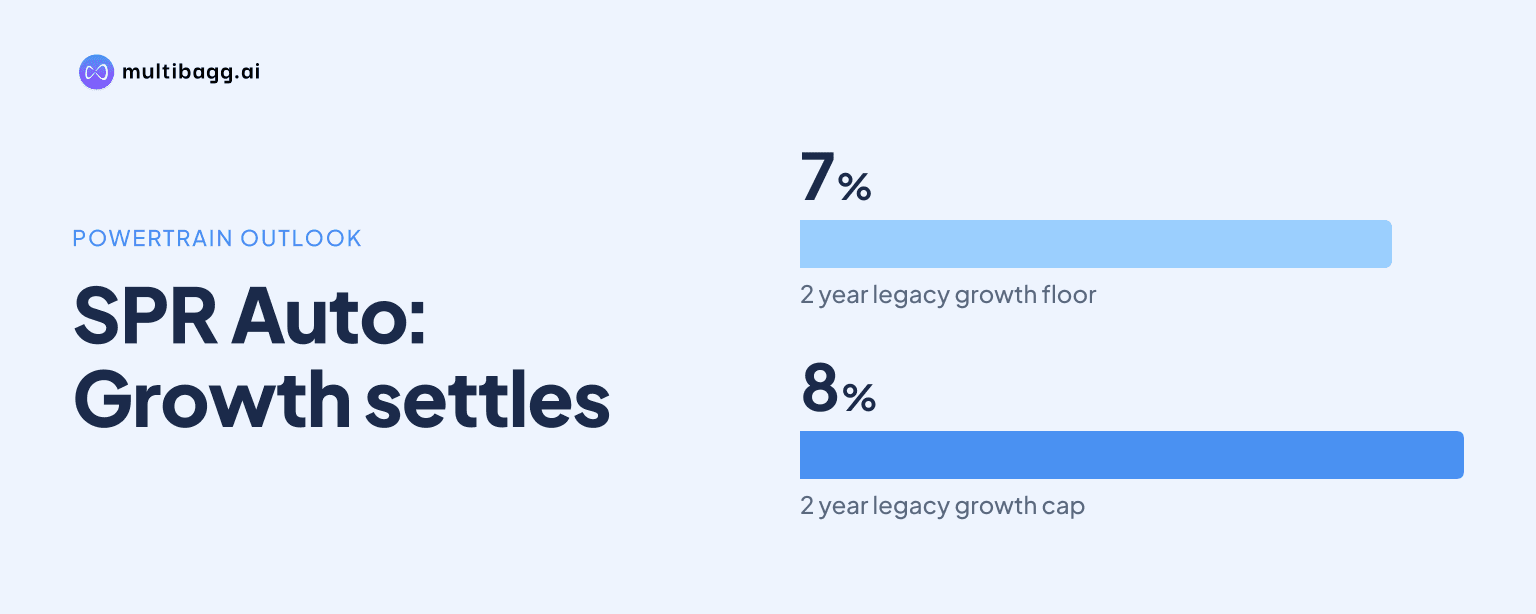
SPR Auto expects the legacy powertrain market to grow at a 7%-8% compound annual growth rate, or CAGR, as vehicle volumes and alternative-fuel options continue to require internal-combustion-engine, or ICE, products through 2030 and 2032. Management said its 17% standalone growth in the first half is unlikely to continue at that pace over the next two years.
Know SPR Auto Technologies inside out
Results, valuation, peers and who's buying, in one view.
Why does SPR Auto expect 7%-8% legacy powertrain growth?
SPR Auto expects the legacy powertrain market to expand at a 7%-8% CAGR rather than sustain growth of 17%-20% over the next two years. Management said its earlier expectation of market growth of about 7%-8% remains unchanged, despite electric-vehicle penetration. The outlook covers the wider market for legacy products, including pistons, rather than a formal SPR Auto revenue forecast.
Management’s argument is that rising vehicle volumes can still require more ICE engines in 2030 and 2032. It cited compressed natural gas, or CNG, hydrogen-enriched compressed natural gas, or HCNG, and other powertrains as part of the expected vehicle mix. SPR Auto did not disclose forecasts for ICE-engine volumes, electric-vehicle penetration, or CNG and HCNG market shares.
SPR Auto said it is adding capacity in its legacy business as well as in other segments because it expects growth across its operations. Management therefore does not see electric-vehicle adoption replacing the full market for engine-related products by 2030 and 2032. The call did not provide a year-by-year view of the transition between ICE, CNG, HCNG and electric powertrains.
How does SPR Auto’s recent growth compare with its outlook?
SPR Auto reported 17% standalone growth in the first half, above its stated longer-term market CAGR expectation of 7%-8%. Management said the weighted average of market growth was also close to 17% in the first half, indicating that the standalone business was growing broadly in line with the market during that period. An analyst identified financial year 2027, or FY27, as a high comparison base for the piston business.
Management said growth in the next two years should become “more or less toned down” to achieve a total CAGR of around 7%-8%. This marks a slower expected pace than the first-half comparison, while retaining management’s expectation of continued legacy-powertrain growth. SPR Auto did not identify the relative role of original equipment manufacturer, or OEM, demand, domestic aftermarket sales, exports, non-automotive applications, or the FY27 base in that moderation.
The analyst cited domestic aftermarket, exports, OEMs and non-auto applications as possible piston-business growth drivers alongside the FY27 high base. Management did not disclose revenue, volume or margin data for any of those channels. The call therefore supports the direction of the 7%-8% market outlook but does not quantify each channel’s contribution to piston demand.
Got a follow-up? Ask IRIS
What businesses support SPR Auto beyond legacy powertrains?
SPR Auto expects mature-year incremental business wins of more than Rs 1,000 crore across its operations, in addition to regular standard business of around Rs 6,000 crore. Management did not disclose customer names, programme start dates or the split of these wins between legacy engine products, electric-vehicle products and interiors, citing competitive sensitivity around individual programmes.
SPR Auto also described activity in electric-vehicle-related interiors programmes. Management said it had nominations from multiple customers for future programmes, including electric vehicles, and was working with at least two or three customers on proof-of-concept discussions for speakerless acoustic headliner technology. It said the product could improve realization by about 15%-18% in smaller cars and by close to 30%-40% in larger vehicles with higher sound-quality requirements.
Management said its ambient-lighting business was growing faster than its other interiors businesses and had won new programmes. These products do not change the 7%-8% legacy-market outlook, but they provide product lines that do not depend on one engine type. SPR Auto did not disclose lighting revenue, customer adoption rates, programme duration or how much of the more than Rs 1,000 crore of incremental mature-year wins relates to interiors.
How is SPR Auto preparing capacity for expected demand?
SPR Auto is expanding capacity ahead of the market in Pithampur, Pathredi, Ghaziabad, Neemrana and its interiors operations, but management did not disclose an annual capital-expenditure budget. It said Pathredi had recently expanded, Ghaziabad was under expansion, and a new precision injection-moulding plant was being developed next to the existing Neemrana plant.
Management also said it was investing in capacity across multiple product lines in the Antolin interiors business and in additional precision injection-moulding capacity. When asked for a capital-expenditure figure, it declined to provide one because three or four further decisions could change the plan. Management described the planned spending as sizable but gave no commissioning date for the Neemrana plant or the other expansions.
SPR Auto completed a qualified institutional placement of Rs 1,000 crore during the quarter. The call did not allocate those proceeds among the capacity projects, working capital or other uses. Management said the expansions were backed by firm business orders from customers, including aftermarket and export customers, without providing contract values or project-level volumes.
Management said group and standalone working-capital levels remained normal despite increased manufacturing activity. In the precision-plastics business, it said raw-material availability may need to cover at least three months of production. That inventory requirement, together with investment in legacy products, precision plastics and interiors, is part of SPR Auto’s preparation for the demand it expects across segments.
Conclusion
SPR Auto’s disclosed view is that electric-vehicle penetration will not remove the need for legacy powertrain products through 2030 and 2032. Management expects the broader market to settle at a 7%-8% CAGR and does not expect the first-half 17% pace, or growth of 17%-20%, to continue over the next two years. Its rationale rests on vehicle volumes and a powertrain mix that includes CNG, HCNG and other ICE-related applications.
The next points to watch are management’s pending three or four capital-expenditure decisions, execution of expansions in Pithampur, Ghaziabad and Neemrana, and progress in converting more than Rs 1,000 crore of incremental mature-year wins into production. Future disclosures on OEM, aftermarket, export and non-auto sales would also show how the 7%-8% market expectation translates across SPR Auto’s channels.