










SPR Auto Technologies Limited Q2 income rises 61% to ₹1,674.6 crore
Key highlights
- SPR Auto Technologies Limited reported Q2 FY27 consolidated total income of ₹1,674.6 crore, up 61% year-on-year.
- Q2 FY27 consolidated EBITDA rose 29% year-on-year to ₹300.4 crore, with an EBITDA margin of 17.9%.
- H1 FY27 consolidated income was ₹3,173.8 crore and EBITDA was ₹583.1 crore, up 56% and 28% year-on-year respectively.
- Acquisition-related finance costs increased by ₹23.4 crore in Q2 FY27 and ₹48.6 crore in H1 FY27.
powered by IRIS
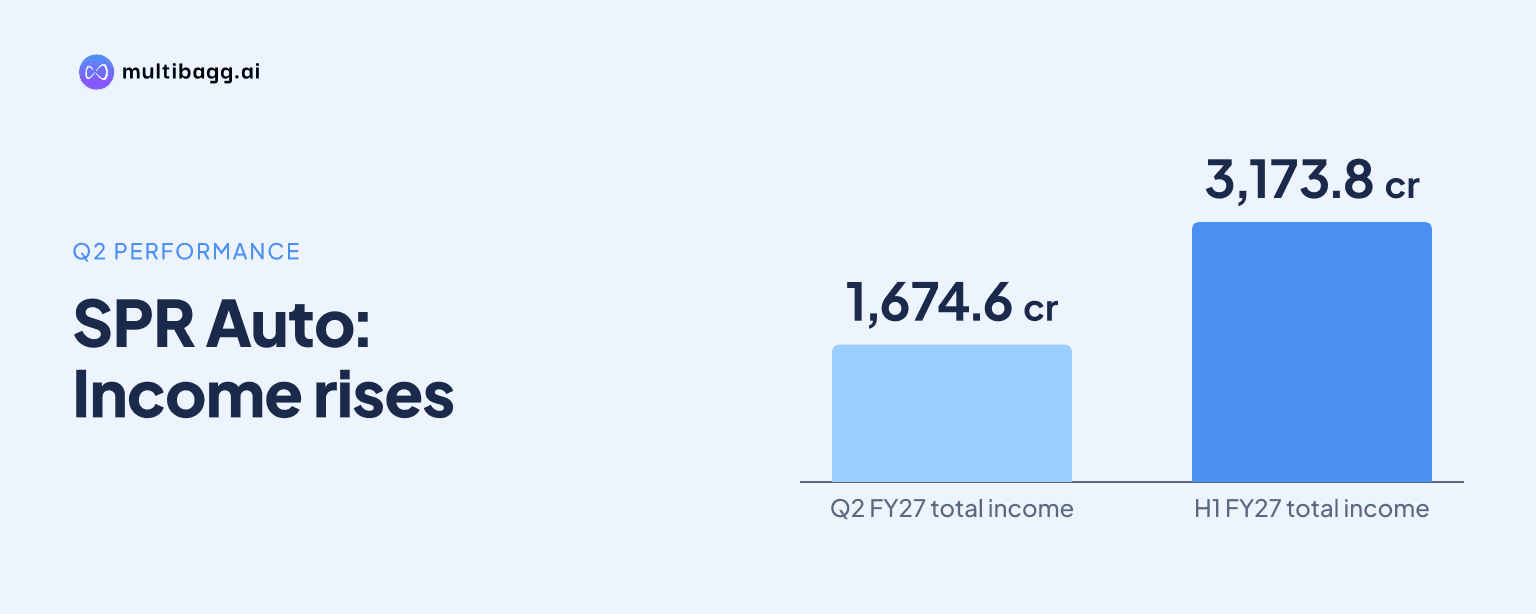
SPR Auto Technologies Limited reported consolidated total income of ₹1,674.6 crore in Q2 FY27, up 61% year-on-year, while EBITDA rose 29% to ₹300.4 crore despite cost pressures from commodities, wages and acquisition-related funding. The result reflects contribution from the acquired Antolin India businesses alongside growth in the stand-alone operations.
Know SPR Auto Technologies inside out
Results, valuation, peers and who's buying, in one view.
What did SPR Auto report in Q2 FY27?
SPR Auto reported a sharp increase in consolidated revenue and operating profit during the September quarter. Consolidated total income reached ₹1,674.6 crore, compared with the corresponding quarter a year earlier, while EBITDA increased to ₹300.4 crore. The company recorded a consolidated EBITDA margin of 17.9% for the quarter.
For the first half of FY27, consolidated total income stood at ₹3,173.8 crore, up 56% year-on-year. First-half EBITDA was ₹583.1 crore, representing year-on-year growth of 28%. The difference between revenue growth and EBITDA growth indicates the effect of higher operating and financing costs during the period.
The company discussed the results in its Q2 and H1 FY27 earnings call held on November 2, 2026. Krishna Kumar Srinivasan, Managing Director and Chief Executive Officer, along with Prem Rathi, Executive Director and Chief Financial Officer, and Nilesh Jain, Head Legal and Company Secretary, represented management on the call.
What drove SPR Auto's revenue growth?
SPR Auto said its diversified business model and the recently acquired Antolin India operations contributed to the quarterly performance. Management described the growth as broad-based across its businesses, with the acquired operations adding to consolidated revenue and helping the company secure new programme wins.
The stand-alone business grew 17% year-on-year. Management said this was broadly in line with weighted industry production growth, showing that the pre-acquisition operations also expanded during the quarter. This distinction is relevant because the 61% consolidated income increase includes both organic growth and the added scale from acquisitions.
The company also highlighted its powertrain-agnostic portfolio. These products accounted for more than 35% of consolidated revenue, while management said nearly 60% of the business was relatively insulated from changes in powertrain technology. This mix includes operations that are not solely dependent on conventional internal-combustion powertrain demand.
Why did SPR Auto's EBITDA margin face pressure?
SPR Auto's Q2 FY27 EBITDA margin was 17.9%, with management attributing the pressure to higher commodity and direct-material costs, changes in sales mix, and revisions under the Minimum Wages Act. Direct-material expenses cited on the call included tools and oils.
The company also incurred higher finance costs after funding the Antolin India acquisition. Finance costs increased by ₹23.4 crore in Q2 FY27 and by ₹48.6 crore in H1 FY27 because of acquisition-related borrowing. Management said these costs were expected to normalise after debt repayment.
These expenses help explain why EBITDA grew 29% even as consolidated income rose 61%. The result therefore combines a substantial increase in business scale with temporary cost factors that affected operating margins and financing charges during the first half.
Got a follow-up? Ask IRIS
How does the acquisition change SPR Auto's business mix?
The Antolin India acquisition has expanded SPR Auto's consolidated operations and was a material contributor to reported growth. Management linked the acquired businesses to new programme wins and wider participation across automotive segments, though it did not provide a separate quarter-wise revenue contribution for the acquired assets.
The company's comments on powertrain-agnostic products provide context for the portfolio strategy. With more than 35% of consolidated revenue coming from these products and nearly 60% of business described as relatively insulated from powertrain shifts, SPR Auto is reporting a broader revenue base than one focused only on engine-related components.
At the same time, acquisition financing has added to finance costs. Investors assessing the transaction's financial impact will need to consider both the additional revenue and operating contribution as well as the borrowing costs incurred while acquisition debt remains outstanding.
What does the Q2 result mean for investors and the auto-component sector?
The quarter shows that SPR Auto delivered growth in both its established operations and newly acquired businesses, even as input and labour-related costs rose. The 17% growth in stand-alone income indicates that the legacy business also participated in the underlying production environment cited by management.
For investors, the main financial indicators are the 17.9% EBITDA margin, the higher finance costs and the company's stated expectation that acquisition-related interest expense will normalise after debt repayment. The company did not provide a specific debt-repayment schedule or a margin target in the supplied call material.
For the auto-component industry, the result illustrates how product diversification and acquisitions can lift consolidated revenue while creating near-term pressure from integration and funding costs. Commodity prices, direct-material costs and wage-related changes remained key operating factors for SPR Auto during the quarter.
Conclusion
SPR Auto delivered Q2 FY27 consolidated income growth of 61% to ₹1,674.6 crore and EBITDA growth of 29% to ₹300.4 crore, supported by its stand-alone business and the Antolin India acquisition. However, the 17.9% EBITDA margin reflected higher commodities, direct materials, labour-related costs and acquisition funding expenses.
The next areas to watch are progress on repayment of acquisition-related debt, the resulting movement in finance costs, and whether margins improve as the cited cost pressures ease. Management has also highlighted new programme wins and the growing contribution of powertrain-agnostic products as operational factors relevant to the business mix.