










SPR Auto expects QIP to reduce acquisition interest costs
Key highlights
- SPR Auto completed its Rs 1,000 crore QIP at the end of August.
- Management expects third-quarter interest costs to improve after repaying most acquisition debt.
- Only a small portion of the QIP benefit appeared in the first-half results.
- SPR Auto reported a 19.9% standalone EBITDA margin in the second quarter, according to management.
powered by IRIS
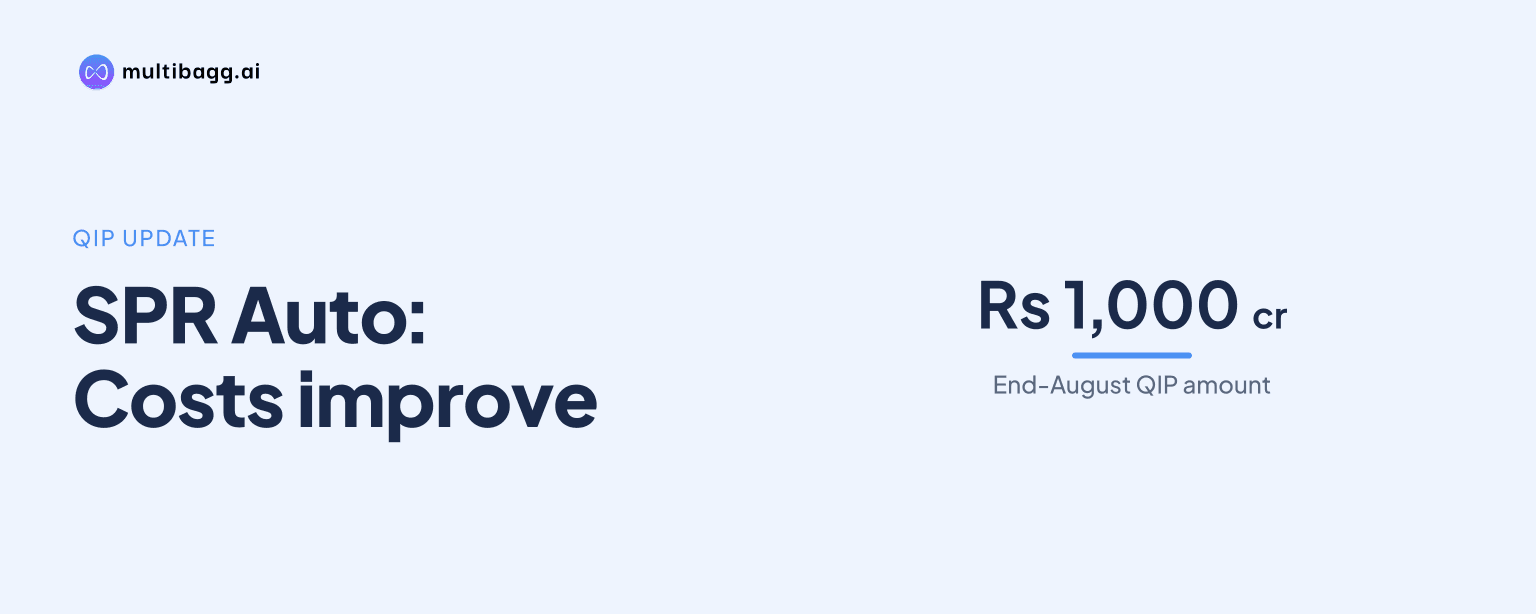
SPR Auto expects third-quarter interest costs to improve after completing a Rs 1,000 crore qualified institutional placement, or QIP, in late August and repaying most debt associated with the Antolin acquisition. Management said only a small benefit was reflected in the first-half results because the capital raise closed near the end of August.
Know SPR Auto Technologies inside out
Results, valuation, peers and who's buying, in one view.
When will SPR Auto's QIP reduce interest costs?
SPR Auto said the third quarter should show an improvement in interest costs because most acquisition-related debt has been repaid using the Rs 1,000 crore QIP proceeds. The company completed the equity issue at the end of August, placing the balance-sheet action late in the first-half reporting period. Management did not provide a quantified saving in finance cost, a revised debt balance or an interest-rate figure.
The timing matters because the Antolin acquisition had increased financing costs before the QIP was completed. In response to a question on whether interest would decline from the next quarter, management said third-quarter results should show improvement. This is a management outlook tied to the completed late-August QIP and debt repayment, rather than a formal forecast of quarterly finance expense.
Why was the first-half interest benefit limited?
SPR Auto said only a small portion of the QIP's effect was visible in the first-half results because the Rs 1,000 crore issue closed at the end of August. The first half therefore contained only a limited period after the capital became available, while the earlier period continued to reflect the pre-repayment financing structure.
The contrast is between the first half, which included only a small post-QIP contribution, and the third quarter, which should include a fuller period after most debt repayment. The call did not state the date on which each borrowing was repaid, nor did it separate acquisition debt from other borrowings. That leaves the reported third-quarter finance-cost line as the main disclosed measure for assessing the expected benefit.
How does the Antolin acquisition affect SPR Auto's growth plans?
SPR Auto sees Antolin as a source of product-led growth, particularly in lighting and complete interior assemblies such as floor consoles and head consoles. Management said lighting represented close to 20% of the interiors business when the company bought that business, and described the lighting operation as growing at a good rate during the call.
Management said future consolidated growth will depend on business wins and product mix after the Antolin base is consolidated through March 2027. If end markets grow 7%, SPR Auto wants to outgrow them, but management said the eventual rate could be 9%, 10%, 12% or 14% depending on wins and the products secured. These are illustrative ranges, not company guidance.
Complete assemblies could lift turnover more than individual components because they carry a broader content scope, according to management. The company specifically identified complete floor-console and head-console business as targets, alongside lighting opportunities in Antolin. This growth strategy is relevant to the QIP-funded debt reduction because it separates the temporary acquisition-financing effect from management's longer-term plan to expand revenue through higher-content products.
Got a follow-up? Ask IRIS
What does management say about operating margins after the acquisition?
SPR Auto said standalone core earnings before interest, tax, depreciation and amortisation, or EBITDA, margin was 19.9% in the second quarter, rather than 18% suggested by an analyst excluding other income. Management attributed a 1% to 2% margin movement primarily to product mix and said costs were being managed, while declining to present the lower figure as a new normal.
Gross margin has moved from about 60%, plus or minus 50 basis points, to roughly 55% to 56% over recent quarters, according to the analyst's question. Management said it was recovering more or less all commodity costs overall, but could not separate the effect of mix from customer-pricing lags. A basis point is one-hundredth of a percentage point, and management described the customer pricing lag as potentially spanning a quarter.
The relevant distinction is that interest-cost improvement from the QIP is a financing effect, while margin changes depend on operating mix, commodity pass-through and timing. Management cited aluminium, steel, copper, plastics, tools and cutting oils as input categories affecting the profit-and-loss account. It also said employee-cost changes linked to minimum-wage changes in Haryana, consequential effects in Rajasthan and Uttar Pradesh, and provident-fund and gratuity regulations were fully accounted for, with gratuity being a one-time impact.
What capital-allocation approach has SPR Auto disclosed?
SPR Auto did not provide a fixed split for capital expenditure between its existing business, Antolin and future acquisitions over the next two years. When asked how Rs 100 of potential capital expenditure might be allocated, management said the answer would depend on the type of business won and the asset turnover of each operation rather than a preset formula.
Management explained that Antolin may require less capital expenditure for a given opportunity if its asset turnover is higher than a business with a 1:1 asset turn. The company said it generally invests in line with industry trends and expects to grow with the industry, but it avoided numerical capital-expenditure guidance because a fixed allocation could mislead analysts modelling growth.
On future acquisitions, SPR Auto said thermal management, mechatronics and other vehicle-related parallel adjacencies remain on its radar. Management clarified that media reporting did not mean it was immediately entering thermal management. The disclosed position is that these areas are under consideration as related growth opportunities, not that a transaction, budget or timetable has been committed.
Conclusion
SPR Auto's central balance-sheet message is that the elevated financing cost associated with the Antolin acquisition should be temporary: the Rs 1,000 crore QIP closed in late August, only partly affected the first-half numbers, and management expects third-quarter interest costs to improve after repaying most acquisition debt. Operating performance remains separately influenced by the 19.9% standalone second-quarter EBITDA margin, product mix and commodity-pricing timing.
The next result to watch is the third quarter, when SPR Auto expects the fuller interest-cost effect of the debt repayment to appear. Investors can also track whether lighting, floor-console and head-console wins support management's ambition to outgrow a 7% end market, and whether the company provides more detail on capital expenditure, debt levels or any vehicle-adjacency acquisition plans.