










Stanley Lifestyles Targets Rs 70-80 Crore Per Mega-Store
Key highlights
- Stanley Lifestyles targets Rs 70 crore to Rs 80 crore of annual sales per mature mega-store from the second or third year onwards.
- The 72,000-square-foot Hyderabad pilot built a prospective Rs 7 crore to Rs 8 crore pipeline in its first 60 days.
- Stanley Lifestyles plans mega-stores in Hyderabad, Mumbai, Delhi and Bengaluru while closing smaller luxury formats in those markets.
- About 15% to 18% of Stanley Lifestyles' 70 stores were loss-making, although most were less than 18 months old.
powered by IRIS
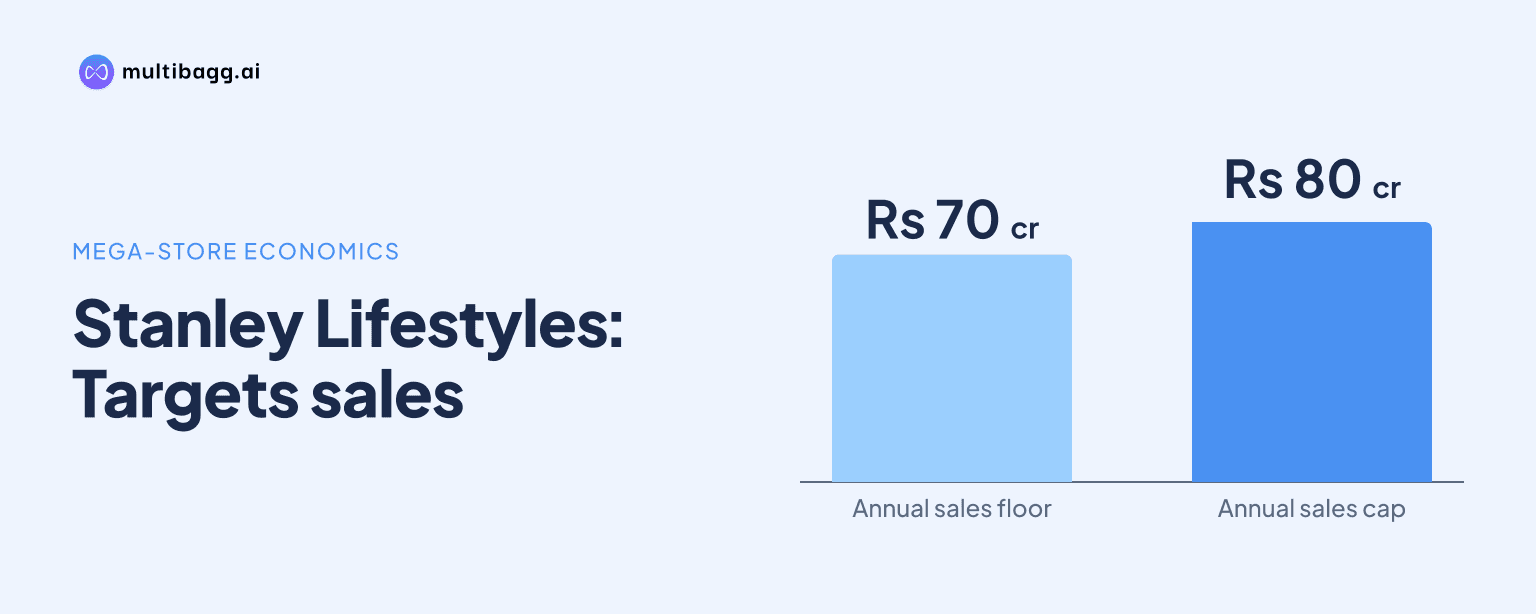
Stanley Lifestyles Limited is replacing smaller luxury outlets with metro mega-stores that management says can generate Rs 70 crore to Rs 80 crore of annual sales each from their second or third year. Its 72,000-square-foot Hyderabad pilot built a prospective Rs 7 crore to Rs 8 crore pipeline in its first 60 days.
Know Stanley Lifestyles inside out
Results, valuation, peers and who's buying, in one view.
What is Stanley Lifestyles changing in its metro store network?
Stanley Lifestyles is shifting from multiple smaller luxury stores to one large, company-owned and company-operated complete-home centre in each selected metro. Management said the format combines design, build, execution, installation and service in one location, rather than directing customers across several stores. The first Superlative Living location in Hyderabad had been open for about two months at the November 16, 2026 call.
Stanley Lifestyles identified Hyderabad, Mumbai, Delhi and Bengaluru as the first four cities for the format. Management said six metros account for about 80% of India’s luxury housing, and that it acquired franchisees in Delhi, Mumbai, Hyderabad, Pune and Chennai after its initial public offering. In the four identified cities, it plans to close smaller Stanley Lifestyles formats while retaining more Sofas & More outlets as spokes around the large-format hub.
Management said the luxury format is intended for cities where Stanley Lifestyles already knows the market and sees an adequate pipeline of luxury housing. About 25% of customers in Hyderabad and Bengaluru come from smaller cities and towns, management said, supporting the view that customers travel to metros for a wider product range. Sofas & More, the value format, is instead intended for expansion into 80 to 100 cities.
What are Stanley Lifestyles' sales and margin targets for mega-stores?
Stanley Lifestyles targets Rs 70 crore to Rs 80 crore of annual revenue from each large anchor store from its second or third year onwards. Management presented this as the revenue capability of a mature location, not reported revenue from Hyderabad. It also said a single captive store should be easier to manage than several smaller company-owned outlets.
Management expects earnings before interest, tax, depreciation and amortisation, or EBITDA, of above 19% to 20% for a mature store after rental expense. It clarified that the measure is before the effect of Ind AS, or Indian Accounting Standards, lease accounting. Stanley Lifestyles did not disclose a store-level profit-and-loss statement, actual Hyderabad sales or a realised margin for the pilot.
The revenue model depends on customised complete-home orders rather than immediate sales from display floors. Management said roughly 75% to 80% of orders are customised, while complete-home customer orders can range from Rs 40 lakh to Rs 1 crore. That mix is why management said conventional revenue-per-square-foot measures are less applicable than for a trading retailer.
How is the Hyderabad mega-store performing after 60 days?
Stanley Lifestyles said the 72,000-square-foot Hyderabad Superlative Living store had produced higher-than-expected footfall and a prospective Rs 7 crore to Rs 8 crore pipeline after 60 days. Management said conversions had begun, but described the site as an experience centre whose order flow will not mainly come from immediate off-the-floor transactions. It expected a clearer assessment of actual conversion within another one to two months.
Management said its experience with large formats is that inquiry pipelines take roughly three to four months to build before conversions become visible. It referred to an earlier Bengaluru store of almost 100,000 square feet, now used as a factory store, as a precedent. The Hyderabad data therefore show initial customer inquiries rather than evidence that the Rs 70 crore to Rs 80 crore annual target has been reached.
Stanley Lifestyles expects a new Superlative format store to take two to three quarters to break even, with a change expected from the fourth quarter. Recurring store costs were about 12% to 13% at present, management said, while certain new Superlative stores could initially reach 15% to 16% before moving towards about 12%. These are management expectations rather than reported Hyderabad cost outcomes.
Got a follow-up? Ask IRIS
Why is Stanley Lifestyles closing smaller stores?
Stanley Lifestyles said it is closing or converting selected smaller locations because some catchments had been substantially utilised over three to five years and were no longer delivering adequate returns per square foot. Of its 70 stores, including hybrid locations, management said about 15% to 18% were loss-making. It had already closed three older stores by the time of the call.
Most loss-making locations were less than 18 months old, according to management, meaning they remain within the company’s stated gestation period. The network redesign is also tied to the conversion of company-owned and company-operated stores from conventional furniture retail into complete-home solution centres. Management said that process requires hiring and training design executives instead of relying only on sales executives.
Management confirmed that same-store sales growth at older company-owned and company-operated stores was negative, even as it said the store base was growing overall. It did not provide a percentage for the 35 stores older than three years, offering to share store-specific historical figures by email. The hub-and-spoke plan is therefore a response both to mature catchments and to the operational requirements of the complete-home format.
What will determine Stanley Lifestyles' next mega-store openings?
Stanley Lifestyles said it would monitor Hyderabad for a couple of quarters before deciding on further rollout. The principal tests are whether the Rs 7 crore to Rs 8 crore pipeline converts in the three-to-four-month period management described and whether the outlet approaches break-even within two to three quarters. Mumbai, Delhi and Bengaluru are the next intended cities, but management did not provide opening dates, store sizes or capital-expenditure figures.
Management said about 70% of the structural changes required after the initial public offering had been completed and that it would stabilise operations for one or two quarters before expanding meaningfully. It also said revenue should grow at double-digit rates going forward, but gave no formal percentage forecast. Its longer-standing goal of Rs 1,000 crore in sales within 1,000 working days remains in place, with management estimating that about 500 to 550 working days had elapsed since listing.
Conclusion
Stanley Lifestyles is concentrating its luxury network in a limited number of metro complete-home centres while using Sofas & More for wider-city expansion. The model carries a stated Rs 70 crore to Rs 80 crore annual sales target per mature mega-store, but Hyderabad currently provides only early indicators: a Rs 7 crore to Rs 8 crore prospective pipeline after 60 days and initial conversions.
The next disclosed milestones are Hyderabad’s conversion trend over the one to two months management identified and its path to break-even over two to three quarters. Management also plans a one-to-two-quarter stabilisation period before meaningful expansion, leaving the timing and economics of Mumbai, Delhi and Bengaluru unresolved.