










Stanley order book reaches Rs 60 crore as handovers delay sales
Key highlights
- Stanley’s Q2 FY27 order book rose to Rs 60 crore from about Rs 53 crore a year earlier.
- Q2 FY27 revenue from operations was Rs 107.06 crore, up 7.8% from Rs 99.35 crore in Q1 FY27.
- H1 FY27 revenue from operations was Rs 206.41 crore, compared with Rs 214.09 crore in the prior-year first half.
- Stanley said existing manufacturing facilities can support almost twice current revenue, depending on product mix.
powered by IRIS
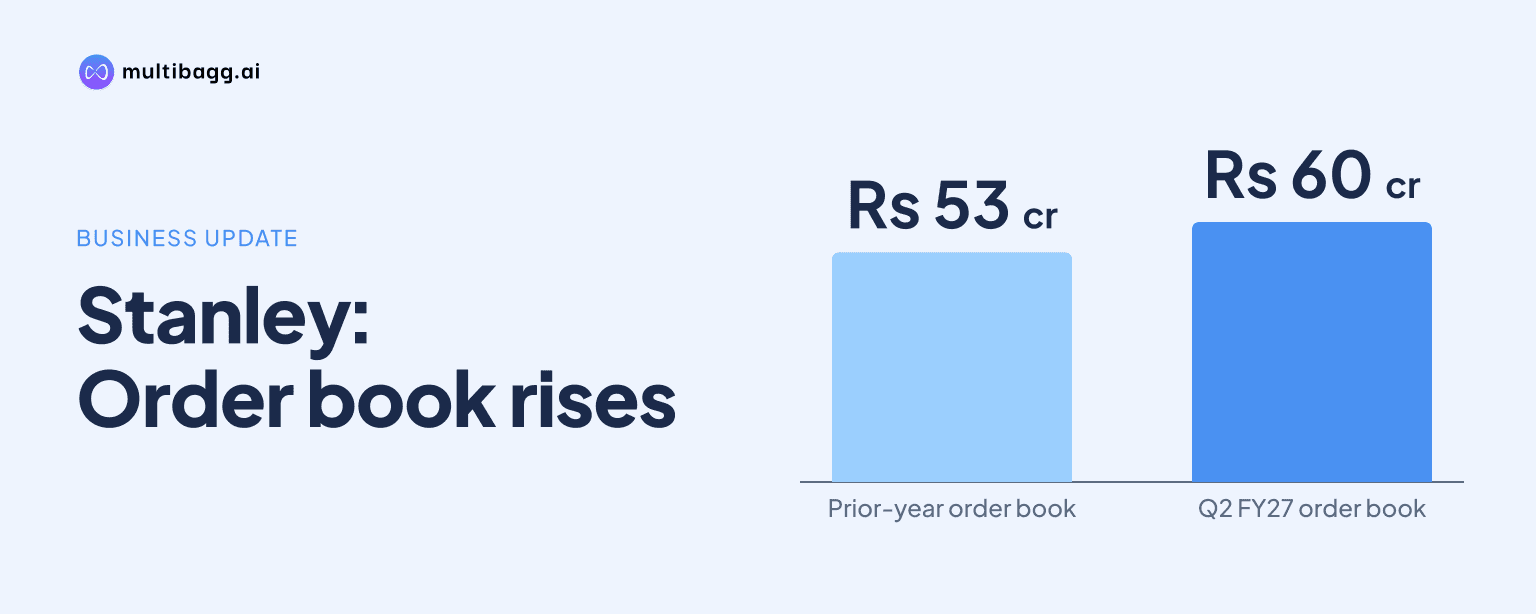
Stanley Lifestyles Limited reported a Rs 60 crore order book in Q2 FY27, up from about Rs 53 crore a year earlier, but said delayed handovers of premium and luxury homes were extending invoicing cycles and holding back retail revenue conversion. Revenue from operations rose 1.6% year-on-year to Rs 107.06 crore.
Know Stanley Lifestyles inside out
Results, valuation, peers and who's buying, in one view.
What is delaying Stanley’s revenue conversion?
Delayed possession of premium and luxury homes is delaying Stanley’s conversion of booked orders and customer interest into invoicing. Management said many of its customers are new-home buyers, and slower residential-project completions mean they are waiting longer to finalise furniture purchases, deliveries and installations.
The company did not describe the issue as a disappearance of demand. During the November 16, 2026 earnings call, management said some customers had completed market research and visited stores but were waiting for home possession, extending the time between a store visit, order completion and invoicing.
Stanley distinguished the Rs 60 crore order book from the pace of its conversion into sales. Chairman and Founder Sunil Suresh said the order book had increased from about Rs 53 crore a year earlier, but project handovers had made invoicing “slightly delayed.” The company did not disclose the order book’s ageing, cancellation rate or project-wise distribution.
Management said it hopes the delivery pipeline will become more robust from Q3 FY27 or, possibly, early Q4 FY27 as residential handovers progress. This was management’s expectation, not formal revenue guidance, and remains dependent on project completions that are outside the company’s direct control.
How did Stanley’s revenue change while its order book increased?
Stanley reported Q2 FY27 revenue from operations of Rs 107.06 crore, up Rs 1.64 crore from Rs 105.42 crore in Q2 of the previous year. The modest year-on-year increase came alongside a roughly Rs 7 crore increase in the order book, indicating that demand recorded in orders was not fully converted into invoiced revenue during the quarter.
Revenue improved 7.8% sequentially from Rs 99.35 crore in Q1 FY27 to Rs 107.06 crore in Q2 FY27. Management nevertheless described the retail environment as challenging because premium-home possession delays continued to lengthen the customer purchase and invoicing cycle.
For H1 FY27, revenue from operations was Rs 206.41 crore, compared with Rs 214.09 crore in the previous year’s first half. The Rs 7.68 crore decline over six months contrasts with the Rs 1.64 crore rise in Q2, meaning the second-quarter improvement did not eliminate the first-half year-on-year shortfall.
What does Stanley’s Rs 60 crore order book say about demand?
The Rs 60 crore order book shows that orders increased from about Rs 53 crore a year earlier even as conversion into invoiced sales slowed. Management called the order book robust and attributed the delay primarily to project handovers rather than an absence of customer demand.
The order book equalled about 56% of Q2 FY27 revenue of Rs 107.06 crore, although Stanley did not present it as a revenue-coverage measure or provide a targeted conversion period. Revenue recognition depends on homes being ready for the furniture delivery and installation process.
Stanley is also attempting to link its furniture offering more closely to luxury housing through branded mock-up homes. Management said it had earlier avoided builder arrangements requiring business-to-business or project pricing, but had begun receiving inquiries from luxury builders seeking branded furniture in their mock-up properties.
Management said those discussions followed the opening of its first Stanley Superlative Living centre in Hyderabad. It plans to appoint a senior chief business development officer focused on high-end luxury builders, but called the opportunity an early-stage development and gave no revenue target or timetable.
Got a follow-up? Ask IRIS
Can Stanley fulfil more orders with current manufacturing capacity?
Stanley said its existing manufacturing facilities can support almost twice its current revenue, depending on product mix. Management made that assessment against its FY26 revenue base of about Rs 419 crore and said some raw materials might need to be shifted from the factory to a warehouse.
This capacity statement means management did not identify factory output as the immediate obstacle to converting the Rs 60 crore order book. The near-term constraint described in Q2 FY27 was instead the timing of residential completion, which determines when customers can receive furniture and complete invoicing.
The company is also revising its store network and formats. Its first Stanley Superlative Living centre in Hyderabad covers 72,000 square feet and combines kitchens, wardrobes, living, dining and other home-interior categories under one format.
Management said it would monitor the Hyderabad centre for a couple of quarters before deciding how to extend the format. Its plan is to establish large-format Stanley locations in Hyderabad, Mumbai, Delhi and Bangalore while using more Sofas & More stores in a hub-and-spoke model in those markets.
What affected Stanley’s profitability and execution in Q2 FY27?
Stanley reported earnings before interest, tax, depreciation and amortisation, or EBITDA, of Rs 19.89 crore in Q2 FY27, equal to an 18.6% margin. EBITDA increased 15.5% from Rs 17.22 crore in Q1 FY27, while management said rupee depreciation pressured gross profit margin.
Employee-benefit expense increased to Rs 17.11 crore from Rs 14.29 crore in the comparable period cited by management. Group Chief Financial Officer Sudhir Iyer attributed the increase to employee increments, amortisation of costs previously capitalised for new-product development and senior-management hiring.
Management also cited a period of overlap between outgoing and incoming senior leaders during organisational changes. It gave no H2 FY27 margin outlook, saying it was too early and that it would provide an update in the next earnings call.
Stanley is progressing with the proposed amalgamation of subsidiaries and step-down subsidiaries into the listed company. Management said the plan is intended to reduce administrative duplication, streamline reporting and improve resource allocation, but it did not quantify expected cost savings or the timing of completion.
Conclusion
Stanley’s Q2 FY27 performance indicates that its higher order book and reported revenue are moving on different timetables. The Rs 60 crore order book points to demand that management says remains present, while H1 revenue of Rs 206.41 crore shows that delayed residential possession has continued to defer the point at which furniture demand becomes invoiced sales.
The next issue to watch is whether housing handovers support the more robust delivery pipeline management expects from Q3 FY27 or early Q4 FY27. Management’s monitoring of the 72,000-square-foot Hyderabad Superlative Living centre over the next couple of quarters, along with its next-call update on H2 profitability and the proposed amalgamation, will provide further indications of execution progress.