










Studds exports rise nearly 50%, guides 25% long-term growth
Key highlights
- Studds said H1 FY2027 exports grew nearly 50% year on year, versus its earlier plan of about 25% for the year.
- Studds expects long-term export growth of about 20% to 25% annually over roughly five years.
- Italy subsidiary establishment costs are expected mainly in Q2 and Q3 of FY2027.
- Studds retained FY2027 volume-growth guidance of 8% to 10% and revenue-growth guidance of 15% to 19%.
powered by IRIS
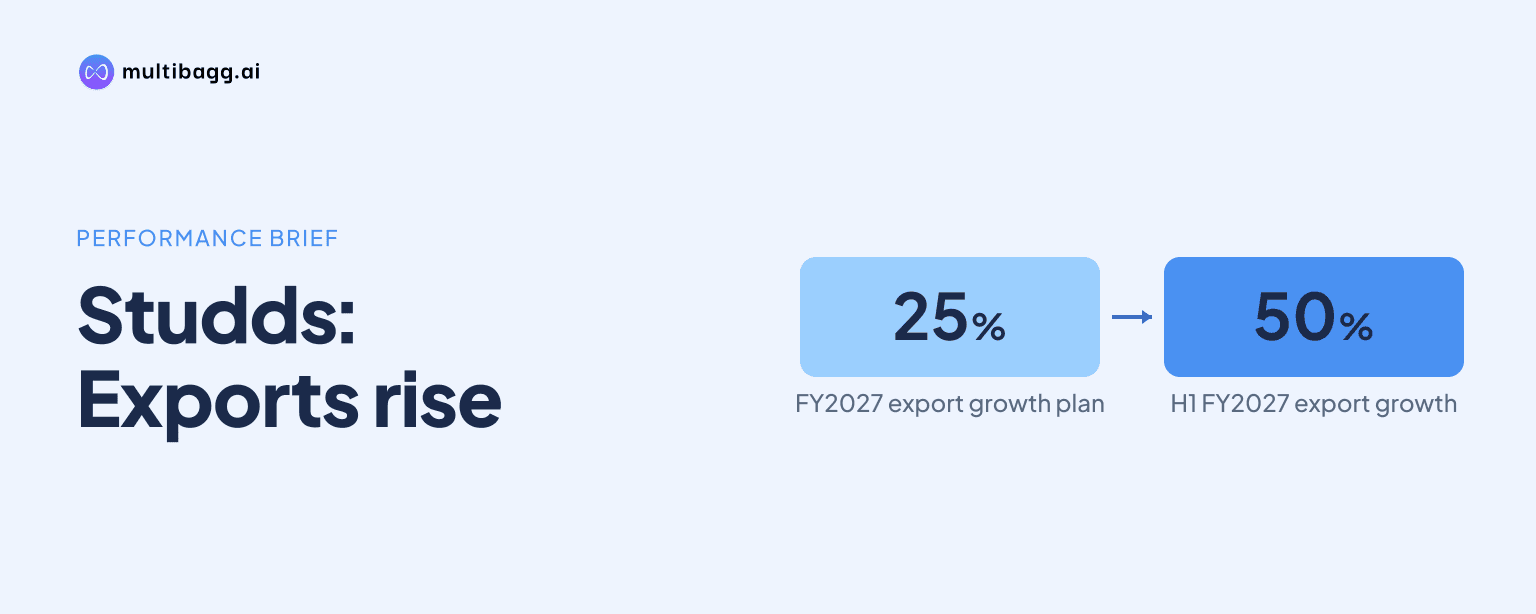
Studds Accessories Limited said exports grew nearly 50% year on year in H1 FY2027, exceeding its earlier plan of about 25% for the year, led by existing markets rather than broad new-market additions. Management expects export growth to moderate to about 20% to 25% annually over roughly five years as its overseas revenue base expands.
Know Studds Accessories inside out
Results, valuation, peers and who's buying, in one view.
How fast did Studds exports grow in H1 FY2027?
Studds said H1 FY2027 exports rose nearly 50% year on year, compared with management's earlier expectation of about 25% export growth for the year. Management said it had not added many markets during H1, indicating that the increase came principally from stronger sales in territories where the company was already operating.
The H1 export result was ahead of the company's initial plan, but Studds did not disclose export revenue, country-level sales or export profitability on the call. Management said growth was occurring through both distributors and retail channels, and described the performance as evidence that its product portfolio was being accepted in existing overseas markets.
Studds said the United States, Europe and Latin America were all growing, without identifying a material difference in the current pattern between those regions. Management said the United States accounted for about 10% of the business, while Latin America was also expanding at a fast pace during the period discussed.
What does the Italy hub mean for Studds' earnings?
Studds is establishing an Italian subsidiary for its international expansion, and management said establishment-related fixed costs would be incurred mainly in Q2 and Q3 of FY2027. It described the project as an investment, with the sales ramp-up rate the principal execution risk because foreign-market fixed costs are high before local sales reach scale.
Management said a new overseas subsidiary could record a slight loss for a period if sales do not grow quickly enough. This makes the Italy hub different from the nearly 50% H1 export growth from established markets: current export growth reflects deeper penetration, while the subsidiary requires upfront fixed-cost spending to build a local platform.
Studds said Q2 had ended and Q3 was under way when management discussed the subsidiary costs. Management expects the establishment-related fixed-cost burden to fall away from next year and said that should support consolidated margins, although that outcome depends on the subsidiary scaling sales as planned.
Which overseas markets is Studds targeting?
Studds identified Latin America, Europe and the United States as the main international opportunity sets for the next three to five years. Management described Latin America as a larger motorcycle market driven by volume and less price-sensitive than India, while it characterised Europe and the United States as premium markets with higher revenue and margin potential.
The regional approach combines volume-led and premium-market opportunities. Latin America is intended to offer scale through its motorcycle market, whereas Europe and the United States are expected to support premium helmet and rider-accessory sales, including products under the SMK brand.
Studds said it has no current plan for an acquisition in the helmet business. Management noted that helmet manufacturing is mainly concentrated in Indonesia, India, China and Vietnam, while adding that it could consider buying a historic or legendary brand if one became available.
The international strategy covers motorcycle accessories as well as helmets. Studds said helmets would remain the major part of the business, but accessories should form a slightly larger share over time, with products including hard luggage, locks, Bluetooth products, jackets, gloves, goggles, rainwear, balaclavas and sleeves.
Got a follow-up? Ask IRIS
Why does Studds expect export growth to moderate?
Studds said nearly 50% export growth is not sustainable over a long period because growth becomes harder as the business base and market share increase. Management's long-term export-growth expectation is about 20% to 25% annually over roughly five years, while its short- to medium-term expectation is about 30%, with some years potentially reaching 50%.
The moderation is a management outlook rather than a change in international ambition. Management said a smaller market share provides more room to take space in overseas markets, whereas a more significant global position in three to five years would require greater emphasis on protecting market share.
Product mix may matter to export economics because Studds said SMK helmet margins are about 70% to 80% higher than Studds helmet margins, depending on the product. Management said jackets are broadly in line with SMK margins, while Bluetooth products follow the margin profile of their respective Studds or SMK brand.
Management also said raw-material costs had reduced margins for both brands despite a cumulative 9% price increase. About 6.5% to 7% was implemented in Q1, with the balance realised in Q2 after older export orders at previous prices were completed; management said it would decide in Q4 whether another increase was necessary if costs did not soften.
How does export expansion fit Studds' FY2027 plan?
Studds retained FY2027 volume-growth guidance of 8% to 10%, saying capacity additions should support a second-half increase. Management said the other plants started on 30 October, so November and December would involve ramp-up, while Q4 should show a bigger increase in volumes.
For revenue, Studds retained its high-teens FY2027 growth guidance of 15% to 19%, after H1 growth of about 16%. Management said Q2 growth was about 18% to 19%, a faster pace than the H1 figure, although it did not provide a revenue amount during the call.
Studds said Phase 1 of its new plant had already started and that demand was good at the time of the call. The capacity programme supports the wider plan to expand helmets and motorcycle-related accessories, while the Italy subsidiary adds a separate early-stage fixed-cost requirement to the overseas expansion.
Studds said it manufactures about 70% to 75% of its listed motorcycle accessory products in-house. Management did not provide a combined accessory-capacity figure because categories such as jackets, luggage and balaclavas use different production lines, but said accessories remain small in absolute terms while growing faster as a share of volume and revenue.
Conclusion
Studds reported nearly 50% export growth in H1 FY2027 from existing markets, above its earlier growth plan, while setting a lower long-term expectation of about 20% to 25% annually. The strategy combines helmet sales, premium SMK products, accessories and an Italian subsidiary intended to support overseas scale, but the Italy operation carries initial fixed costs.
The next indicators are the Q3 cost impact from establishing the Italian subsidiary, the expected Q4 volume increase after plants started on 30 October, and management's Q4 assessment of whether raw-material prices require another price increase. Management has identified the Italy hub's sales ramp-up as the key test of whether its initial fixed costs can be absorbed on schedule.