










Studds says 9% hike has yet to offset elevated styrenics costs
Key highlights
- Studds said its net 9% price increase was fully implemented after Q2 FY27 but did not fully cover raw-material inflation.
- Q2 FY27 revenue rose 18.6% to Rs 183.1 crore, while EBITDA margin was 12.4% and EBITDA fell 23.7% to Rs 22.8 crore.
- H1 FY27 export revenue increased nearly 50% year on year to Rs 79.4 crore.
- Studds began production at a new plant on 30 October 2026, adding annual capacity of 1.5 million helmet and boxes units.
powered by IRIS
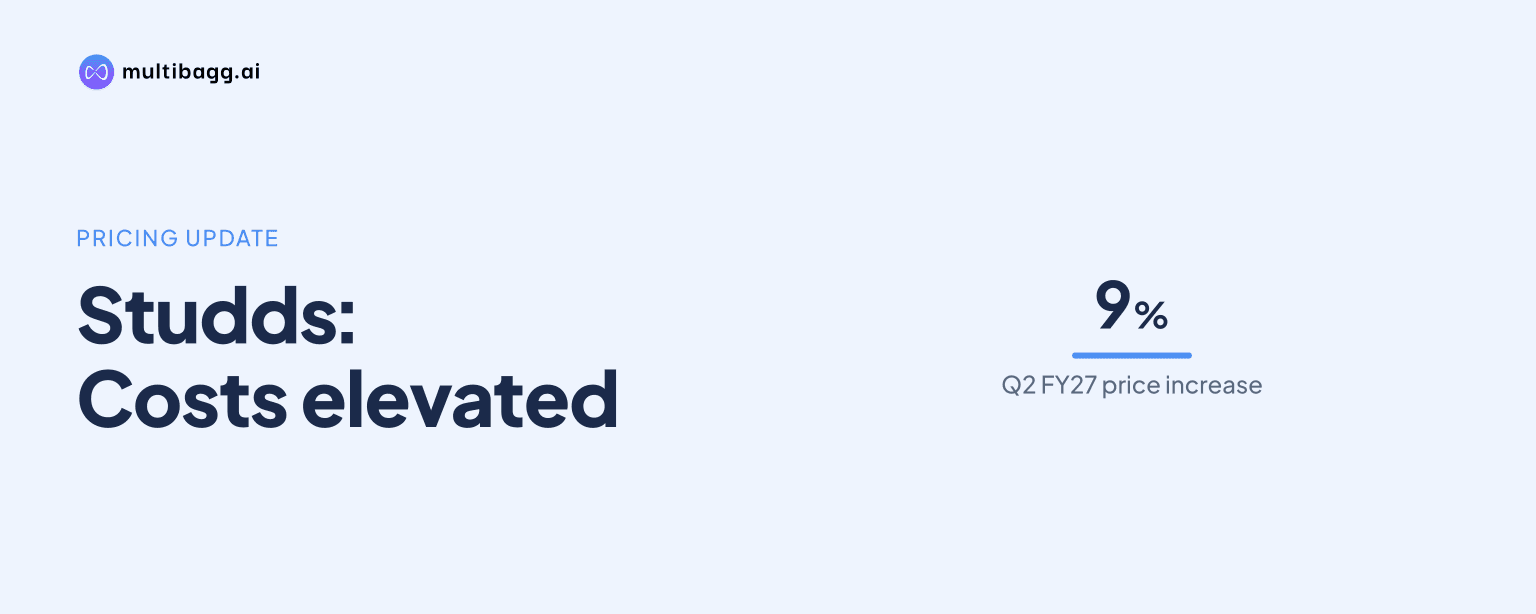
Studds said its 9% cumulative price increase was fully in the system after Q2 FY27 but had not offset elevated styrenics costs, contributing to a Q2 FY27 EBITDA margin of 12.4%. Management said it would assess raw-material prices through Q3 and decide in Q4 whether another increase is needed.
Know Studds Accessories inside out
Results, valuation, peers and who's buying, in one view.
Why are Studds margins under pressure?
Studds said raw-material inflation, rather than a demand shortfall, was the principal pressure on profitability in Q2 FY27. Management said margins at both the Studds and SMK brands had declined because raw-material prices had risen, and described the pressure as cyclical rather than a fundamental issue in the business. It also cited a wage impact of about 30% to 35% in April as an additional drag on margins.
The financial outcome was a divergence between revenue growth and earnings. Consolidated Q2 FY27 revenue rose 18.6% year on year to Rs 183.1 crore, while EBITDA fell 23.7% to Rs 22.8 crore and profit after tax, or PAT, declined 28% to Rs 14.7 crore. The EBITDA margin was 12.4% and PAT margin was 8.1%, meaning higher sales did not translate into higher operating profit during the quarter.
The same pattern was present over the first half. H1 FY27 consolidated revenue increased 16.2% year on year to Rs 352.8 crore, but EBITDA decreased 29.6% to Rs 42.3 crore and PAT fell 33.8% to Rs 27 crore. H1 EBITDA margin was 12% and PAT margin was 7.7%, with management specifically identifying raw-material costs as the main current cost pressure.
How much pricing has Studds already passed through?
Studds said it has taken a net 9% price increase, with about 6.5% to 7% realised in Q1 FY27 and the balance realised in Q2 FY27. The phased implementation reflected older orders, particularly export orders, that had been committed at previous prices. Management said the entire 9% increase was in the system after Q2 FY27.
That pricing action has recovered part of the cost increase but not all of it, according to management. Studds said raw-material prices had risen enough that the 9% increase could not fully compensate for the increase in input costs. The company is therefore waiting to see whether styrenics soften before deciding on a further increase rather than immediately raising prices again.
Management said Q2 FY27 styrenics conditions were slightly better than Q1 FY27, but prices had not softened in Q3 FY27 as expected and remained elevated. Its stated process is to monitor conditions through the current quarter and make a decision in Q4 FY27. Management added that it would take another price increase if prices do not soften, while maintaining that it prefers calibrated changes over a sharp increase that might later require discounting.
How do Studds and SMK margins differ?
Studds said SMK margins are about 70% to 80% higher than Studds margins, depending on the product, although raw-material pressure has reduced margins at both brands. This distinction matters because the company is increasing its international presence, where SMK is part of its premium offering, while the Studds brand remains central to its domestic mass-market position.
Export growth did not prevent the consolidated margin decline in H1 FY27 because management said cost inflation affected both brands. Export revenue reached Rs 79.4 crore in H1 FY27, nearly 50% above H1 FY26, but consolidated EBITDA still fell 29.6% to Rs 42.3 crore. Management attributed the outcome to elevated materials costs and the April wage effect, rather than any reported weakness in demand.
New rider-accessory categories are expected to follow existing brand economics rather than create a separate disclosed margin profile. Studds said jackets would be in line with SMK margins, while Bluetooth communication products would carry margins aligned with the brand under which each product is sold. The company began manufacturing riding jackets in September 2026 and plans to produce and sell 40,000 units in the next financial year.
Got a follow-up? Ask IRIS
What does capacity and demand indicate for Studds?
Studds said it was seeing good demand and reported no demand issue as of the call, framing raw materials as the main near-term cost risk. Q2 FY27 helmet and boxes volume was 2.04 million units, while capacity utilisation was about 85% for two-wheeler helmets and boxes, 88% for expanded polystyrene, or EPS, and 64% for water decals.
The company commenced commercial production at a new plant on 30 October 2026, adding annual capacity of 1.5 million helmet and boxes units. Management corrected its earlier installed-capacity figure to about 11 million units per year, rather than 11.5 million units, and said it plans a further 1.5 million units over the next 18 to 24 months, taking planned capacity to about 12.5 million units.
Management retained its FY27 volume-growth guidance of 8% to 10% and said volume growth should improve in the second half as the new plant ramps up. It specifically expects a larger rise in Q4 FY27 because production only began at the new plant at the end of October, leaving November and December as ramp-up months. H1 FY27 helmet and boxes volume was 3.99 million units, with capacity utilisation of about 83%.
What could restore Studds profitability?
Studds said a softening in styrenics would support margin improvement because the cost surge has reduced margins across both brands. Management considers the current episode cyclical and said the company had seen only one other extraordinary raw-material cycle in the past decade, during COVID, when the disruption lasted about two years. Its expectation is that the current cycle will be shorter, though it said geopolitical developments remain uncertain.
Price management is the other identified mechanism. The completed 9% increase has partially recovered inflation, and management said it could impose another increase if input prices stay elevated through Q3 FY27. This creates a direct link between the Q4 FY27 pricing decision and the pace at which margins may recover, while leaving the actual direction of styrenics unresolved.
Conclusion
Studds reported growing revenue and exports alongside lower operating profit because its price increase lagged the rise in raw-material costs. Q2 FY27 revenue rose 18.6% to Rs 183.1 crore, while EBITDA margin was 12.4%; H1 export revenue climbed nearly 50% to Rs 79.4 crore, but cost pressure was reported across both brands.
The next item to watch is management’s Q4 FY27 decision on another price increase after observing Q3 styrenics prices. Investors can also monitor the ramp-up of the plant commissioned on 30 October 2026, management’s unchanged 8% to 10% FY27 volume-growth guidance, and whether planned capacity reaches about 12.5 million units over the next 18 to 24 months.