










Studds targets Rs 15-20 crore from FY28 riding jacket sales
Key highlights
- Studds targets Rs 15-20 crore of FY28 revenue from 40,000 riding jackets.
- Studds began in-house jacket production in September 2026 and targets 10,000 units by March 2027.
- Studds plans to launch three Bluetooth rider communication products in November 2026, with annual capacity above 2 lakh units.
- Studds reported export revenue of Rs 79.4 crore in H1 FY27, nearly 50% higher year on year.
powered by IRIS
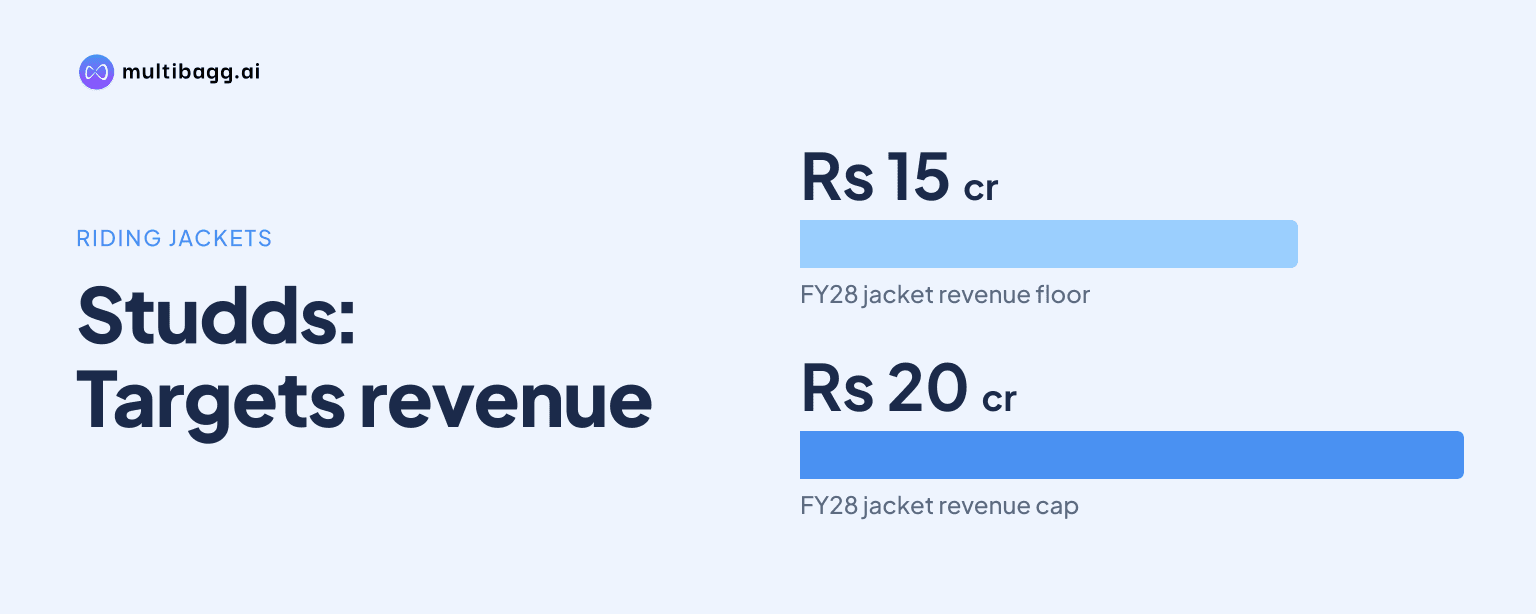
Studds Accessories Limited is targeting Rs 15-20 crore of first-year revenue from 40,000 riding jackets in FY28, while its Bluetooth rider communication devices are due to launch in November 2026 for both domestic and export markets. The moves extend Studds beyond helmets into apparel and connected rider accessories.
Know Studds Accessories inside out
Results, valuation, peers and who's buying, in one view.
What is Studds targeting from riding jackets in FY28?
Studds is targeting Rs 15-20 crore in first-year accessory revenue tied to its plan to manufacture and sell 40,000 riding jackets in FY28. Management gave the revenue range in response to a question on the potential from new products, saying the 40,000-jacket plan represented its first year after production began. FY28 is the financial year following the March 2027 milestone disclosed on the November 3, 2026 call.
Studds began in-house jacket production in September 2026 and plans to produce 10,000 units by March 2027. The planned 40,000 units in the following financial year represent a fourfold increase from that initial production target. Management said the jackets will be sold under its SMK brand and described the category as part of the broader rider-safety ecosystem, providing protection beyond a helmet.
The first-year revenue target means apparel is an early-stage diversification initiative alongside the core helmet business. By comparison, Studds reported consolidated revenue of Rs 352.8 crore in H1 FY27, while its two-wheeler helmet and boxes volume was 39.9 lakh units. The jacket target is therefore a defined new revenue stream alongside a much larger existing production base.
Management said the global accessories market, including apparel, is larger than the initial Rs 15-20 crore objective, but did not provide a longer-term sales forecast or addressable-market value. It also said jacket margins are expected to be in line with SMK margins. Management stated that SMK margins are typically about 70% to 80% higher than Studds brand margins, varying by product, although both brands faced raw-material pressure in FY27.
Where will Studds sell jackets and Bluetooth rider devices?
Studds plans to focus jackets on India initially, while Bluetooth communication products will be sold in both domestic and export markets from launch. Management said export apparel needs products tailored for those markets, which the company is developing during FY27. This creates a different initial route to market for the two adjacent categories.
The Bluetooth-based communication system is scheduled for launch in November 2026. Studds said it is launching three Bluetooth products: one will be completely built in-house and two will be assembled in-house. Annual Bluetooth capacity exceeds 2 lakh units, and management said expanding that capacity would not be a major challenge if sales ramp up.
Management cited Bluetooth penetration of as much as 60% in developed markets, while saying penetration is lower in rural markets. That comparison underpins its view of expansion potential, but Studds did not disclose a first-year Bluetooth sales volume, revenue target or product price. Jackets have a disclosed FY28 unit and revenue objective, whereas Bluetooth currently has a launch date and capacity indication.
Studds has export operations in more than 70 countries, providing an existing international footprint for the Bluetooth plan. Export revenue reached Rs 79.4 crore in H1 FY27, nearly 50% higher than H1 FY26, after rising from Rs 53.2 crore in FY24 to Rs 127.6 crore in FY26. Studds has also incorporated a wholly owned Italian subsidiary to serve as a European warehousing and distribution hub.
Got a follow-up? Ask IRIS
How do the new products fit Studds' premium strategy?
Studds is using the SMK brand for riding jackets, placing the apparel entry within its premium-product strategy. SMK contributed about 20% of sales in Q2 FY27, compared with about 13% in Q2 FY26. The 7-percentage-point increase coincided with management’s effort to expand premium designs, features and product offerings.
Jackets are expected to carry SMK-level margins, according to management. Bluetooth will have both SMK and Studds products, with margins intended to align with the respective brand rather than follow one single accessory margin. This stated brand architecture links product positioning to Studds' existing premium and mass-market labels.
The new categories arrive while profitability has been affected by input costs. Consolidated EBITDA, or earnings before interest, tax, depreciation and amortisation, was Rs 42.3 crore in H1 FY27, down 29.6% year on year, and the EBITDA margin was 12%. Management attributed pressure mainly to elevated styrene-based raw-material prices and said a 9% price increase had entered the system after being phased through Q1 and Q2 FY27.
Management said it expects margins on new jackets and Bluetooth products to be in line with helmets, not necessarily to lift group profitability immediately. It said a further price increase would be considered in Q4 if raw-material prices did not soften. Accordingly, the FY28 jacket target is a sales goal, while the transcript does not provide a separate profit target for apparel or connected devices.
Does Studds have capacity to support its wider rider-safety portfolio?
Studds has begun adding production capacity while launching jackets and Bluetooth products, with a new plant commencing commercial production on October 30, 2026. The plant adds 15 lakh annual units of helmet and boxes capacity. Management corrected an earlier figure and said total installed helmet and boxes capacity should be read as 1.1 crore units annually, rather than 1.15 crore units.
At September 30, 2026, existing helmet and boxes capacity utilisation was about 83%, showing why management is adding headroom in its core operations. It plans a further 15 lakh units of helmet and boxes capacity over the next 18 to 24 months, which would take planned installed capacity to about 1.25 crore units. The jacket plan is separate from those disclosed helmet and boxes capacity figures.
Studds expects FY27 capital expenditure of Rs 84.7 crore, including Rs 58.22 crore for the new plant. The company reported Q2 FY27 helmet and boxes volume of 20.4 lakh units and consolidated revenue of Rs 183.1 crore, up 18.6% year on year. Those figures show that the manufacturing expansion is being undertaken alongside ongoing growth in the core category.
Studds' medium-term aspiration is overall revenue of Rs 1,000 crore, with exports contributing about 25% to 30%. Management did not assign a specific share of that aspiration to jackets or Bluetooth. It did, however, present the new products as categories intended to broaden the portfolio for the rider community rather than as a standalone business segment with separately reported financials.
Conclusion
Studds has set a measurable first-year apparel objective: 40,000 jackets and Rs 15-20 crore in FY28 revenue, following production that began in September 2026. Bluetooth devices add a second adjacent category, with a November 2026 launch, more than 2 lakh units of annual capacity and domestic as well as export distribution planned from the outset. Together, the initiatives extend the SMK premium offering and the Studds mass-market range beyond helmets.
The next milestones are the production of 10,000 jackets by March 2027, the November 2026 Bluetooth launch and the development of export-ready apparel during FY27. Investors can also watch whether raw-material prices soften after the 9% helmet price increase, and whether the planned additional 15 lakh-unit helmet and boxes capacity is delivered within the stated 18-to-24-month period.