










Sunrakshakk operates FMCG capacity at 50%-55%, Q4 ramp due
Key highlights
- Sunrakshakk said aggregate FMCG and FMCG-intermediate capacity utilisation was about 50%-55% in Q2 FY27.
- Guwahati’s 2,160-metric-tonne monthly soap-noodle capacity and 1,000-metric-tonne cosmetics capacity were each about 50% utilised.
- Management expects added revenue from Roorkee’s 1,700-metric-tonne soap-line expansion by Q4 FY27.
- FMCG, FMCG intermediates and edibles accounted for about 90.7% of Sunrakshakk’s H1 FY27 revenue.
powered by IRIS
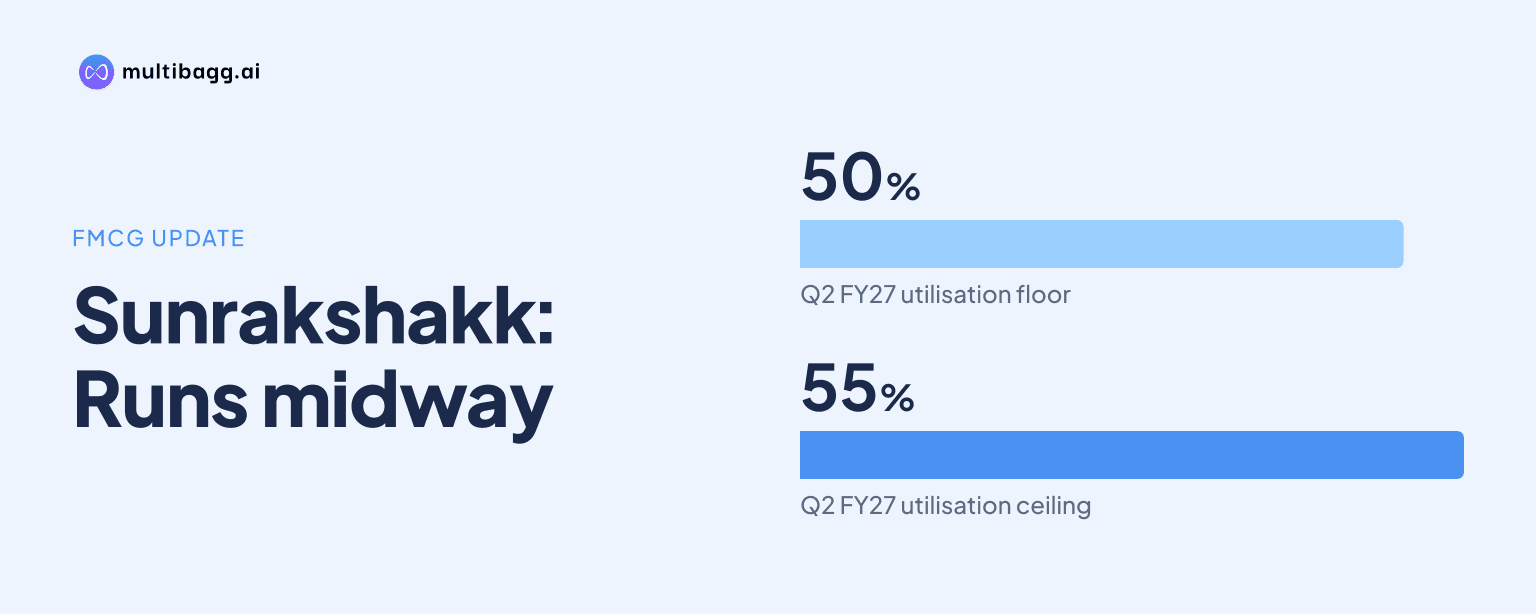
Sunrakshakk said in its Q2 FY27 earnings call that it is using about 50%-55% of its FMCG and FMCG-intermediate capacity, leaving material headroom as management expects revenue from Roorkee’s added 1,700-metric-ton soap line by Q4 FY27. The company said future facilities and investment will be directed mainly to FMCG rather than textiles.
Know Sunrakshakk Industries India inside out
Results, valuation, peers and who's buying, in one view.
How much FMCG capacity is Sunrakshakk using?
Sunrakshakk is using approximately 50%-55% of its current aggregate FMCG and FMCG-intermediate manufacturing capacity, according to management’s answer in the Q2 FY27 call. An analyst cited aggregate installed capacity of more than 2,500 tonnes per month across these operations, while management said utilisation should improve over time. The disclosure indicates that the company’s recent capacity additions are not yet operating near their full output potential.
Guwahati was also operating at roughly 50% utilisation in both of its new sections: soap noodles and cosmetics. The facility has monthly capacity of 2,160 metric tonnes for soap noodles and 1,000 metric tonnes for cosmetics. Management said it is seeking additional customers while seeing demand growth from existing customers, but did not provide a date for reaching its stated optimal utilisation range of 85%-90%.
The gap between present utilisation and the 85%-90% level management described for Guwahati is the central operating issue in the ramp-up. Management identified customer additions and higher orders from current customers as the mechanisms for closing it. It did not quantify revenue per tonne, expected customer wins or a phased utilisation schedule for the next 12 to 18 months.
When will the added Roorkee soap line generate revenue?
Sunrakshakk expects additional revenue from the expanded Roorkee soap line by Q4 FY27, management said, after increasing that line’s capacity by 1,700 metric tonnes. Management said it was in discussions with several customers and had reached a very final stage with one or two customers. That timeline depends on those discussions translating into business for the new lines.
Roorkee’s existing soap section generated Rs 25.85 crore in Q2 FY27, down from Rs 27.50 crore in Q1 FY27. Its noodle section produced Rs 82.74 crore in Q2, compared with Rs 87.62 crore in Q1. The additional 1,700-metric-tonne soap-line capacity therefore comes after a quarter in which both reported Roorkee revenue streams declined sequentially, rather than after a disclosed full-capacity run rate.
Management named soap and edibles as Sunrakshakk’s primary expected growth drivers. Edibles revenue at Bhilwara rose to Rs 49.67 crore in Q2 FY27 from Rs 30.30 crore in Q1, a sequential increase of 63.71%, while Bhilwara home care and detergent revenue fell to Rs 27.14 crore from Rs 40.98 crore. The contrast shows that the planned Roorkee ramp is intended to supplement a product mix whose quarterly trends varied by category.
Got a follow-up? Ask IRIS
Why is Sunrakshakk directing new investment toward FMCG?
Sunrakshakk said it has no major current plan for textile investment or capacity addition and that any new facilities or investment will mainly be for FMCG. Management’s stated rationale is its transition toward an FMCG-led mix: FMCG, FMCG intermediates and edibles accounted for about 90.7% of H1 FY27 revenue, while management put the current FMCG share at roughly 90%-91%.
Management expects the FMCG proportion to rise by a further 1%-1.5% over about a year and then remain broadly around that level, within plus or minus 1%-2%. Textiles will continue in the portfolio, but management said capacity additions there would not be aggressive and would instead be used to balance overall production facilities. This is a capital-allocation plan, not a stated intention to exit textiles.
The earnings figures explain the strategic distinction between the divisions. FMCG, FMCG intermediates and edibles generated Rs 240.92 crore of Q2 FY27 revenue, up 154.28% year on year, with a segment result margin of 9.27%. Textiles generated Rs 24.25 crore, down 7.53% year on year, and recorded a segment loss of Rs 0.97 crore as management cited higher dyes, chemicals and other input costs.
Textile profitability was also affected by installation of a machine that reduced production during the quarter, management said. It expects volatility in textile consumables and raw materials to settle in Q3 FY27 and Q4 FY27, after which it sees the business as favourable and profitable. That expectation remains dependent on costs stabilising and production returning to a higher level following the installation activity.
How does current financial performance frame the capacity ramp?
Sunrakshakk’s Q2 FY27 consolidated revenue was Rs 265.17 crore, up 119.2% from Rs 120.97 crore in Q2 FY26, but down 4.04% sequentially from Rs 276.33 crore in Q1 FY27. Management attributed the quarter-on-quarter decline to lower home care and detergent revenue, lower Guwahati noodle revenue and modest moderation at Roorkee, partly offset by edibles growth.
Despite the revenue decline from Q1, Q2 earnings increased sequentially: earnings before interest, taxes, depreciation and amortisation, or EBITDA, rose 2.42% to Rs 23.14 crore, and profit after tax rose 6.38% to Rs 16 crore. EBITDA margin was 8.73%, slightly below 8.81% in Q1 and 9.65% in Q2 FY26. The raw-material-cost ratio declined to 74.37% of revenue from 75.6% in Q1.
For H1 FY27, revenue reached Rs 541.50 crore, compared with roughly Rs 245 crore in H1 FY26 as cited by an analyst on the call. Management said this pace puts its earlier Rs 1,000 crore FY28 revenue aspiration within reach sooner than planned, but did not give a revised FY27 or FY28 revenue target. It said it expects 20%-25% to 30% year-on-year growth after first reaching Rs 1,000 crore.
Management also said it does not foresee a fresh loan for the current business, while it works to optimise working capital. It stated that the FMCG business has no debt of the kind carried for the textile business and that it plans to repay that textile-related debt over time. The capacity ramp will consequently be measured not only by volume and revenue but also by inventory, collections, procurement and cash-flow discipline.
Conclusion
Sunrakshakk’s disclosure places the near-term emphasis on converting underused FMCG capacity into sales. Aggregate utilisation of 50%-55%, including about 50% at Guwahati’s soap-noodles and cosmetics lines, provides scope for growth without a disclosed need for immediate new debt. The planned Q4 FY27 Roorkee soap-line revenue is a specific test of whether customer discussions can turn added 1,700-metric-tonne capacity into output.
The next developments to watch are the Q4 FY27 start of revenue from the added Roorkee line, progress in finding Guwahati customers and movement toward its 85%-90% utilisation objective. Management’s plan is for new facilities and investment to be focused mainly on FMCG, while it expects textile input-cost volatility to settle through Q3 FY27 and Q4 FY27 and is still assessing other capacity and product-line opportunities.