










Sunrakshakk says RCM accounted for 44% of quarterly revenue
Key highlights
- RCM accounted for around 44% of Sunrakshakk's last-quarter revenue and around 42% to 42.5% of YTD revenue.
- Sunrakshakk said FMCG capacity utilisation was 50% to 55%, compared with 80% to 85% in textiles.
- The Guwahati facility has monthly capacity of 2,160 metric tonnes of soap noodles and 1,000 metric tonnes of cosmetics.
- Management said it will first seek to reach Rs 1,000 crore of revenue before targeting 20% to 25% or 30% year-on-year growth.
powered by IRIS
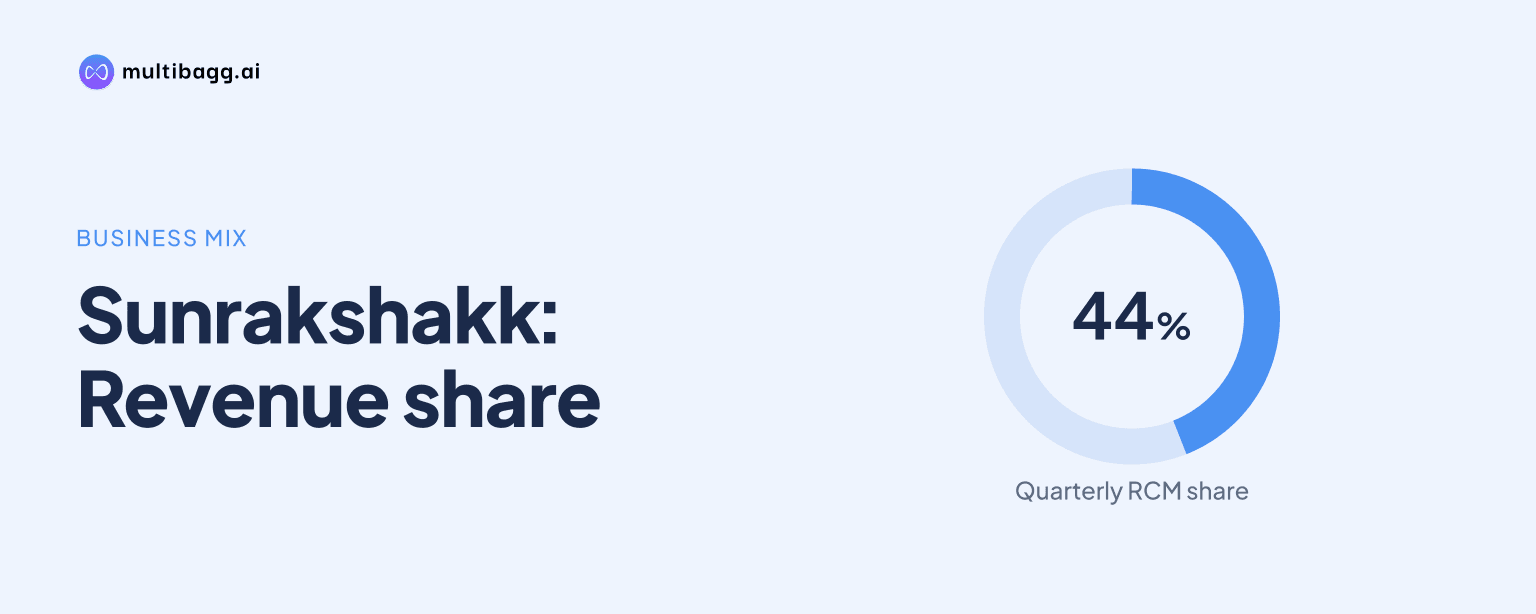
Sunrakshakk Industries India Limited said RCM, a group company and customer, accounted for about 44% of revenue in the last quarter, compared with about 42% to 42.5% year to date, while management said it would focus on manufacturing for established brands rather than directly launching consumer products.
Know Sunrakshakk Industries India inside out
Results, valuation, peers and who's buying, in one view.
How concentrated is Sunrakshakk's revenue in RCM?
RCM accounted for around 44% of Sunrakshakk's overall revenue in the last quarter, management said on the November 17, 2026 call. For year to date, or YTD, management put RCM's contribution at around 42% to 42.5%, making the latest quarter's share about 1.5 to 2 percentage points higher than the stated YTD range. The disclosure identifies RCM as a significant single customer within Sunrakshakk's current revenue base.
Management described RCM as a sister concern or principal group company that also acts as a customer. It said the relationship supports demand and volumes across its facilities as RCM grows. At the same time, Sunrakshakk said it serves a diversified set of customers across personal care, edibles and other categories, rather than relying on the same customer set for every product line.
What is Sunrakshakk's FMCG business model?
Sunrakshakk's stated model is business-to-business, or B2B, contract manufacturing for brands rather than building its own consumer brand. Management said it is targeting established brands and presently supplies companies such as Godrej, Wipro and ITC through its facilities. It said there are no immediate plans to launch a product directly in the market, meaning retail distribution and direct price competition are not its stated near-term priorities.
The model is built around manufacturing capability across soap, personal care and skincare products. Management said the cosmetics portfolio is already sufficiently diversified to serve brands and that the focus is now on using the capacity installed so far, not on further cosmetics expansion. This positions the facilities as suppliers to brand owners, with Sunrakshakk seeking production volumes rather than consumer-facing product launches.
Why does Sunrakshakk expect customer relationships to endure?
Sunrakshakk said supplying a major brand involves a lengthy validation process covering quality parameters and operating norms, which can make relationships durable once a supplier is approved. Management used the example of manufacturing soap for Godrej, saying customers can remain associated for years unless the manufacturer fails to meet commitments or standards. The company said some group client relationships have already lasted more than a decade.
That mechanism does not remove customer-concentration exposure, particularly when RCM represented around 44% of last-quarter revenue. But management's explanation was that the company can add new customers after qualifying with them, supported by its expanded manufacturing infrastructure. It said demand is not generally a one-time order pattern in its product categories, although its B2B planning is based on one month of firm customer plans and two months of tentative plans rather than a conventional order book.
Got a follow-up? Ask IRIS
Which product lines are intended to add customers and volumes?
Sunrakshakk said soap and edibles are its primary growth drivers, while it sees scope to add capability if market demand emerges in other fast-moving consumer goods, or FMCG, categories. Management also said it was considering portfolio diversification in edibles, including a biscuit manufacturing facility or other products, but did not announce a committed project, investment amount or launch date.
Capacity utilisation is central to the plan to broaden volumes beyond existing customers. The Guwahati facility has monthly capacity of 2,160 metric tonnes of soap noodles and 1,000 metric tonnes of cosmetics, and management said both sections were running at about 50% utilisation. It said it was seeking additional customers while demand from existing customers was rising, but reaching an 85% to 90% utilisation level may take time.
Sunrakshakk also said its Roorkee soap line had added 1,700 metric tonnes of capacity. Management said it was in discussions with several customers and at a final stage with one or two, with potential additional revenue from those lines by the fourth quarter of the year. The combination of new customer discussions and existing-brand demand is the disclosed mechanism for reducing idle capacity rather than a plan to sell directly to consumers.
What are management's financial and operating targets?
Sunrakshakk said overall capacity utilisation across product segments was 50% to 55%, while FMCG capacity was also 50% to 55% and textiles were at 80% to 85%. Management expects higher FMCG utilisation to improve earnings before interest, taxes, depreciation and amortisation, or EBITDA, through greater operating scale. It also said a settling of raw-material price volatility would help margins, though it gave no margin target.
Management said it will first seek to reach Rs 1,000 crore of revenue, followed by expected year-on-year growth of 20% to 25% or 30%. For the next two to three years, it indicated an expectation of 25% to 30% growth, while its five-year view was around 20% to 25%. These are management expectations, not formal revenue guidance, and management said visibility beyond the near term was difficult because it was exploring investment opportunities, capacity and product lines.
Textiles are expected to remain part of the business even as FMCG becomes the larger component. Management said FMCG represented around 90% to 91% of the current mix and could rise by another 1% to 1.5% in a year, after which it expected the ratio to remain broadly stable within plus or minus 1% to 2%. It said new investment would mainly be directed toward FMCG, while textile capacity additions would not be aggressive.
Conclusion
The key implication is that Sunrakshakk combines a large disclosed exposure to RCM, at around 44% of last-quarter revenue, with a contract-manufacturing strategy aimed at established external brands. Management's case is that qualification requirements, long client relationships and a product mix spanning soap, personal care, skincare and edibles can support repeat business, while RCM contributes demand and volumes.
The next operating test is whether Sunrakshakk can raise FMCG capacity use from 50% to 55% toward the 85% to 90% level management described as optimal. Investors will also watch for the anticipated fourth-quarter revenue contribution from Roorkee's added 1,700-metric-tonne soap capacity, progress in adding customers at Guwahati, and movement toward the Rs 1,000 crore revenue objective.