










Synergy Green Industries Limited has 80% wind business exposure
Key highlights
- Synergy Green identifies 80% of business from wind as a stated threat.
- Wind castings represent 70% and gearbox castings represent 15% of the disclosed product mix.
- Synergy Green estimates non-wind large-casting demand at about 6 million metric tonnes, versus 1.5 million metric tonnes for wind.
- Foundry capacity is 45,000 TPA, while actual utilisation was 75% in H1 FY26-27.
powered by IRIS
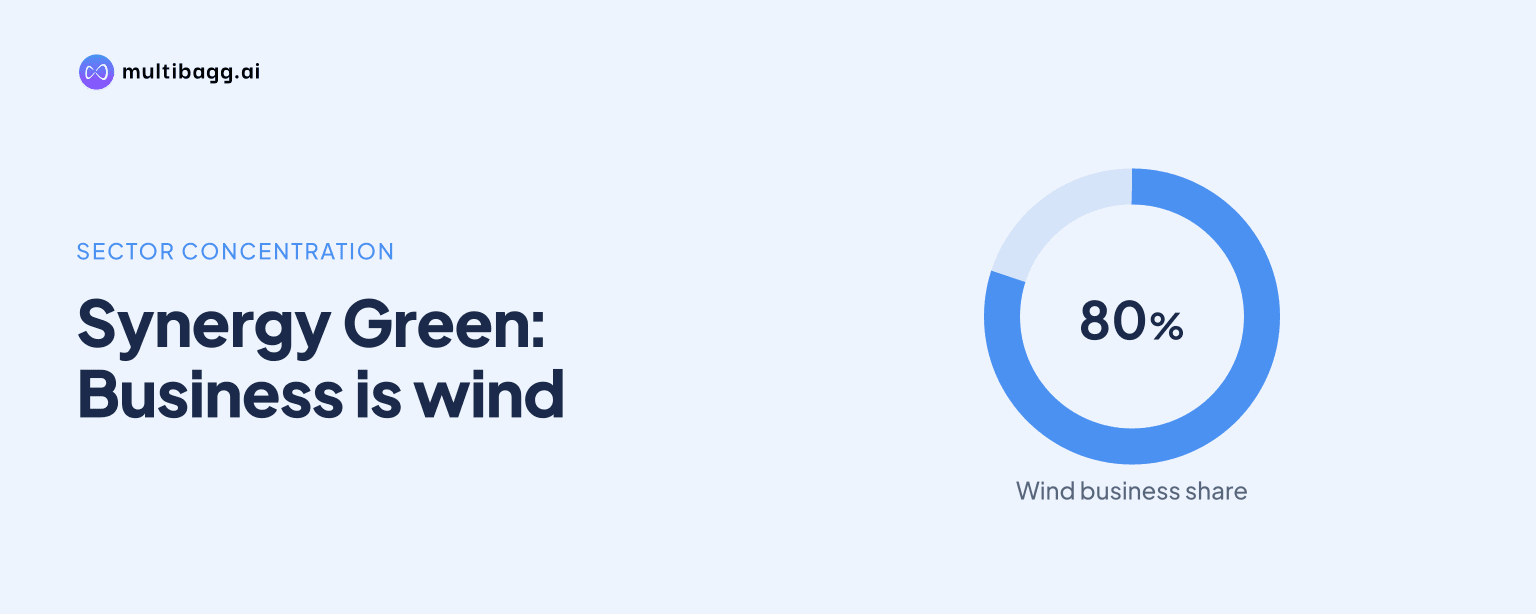
Synergy Green says 80% of its business is tied to the wind industry, while it pursues non-wind castings in markets with estimated demand of about 6 million metric tonnes, compared with 1.5 million metric tonnes for large wind castings. Its 45,000-tonnes-per-annum foundry is designed for castings up to 30 metric tonnes.
Know Synergy Green Industries inside out
Results, valuation, peers and who's buying, in one view.
How dependent is Synergy Green on wind?
Synergy Green is materially dependent on wind because its SWOT analysis identifies 80% of business from the wind industry as a threat. Its product presentation separately lists wind castings at 70% and gearbox castings at 15%. The company does not reconcile the 80% business exposure with the 85% combined product categories, so these measures should not be treated as directly equivalent.
The wind portfolio includes blade, nacelle, spinner, main bearing, main shaft, generator, gearbox, hub-casting and nacelle-bedplate components. Synergy Green says it works with six of the 15 leading wind original equipment manufacturers, or OEMs. Its listed wind customers include Vestas, Adani, Vayona Energy, Senvion, GE Renewable Energy, Envision, Flender and Nordex.
The presentation places this concentration against rising installation activity. Global annual wind installations increased to 165 gigawatts in 2025 from 117 gigawatts in 2024, while India onshore installations rose to 6.34 gigawatts in FY 2026 from 4.10 gigawatts in FY 2025. The presentation projects global annual installations of 212 gigawatts by 2030 and says Indian installed wind capacity could increase from 51 gigawatts in 2026 to 107 gigawatts by 2030; these are industry projections, not a sales forecast for Synergy Green.
How is Synergy Green pursuing non-wind castings?
Synergy Green says requests for quotation, or RFQs, are gaining traction in automobile dies, plastic injection, mining and power. Its non-wind product list includes cone crushers, coal pulverizers, turbine casings, mining castings, plastic injection-machine castings and pumps. The RFQ disclosure indicates enquiry activity rather than confirmed orders, revenue or a non-wind sales target.
Synergy Green frames the opportunity around a larger non-wind large-casting market. It estimates non-wind demand at about 6 million metric tonnes, four times its 1.5 million metric-tonne estimate for large wind castings. India’s total casting demand is shown as 11.49 million metric tonnes within a global casting market of 110 million metric tonnes in 2024.
India’s major casting-consuming sectors also extend beyond wind. Auto accounts for 32% of consumption in the presentation, while sanitary ware and pipes and fittings each account for 8%. Industrial machinery and railways each represent 6%, while pumps and compressors, valves, and power each represent 5%; the figures identify potential demand pools but do not measure Synergy Green’s current share in them.
Got a follow-up? Ask IRIS
Which customers support Synergy Green's non-wind push?
Synergy Green lists Terex, Ferromatik Milacron India, Mater+Platt, Wilo, Mahindra and L&T as non-wind customers. Ferromatik Milacron India is described as a plastics injection-moulding machine manufacturer. These names align with the company’s stated focus on mining, plastics, pumps and industrial applications, but the presentation does not disclose revenue, order value or production volume for any relationship.
The company says it can produce large castings up to 30 metric tonnes, a capability it presents as applicable to other industries as well as wind. Its 45,000-tonnes-per-annum, or TPA, foundry is supported by 20,000 TPA of machining and surface-treatment capacity. Synergy Green nevertheless identifies outsourced machining as a weakness despite establishing the 20,000 TPA in-house machining facility.
Its operating infrastructure includes 10 megawatts of captive solar power and a National Accreditation Board for Testing and Calibration Laboratories-certified laboratory. The presentation also lists ISO 9001, 14001, 18001, 27001 and 50001 certifications, alongside SAP, ATAS and simulation software. These disclosures describe the manufacturing platform, while the stated non-wind commercial evidence remains RFQ activity and the customer list.
Can Synergy Green expand capacity beyond wind demand?
Synergy Green says its facilities can produce large castings for industries beyond wind, and it is planning further expansion from its current 45,000 TPA foundry capacity. The company also identifies limited capacity compared with peers as a weakness. It does not provide a proposed capacity figure, capital expenditure amount or completion date for the expansion plan.
Capacity utilisation increased from 72% in FY 22-23 to 93% in FY 25-26, following 80% in FY 23-24 and 88% in FY 24-25. Actual utilisation was 75% in H1 FY26-27, and Synergy Green projected 80% for FY 26-27. The fall from 93% in FY 25-26 to 75% in the first half of FY26-27 shows that the full-year projection depends on higher utilisation in the remaining period.
Synergy Green also identifies volatile commodity prices as a threat to profitability and says key commodities are hedged with customers on a quarterly basis. In H1 FY27, revenue rose 20.2% year on year and production rose 25.8%, but PBDIT, or profit before depreciation, interest and tax, margin declined to 8.9% from 15.6% in H1 FY26. The company attributes the margin change primarily to steep input-cost escalation.
Conclusion
Synergy Green’s diversification case rests on an 80% wind-business exposure, a foundry capable of producing castings up to 30 metric tonnes, and non-wind demand estimated at about 6 million metric tonnes. The company is not presenting a move away from wind: its product slide assigns 70% to wind castings and 15% to gearbox castings, while it seeks additional applications in mining, power, plastics, pumps and automobile dies.
The next disclosed markers are whether RFQs in automobile dies, plastic injection, mining and power turn into measurable orders, and whether Synergy Green provides a capacity, cost and timing plan for its further expansion. Utilisation against the company’s 80% FY 26-27 projection will also matter after the 75% actual rate in H1 FY26-27, as will progress in reducing its stated reliance on outsourced machining.